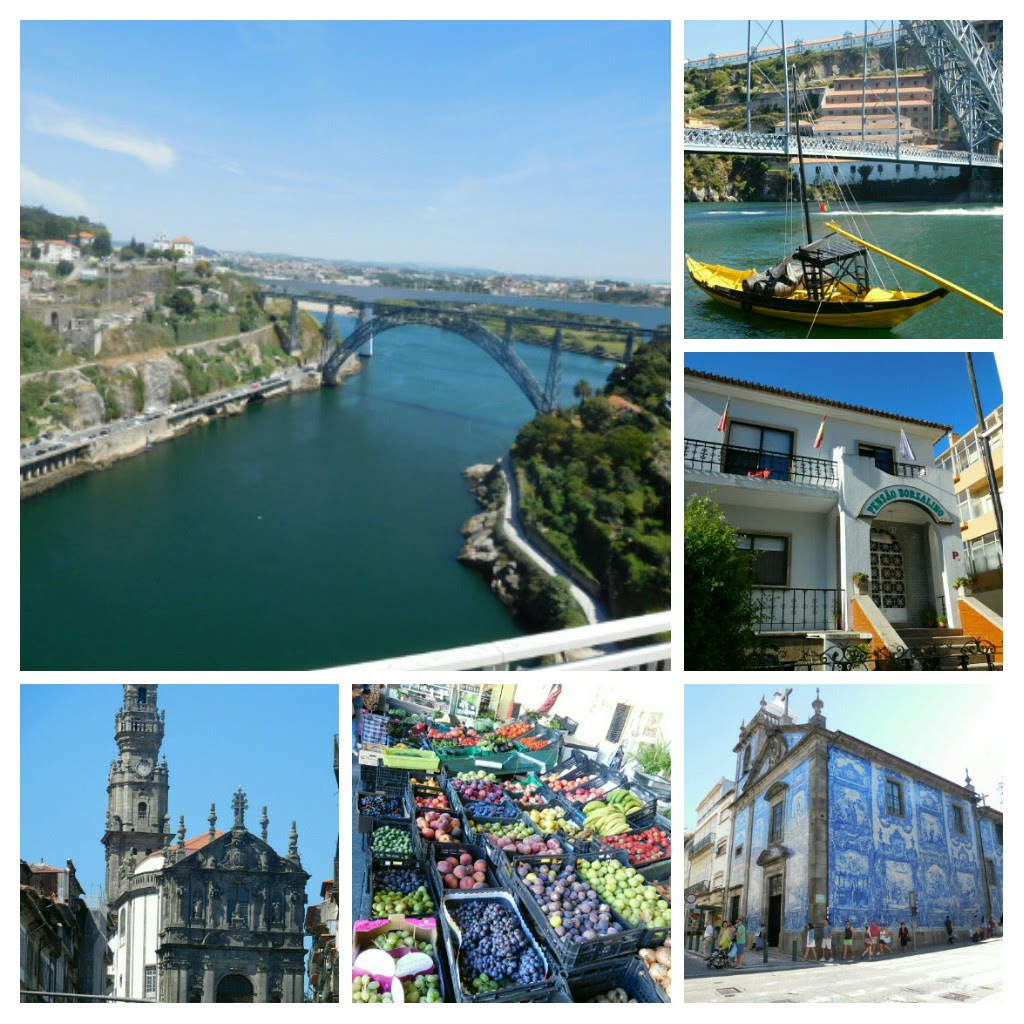
The place is buzzing with people everywhere and we’ve had lovely sunshine with temperature in the low 30s. Tania is in her element at present in a Costa Coffee shop having a coffee similar to what we have at home. Portugal and Spain don’t do coffee like we are used to so this could be one of the last nice ones we’ll have for awhile. Saturday was a lazier day wandering around, a 6 bridge river cruise and another port tasting at Ca´mel winery – wonderful !
We found a little cafe in town that was so good and so cheap – we ate there all 3 nights. (main meal and drink each for $24AUS) We posted off our 2 suit cases Friday and we will collect them when we finish our walk in a fortnight.
Tania set the pace and direction as usual with map in hand each day as we walked 20 mins. from our accommodation into town. We passed many interesting buildings, a traditional old market, churches, street musicians and did lots of window shopping.
Sunday we head off by foot…. let’s hope the backpacks aren’t too heavy otherwise it could be the bus!
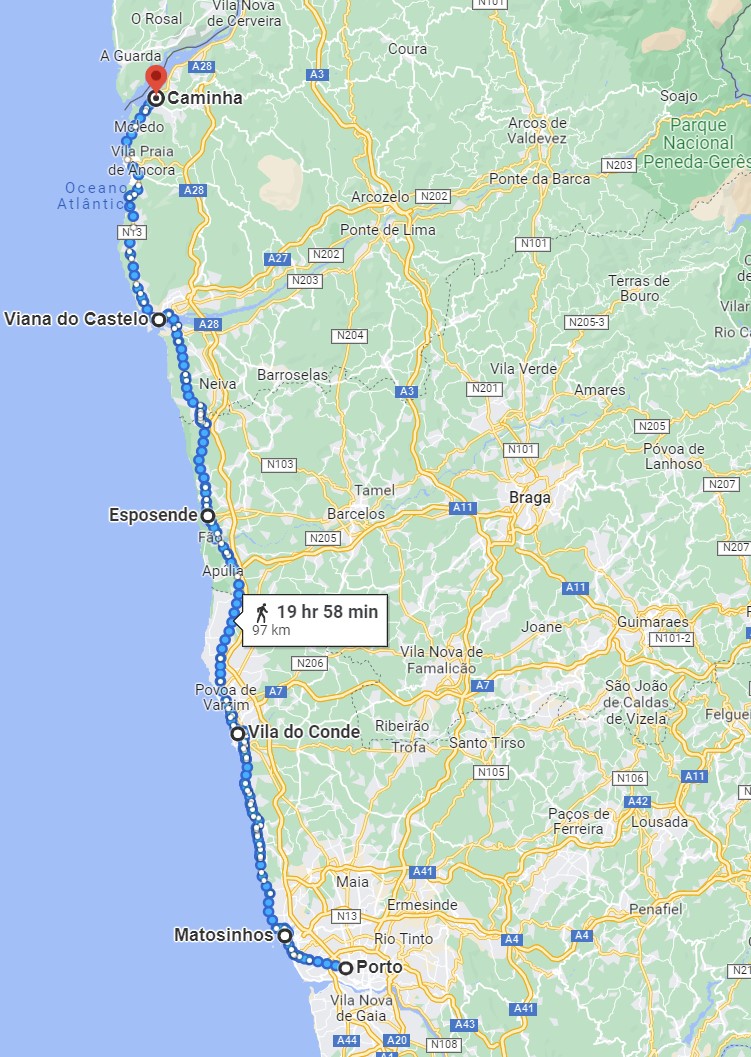
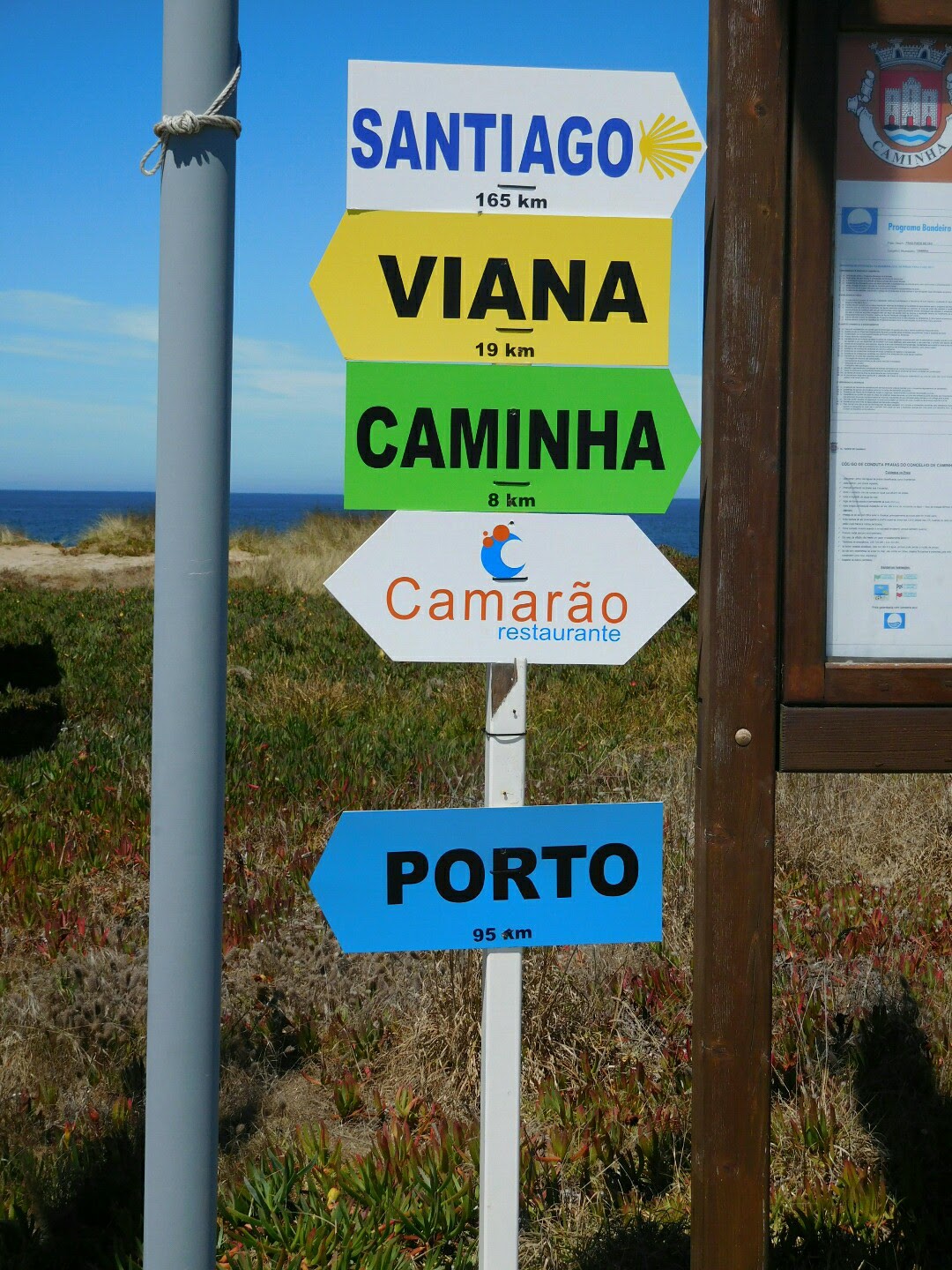
Camino Walk Porto - Caminha
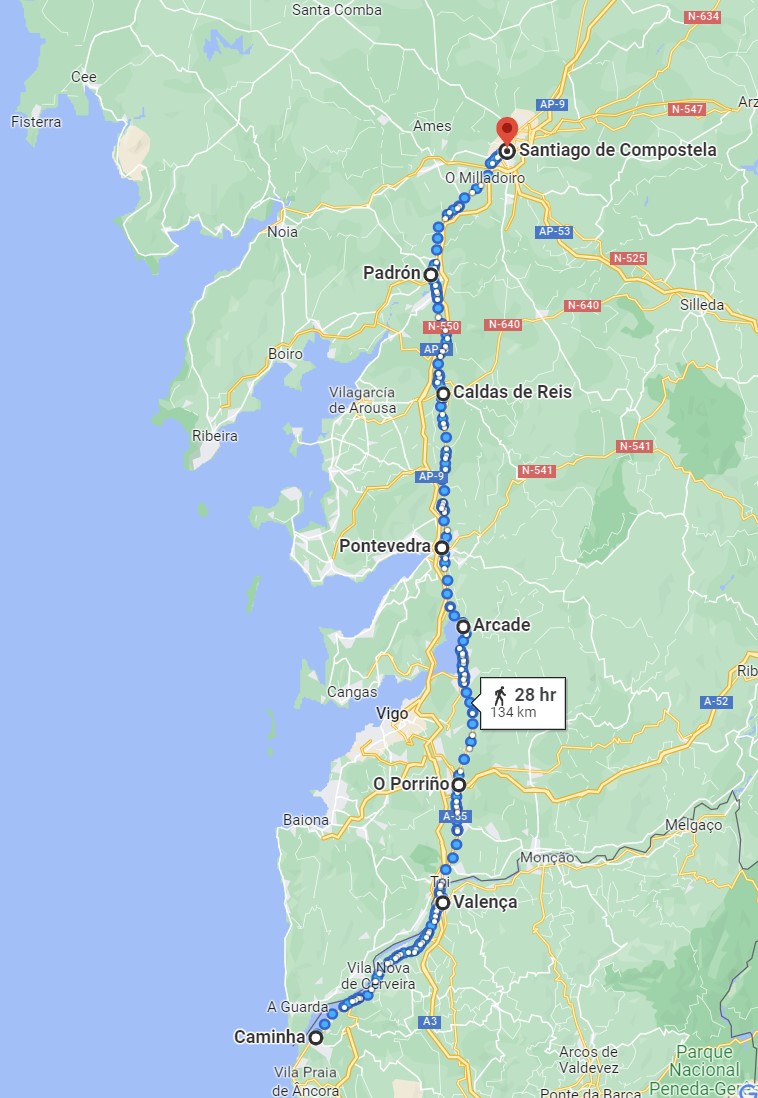
Camino Walk Caminha - Santiago de Compostela
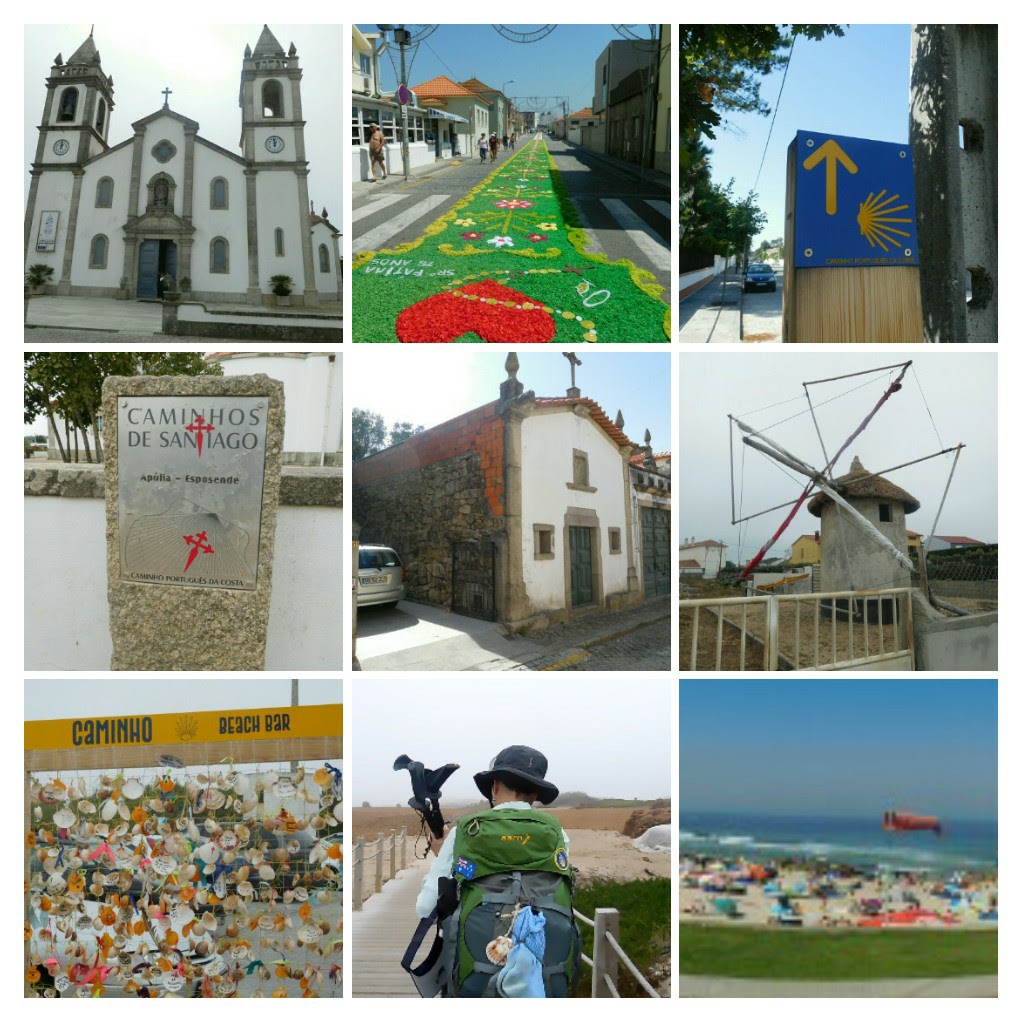
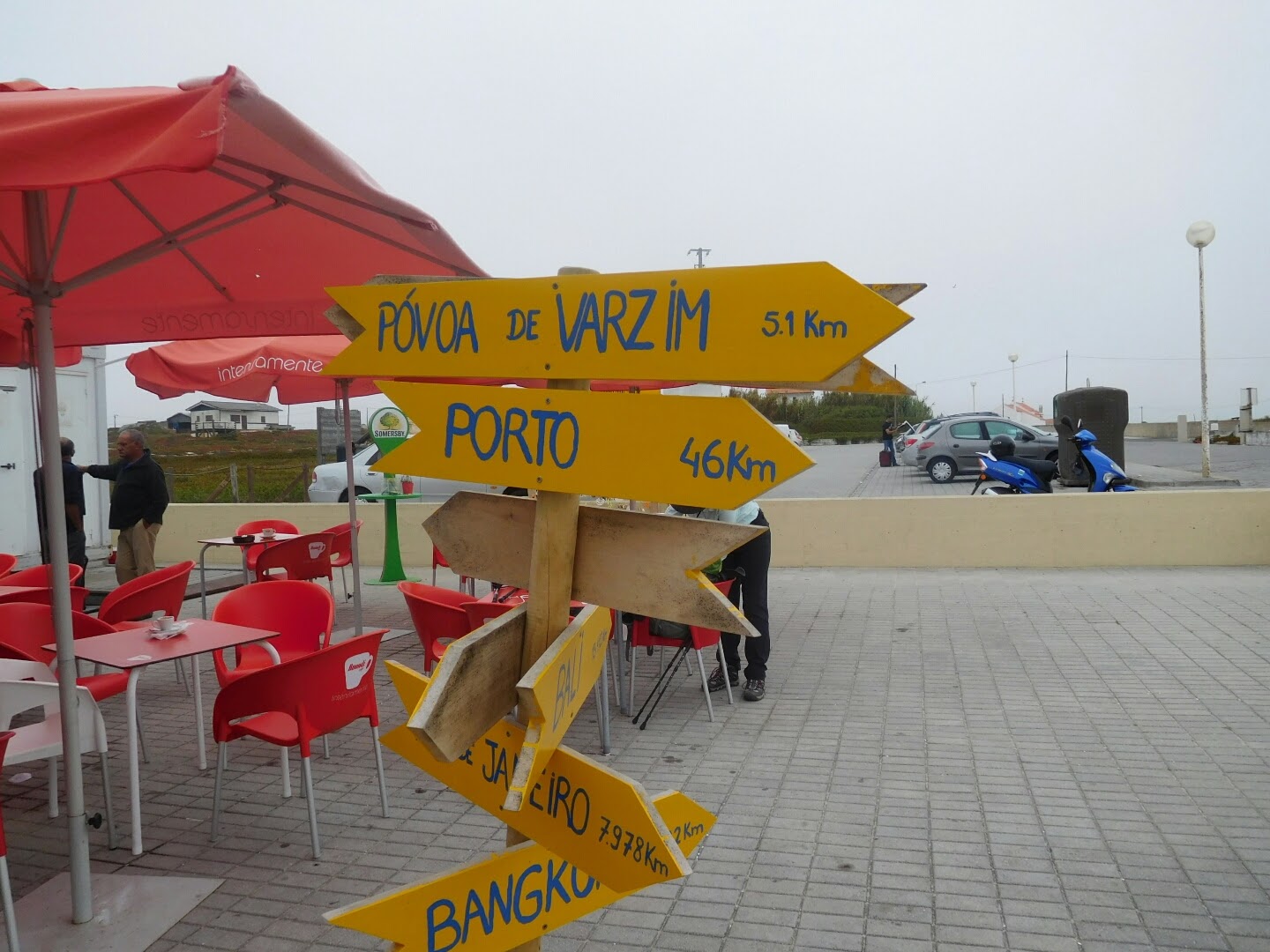
The first few days were coastal walks and then we headed inland to eventually connect with the central Camino.
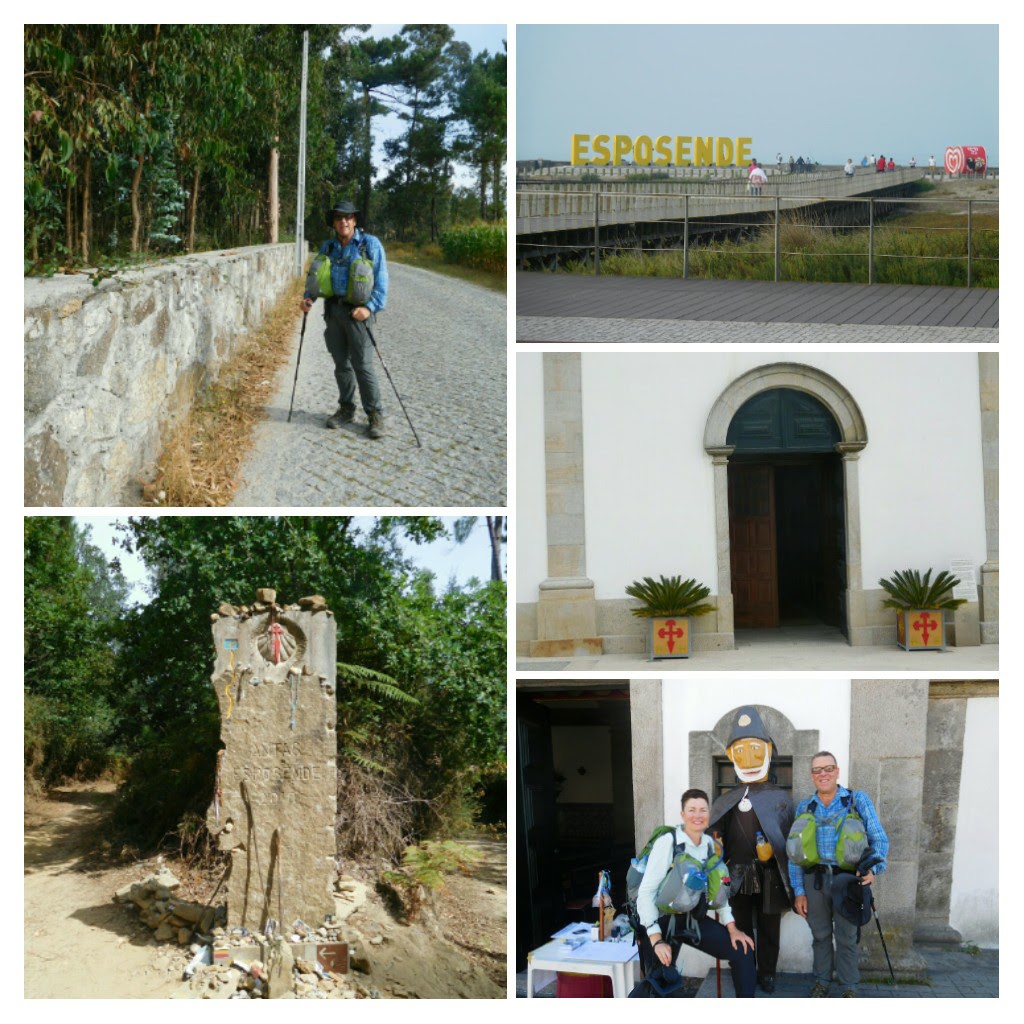
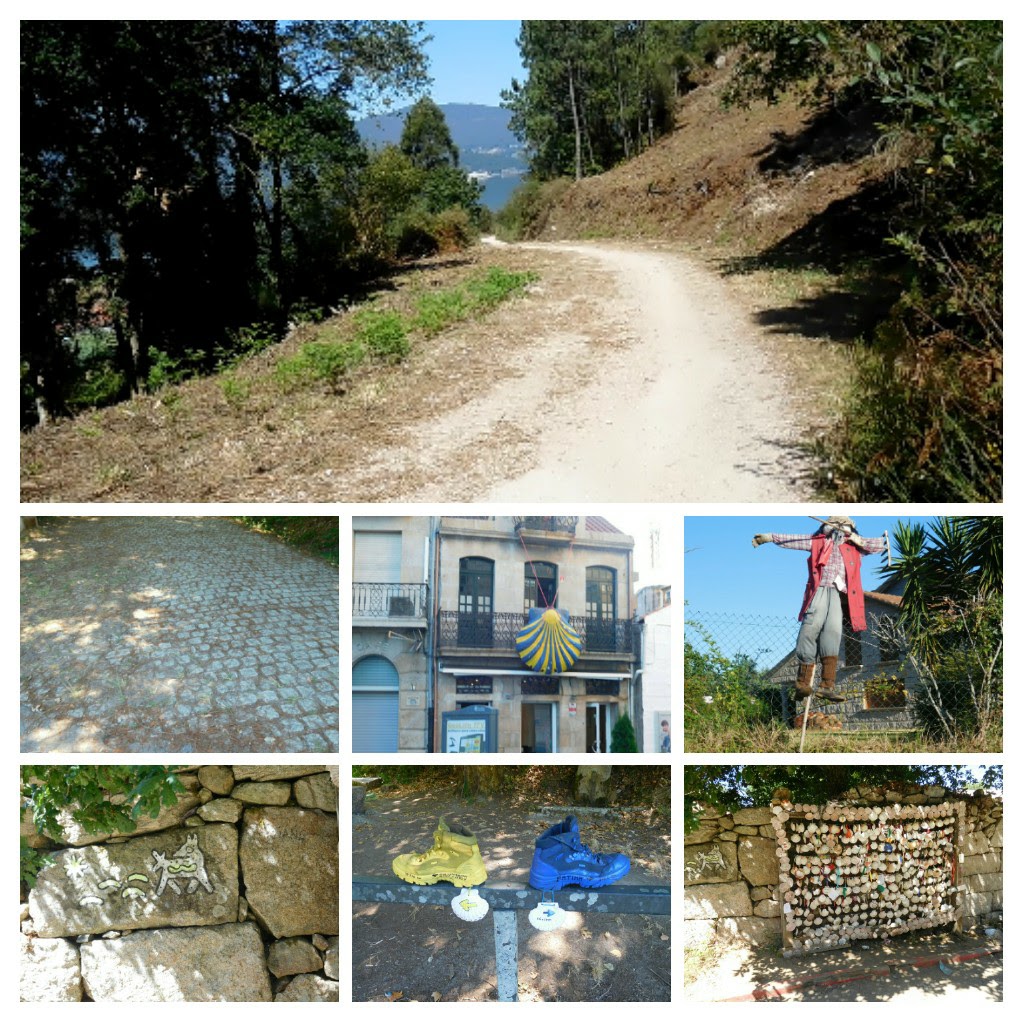
The scenery then changed considerably to back laneways, forests, agricultural and farm land with variations of undulation and hilly challenges for us. Our walking poles have been the best purchase we have made!
We don’t want to see any more cobblestone surfaces as it is quite challenging on the sore feet and knees. Both of us are experiencing body aches along with the odd blister as each day progresses and Tania’s arthritic feet are screaming as the day passes. Thank goodness for Tiger Balm and strapping tape. Where are our minds? We do look forward to taking our boots off at the end of the day and airing our feet.
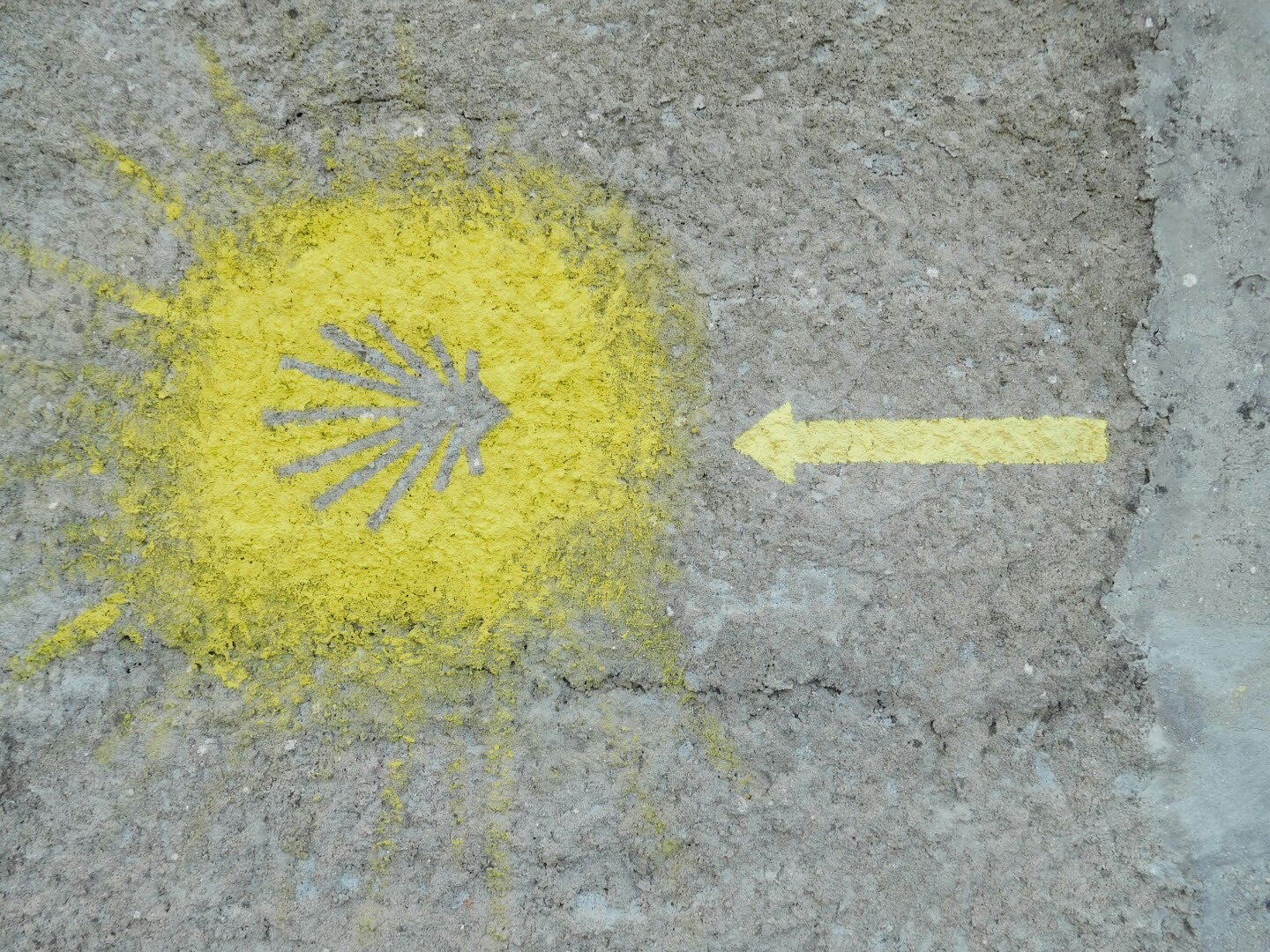
The symbol is either an arrow or the shape of a shell but it is nearly always yellow (unless it is a steel plate with a cut out stencil). There could be single sign or multiple signs in the one place and it could be either painted, a ceramic tile, a wooden arrow, or the shape of a shell but always pointing the direction to go.
The arrows inevitably take us past the many local churches which are always high on a hilltop. Our daily distances have varied from 15 to 33km and to date we have covered 160km which leaves approximately 105km over our last 5 days to Santiago de Compostela.
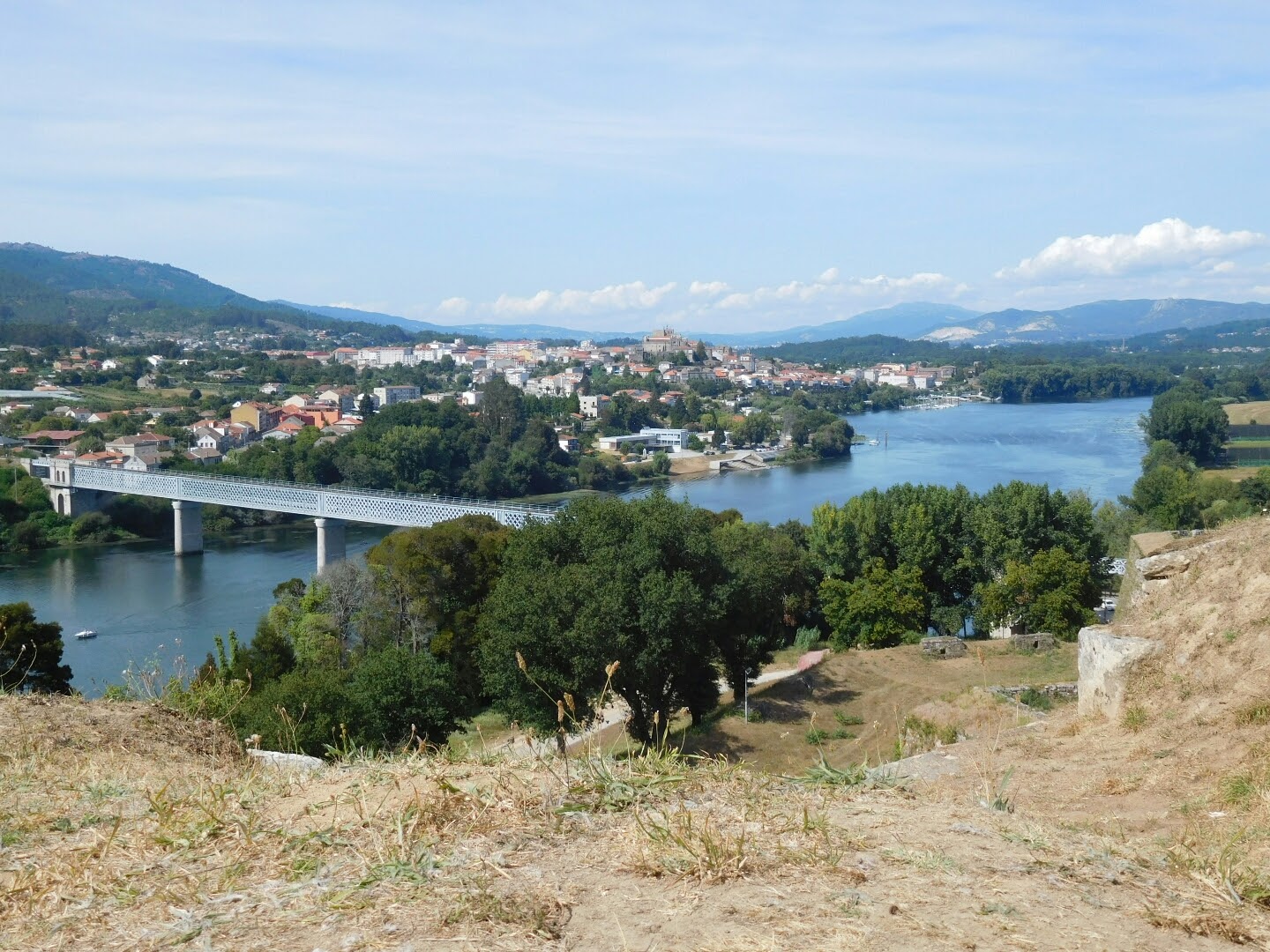
Bridge crossing the Rio Minho River to enter Spain
Day 6 of our walk found us leaving Portugal crossing the Rio Minho River for Spain. Before stopping at a bar to have the last Portuguese sangria we wandered through a large medieval fortress and found a post office where we both shed another 3 kilos from each backpack posting it forward !!
Stayed at an auberge and suggestion was a café in town that served peregrino meals for *euros". The meal was far too large for us and we were in bed by 10.00pm
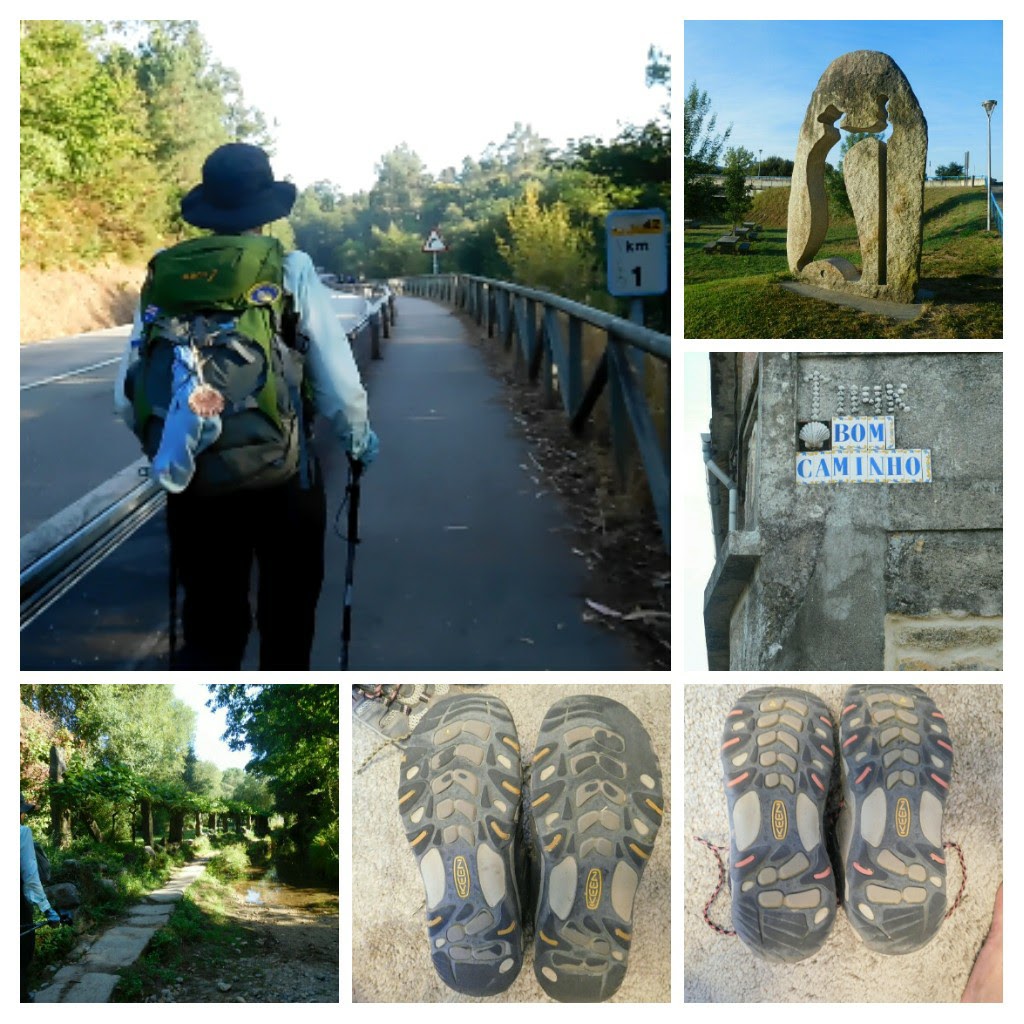
It’s a good thing Graeme organised all of our walking accommodation before we left home as the Albergues (cheaper hostels which can’t be pre-booked) are often full of pilgrims by the time we pass. We have found the room standard has been quite good although by the end of the day we would be happy to sleep anywhere after a shower.
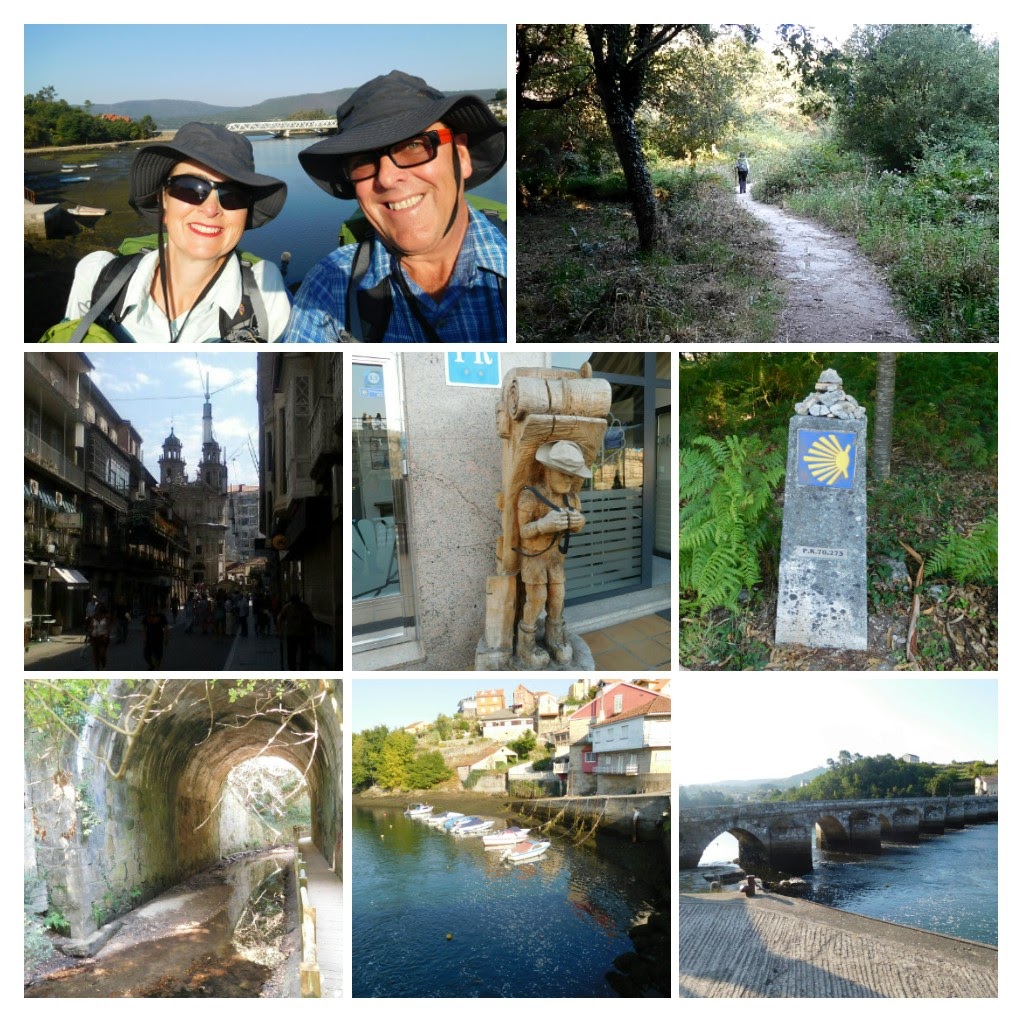
As the days are progressing the weather is even more glorious with blue skies and forecasted to be 37 degrees for the next few days. This will mean setting off earlier each morning to avoid the warmer part of the day and staying well hydrated. We carry our water in a ‘camel’ bladder in our backpacks each day and top up sometimes at a drinking fountain or buy chilled water to cool us down.
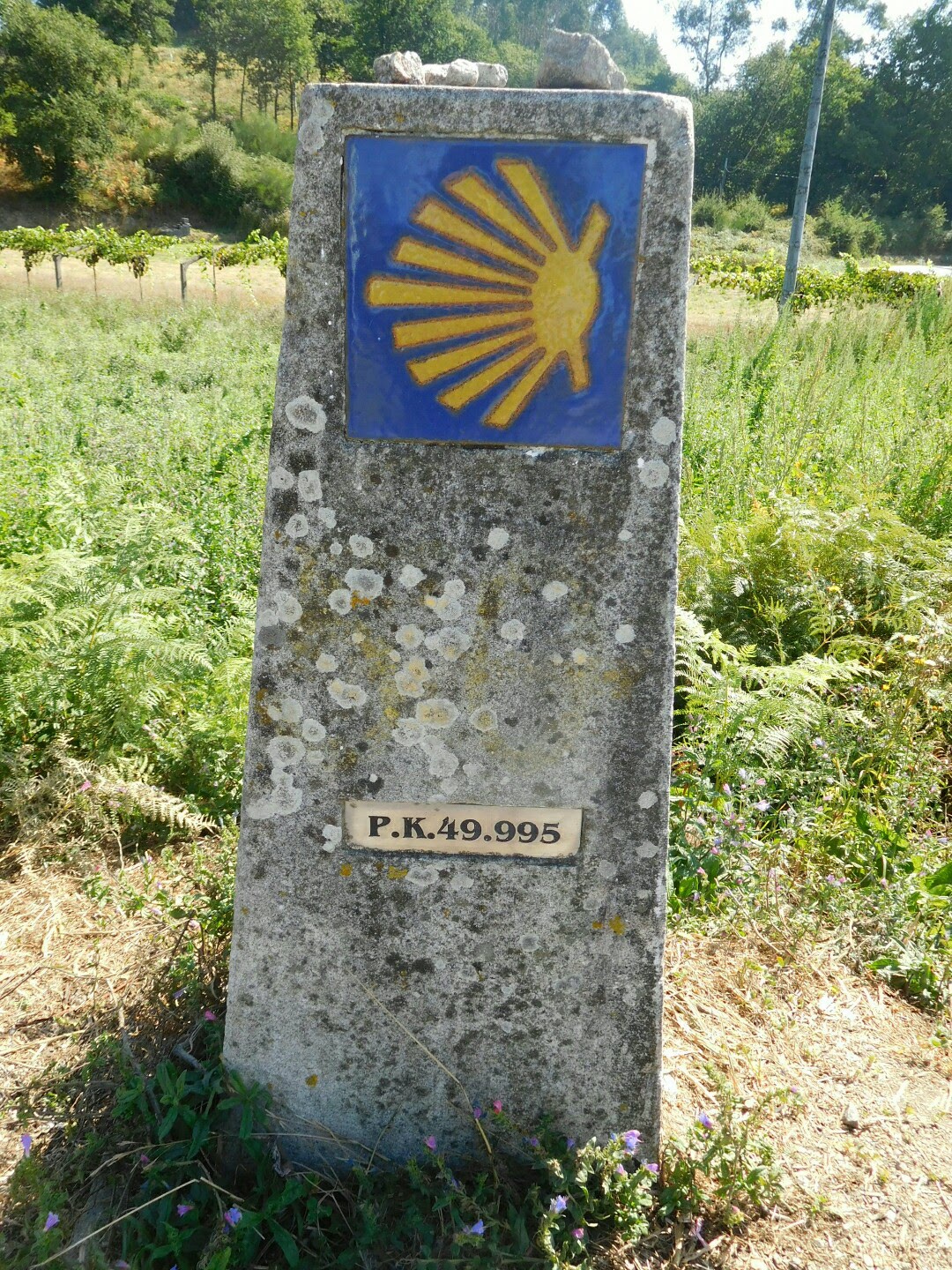
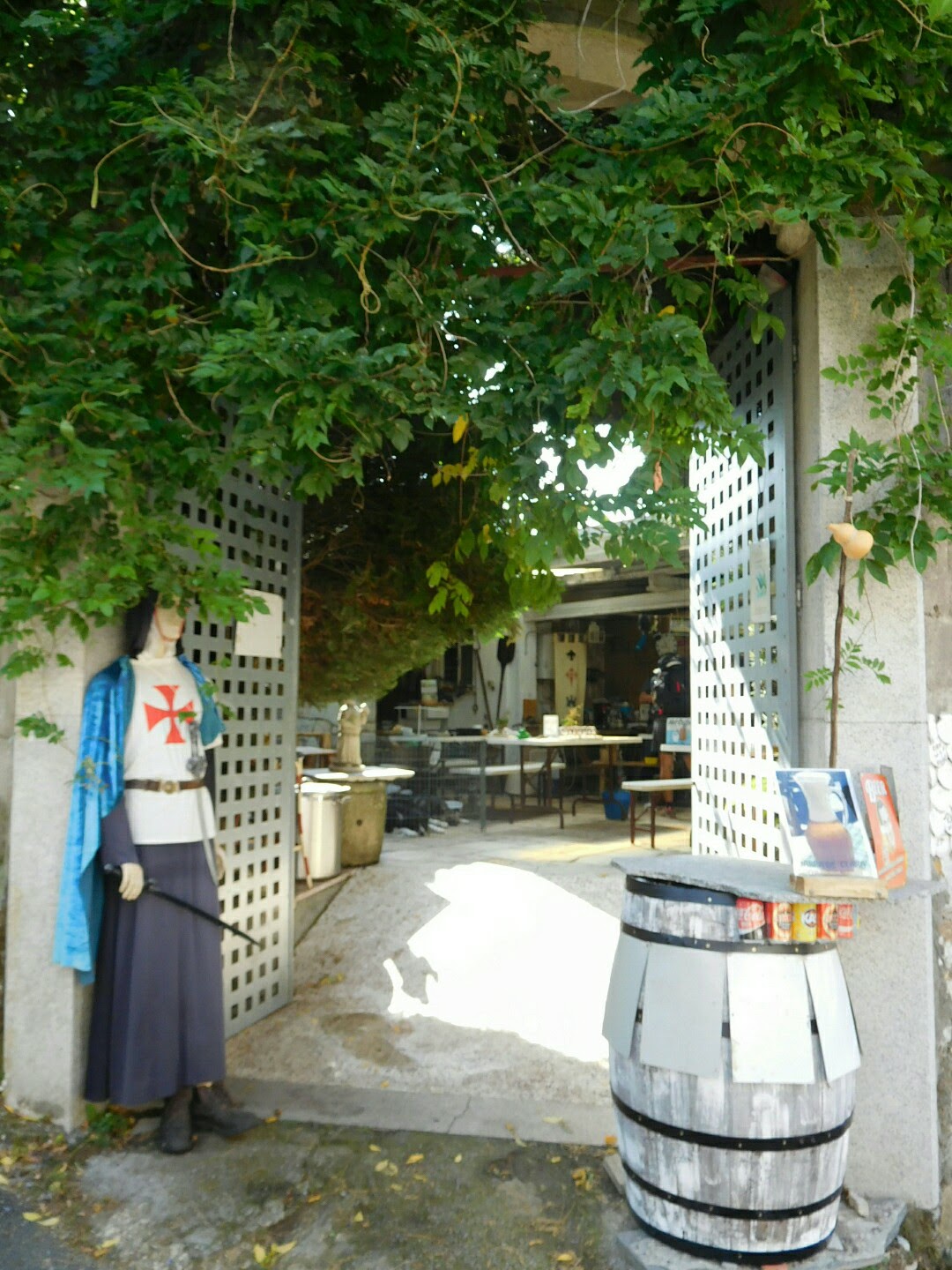
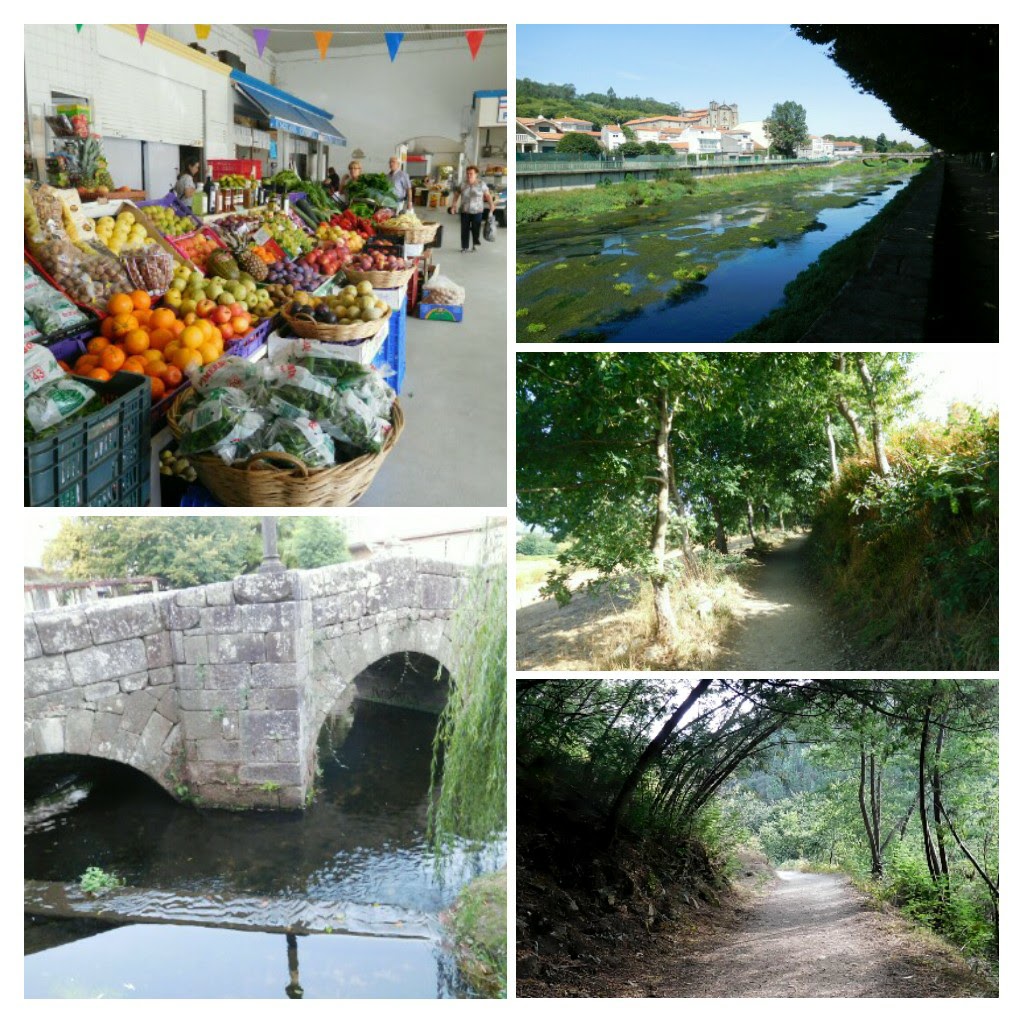
Todays walk was very beautiful through forests and along riverlets, villages abd rural areas.
We were keen to finish our walk and today was the day ! It turned out to be one of the worst days scenery wise, a lot of road walking and dusty back roads. We walked straight through without a break – 26 kms and 5 hours.
When we reached the edge of town, the yellow arrows marking the way became less obvious and so we had to ask a couple of times if we were still on track .. which we were.
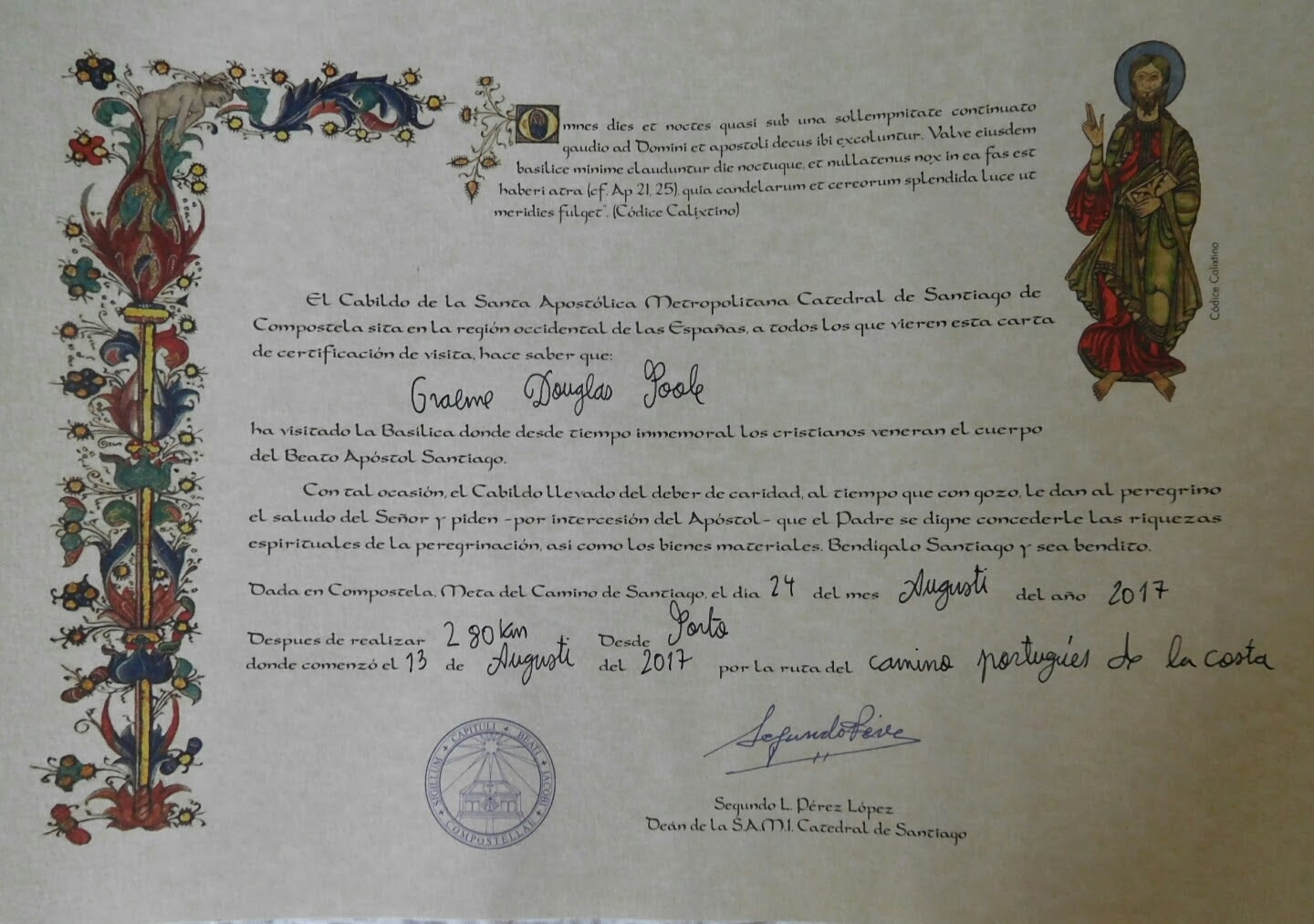
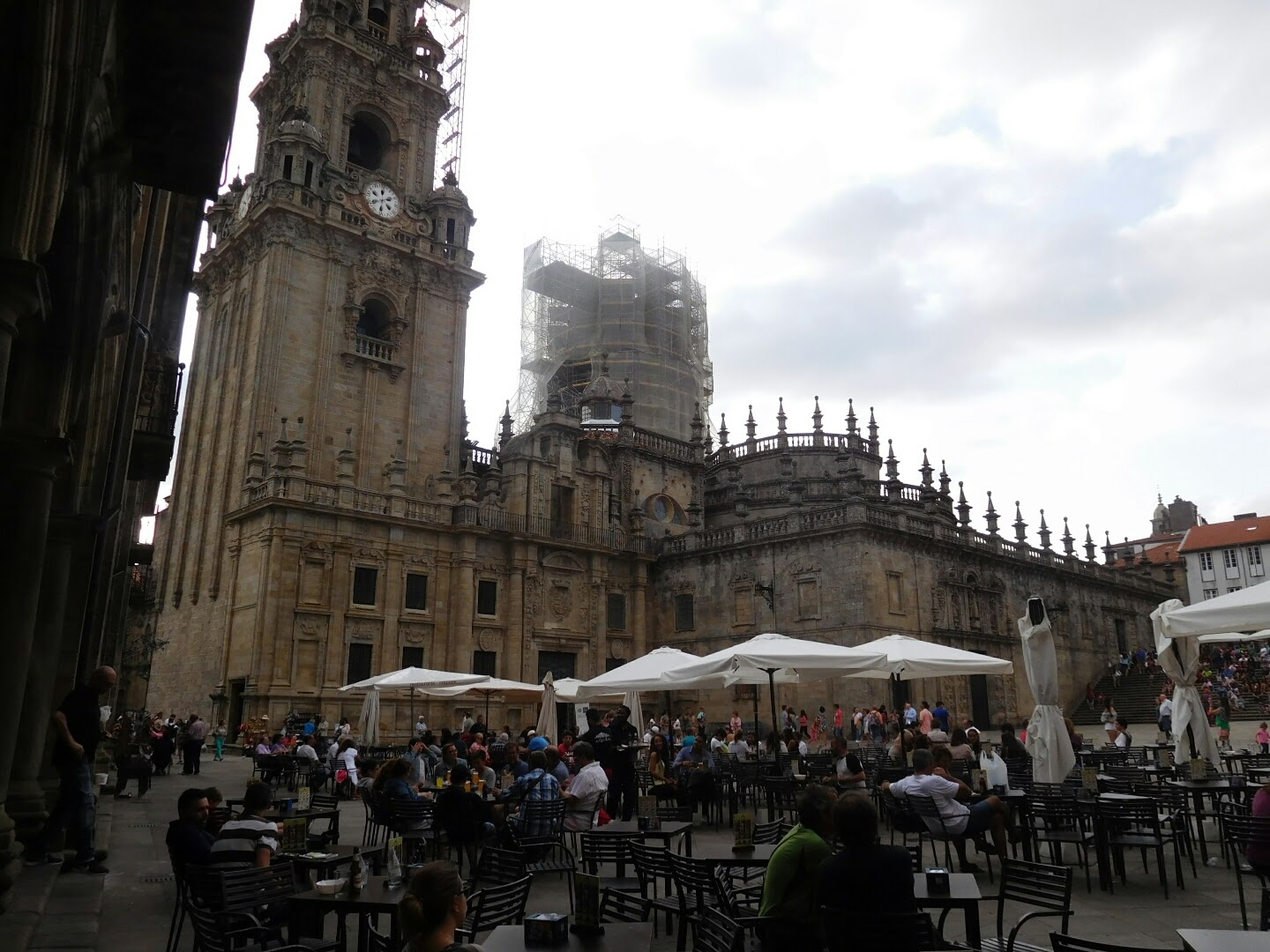
The arrival at the Cathedral in Santiago was with mixed feelings … total elation at completing the journey we had planned and trained for so long, but dampened by the day’s walk, the wait to get our certificate (over an hour) and the Cathedral was draped with scaffolding.
Tania finally found out how to order coffee that she enjoys here .. a machiatto with milk .. half-shot filled wth hot milk.
Anyway we have done it ! We both loved and enjoyed it, at times we questioned our sanity, but we got through with little injury and in surprisingly good shape. Would we do something similar again – we think so – maybe for not so many days, and maybe not carrying as much weight or more rest days in between.
There is a great sense of fulfilment that we have been able to plan such a walk, prepare ourselves both in equipment and training, and to actually achieve it !! We were quite a bit older than most of the pilgrims on the Portuguese Camino Way.
When we started, we said this was either going to kill us … or we would be the fittest we have ever been …  The bus option was never considered.
Today 1650 pilgrims arrived at Santiago de Compostela as at 19:05 pm. (No wonder there was a wait for our certificates !) Most of these pilgrims would have been on the French Camino Way which is the most popular. I have no idea how many were on the same walk as us.
Over the last 12 days we walked 260.4 kilometres (Camino Way only – not counting walking around towns), and took 353,400 steps.
Buen Camino !!
We collected our 2 stored suitcases, sorted through all of our belongings and posted back home the overflow of the walking component of our holiday plus extra. Weight of nearly 15 kg, cost of 93 euros to post.
We know how to travel light when away for 3 months, but walking with everything on your back gives you a new appreciation of the amount of material items that are really important.. with the balance being superficial.
At 6.30am Tania walked 1.5km making her way through the many groups of Friday night party goers who were still hanging out in the streets, to bring a taxi back to collect Graeme and the suitcases.
We left early for the airport with plenty of time to check in and then flew to Berlin stopping for a short time in Barcelona…just long enough a stop for Tania to find a Costa Coffee outlet for a tasty brew for the both of us. The 5 hour flying and lay over time went quickly and it was refreshing to hear 3 Aussie voices standing in line with us ready to board the connecting flight.
After an enjoyable chat it wasn’t long before we were back in the air and looking down onto the amazing and massive snow capped French Pyrenees making the Adelaide Hills look like termite mounds.
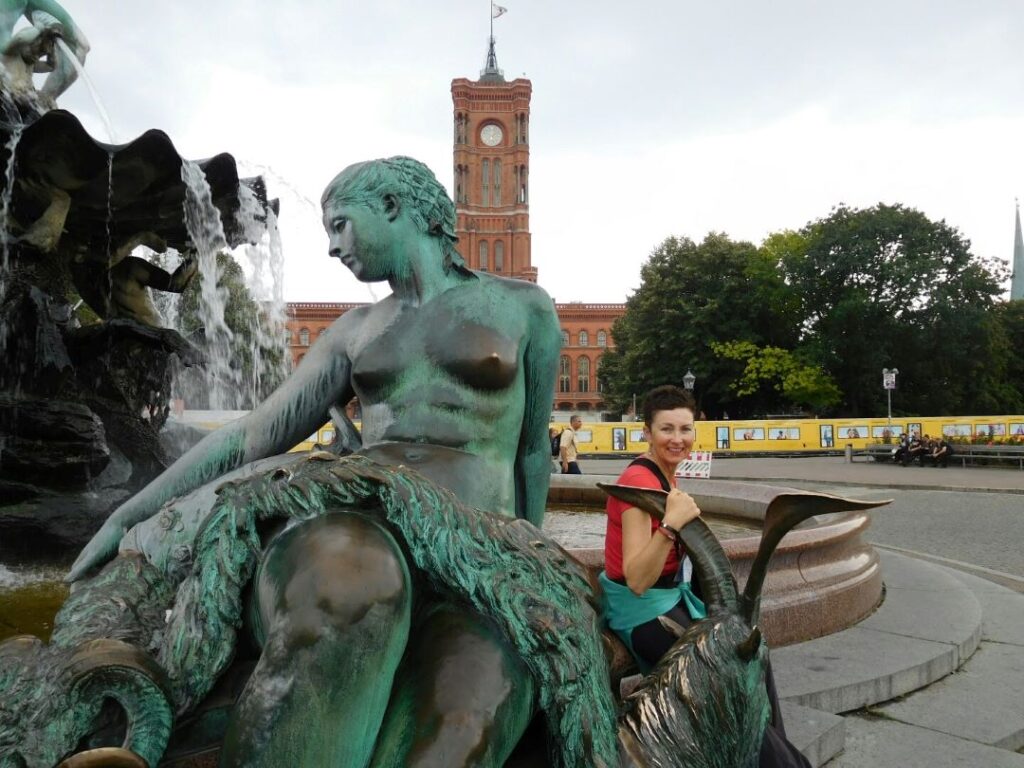
Graeme had done it again, a nice 2 room apartment with a full size kitchen in an area buzzing with people and eateries everywhere. Normally a 20 minute walk to the centre of the busy area, our first outing took a little longer as we checked out everything the area had to offer. Again with map in hand we took off, often distracted by the cake shops and trying to decide what different offerings we would like to try whilst here. We walked for quite some time but did not want to visit too many things as a walking tour was booked for the next day and we did not want to spoil the surprises.
The parks were full of people relaxing and socialising and the footpaths had people spilling over from the restaurants and cafes. There was a massive market in a square offering all kinds of vegetarian and vegan friendly foods and products, and another market relatively close with artisan goods with very alternative looking stall owners !! Sunday morning after putting together our lunch, we headed in for the 11am free walking tour but found the streets quite abandoned in comparison as the shops only trade Monday to Saturday staying open late each night though.
We met our Canadian tour guide Corey for a 3 1/2 hour long history tour of Berlin covering over 6 kms on foot. We walked the history highlights of Berlin and heard really interesting facts and anecdotes along the way. The Brandenburg Gates were impressive, Checkpoint Charlie (the 3rd checkpoint of 18, hence Charlie using the phenotic alphabet call signs), Luftwaffe HQ (later used as the KGB headquarters), site of Hitler’s bunker where he committed suicide, Reichstag Building, Tiergarten, Memorial to the Murdered Jews of Europe, Humboldt University where Einstein studied and taught and the site of the book burning memorial.
When the Berlin Wall was erected virtually overnight, armed soldiers prevented anyone crossing it and returning for 28 years until it was eventually brought down. The wall itself was not the only deterrent but an adjacent death strip with various barriers preventing the Germans in the East entering the West. Corey reminded us that the first people that were persecuted by the Nazis were in fact German citizens and that we should not confuse the fact that Nazis were German but not all Germans were Nazis. The holocaust included other ethnic groups such as those mentally or physically disabled, prisoners of war, homosexuals, Jehovah’s Witnesses, black people, political opponents and anyone who spoke out against the Nazis.
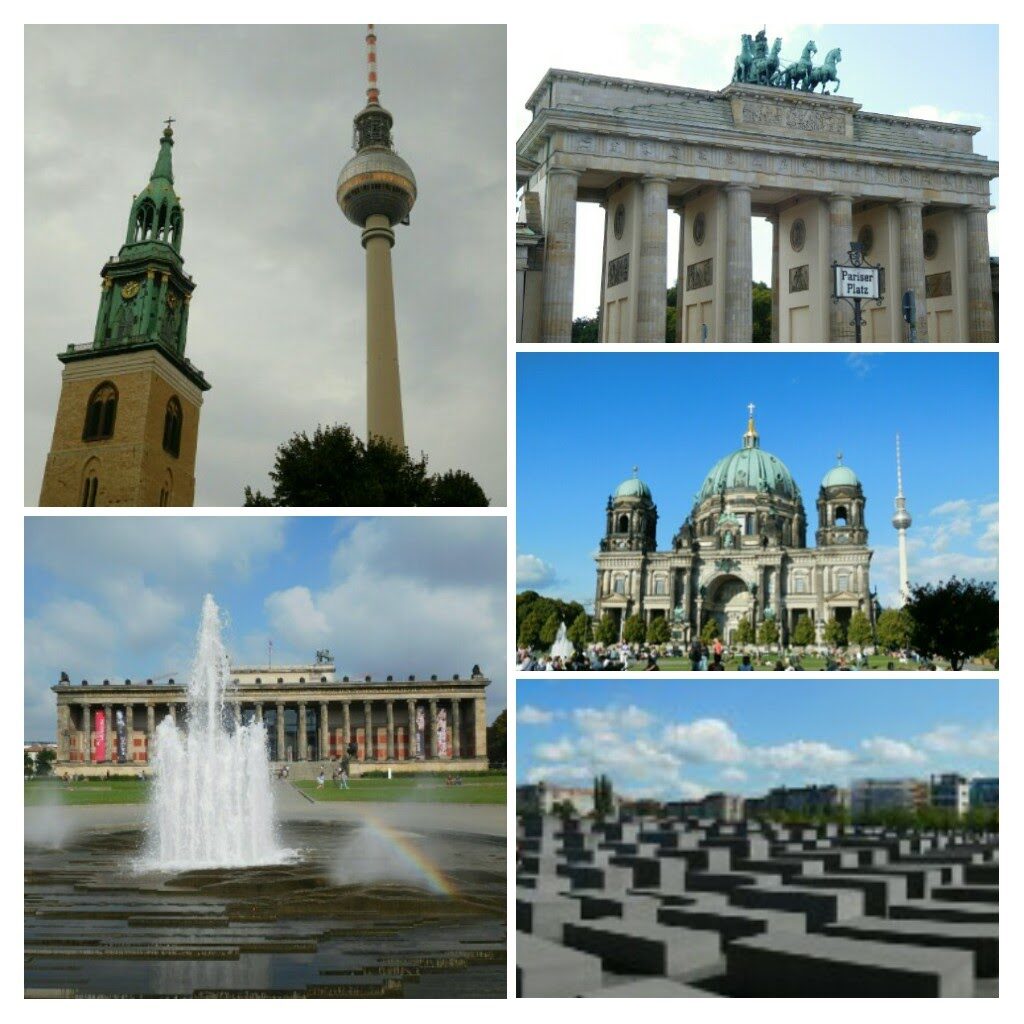
An interesting fact, Hugo Boss made the uniforms for the SS during WW2. Corey mentioned 2 Chinese tourists visiting Berlin were presently in prison for 30 days for saluting in the Nazi fashion. A prison term would also occur today if you denied the holocaust and also displayed the swastika.
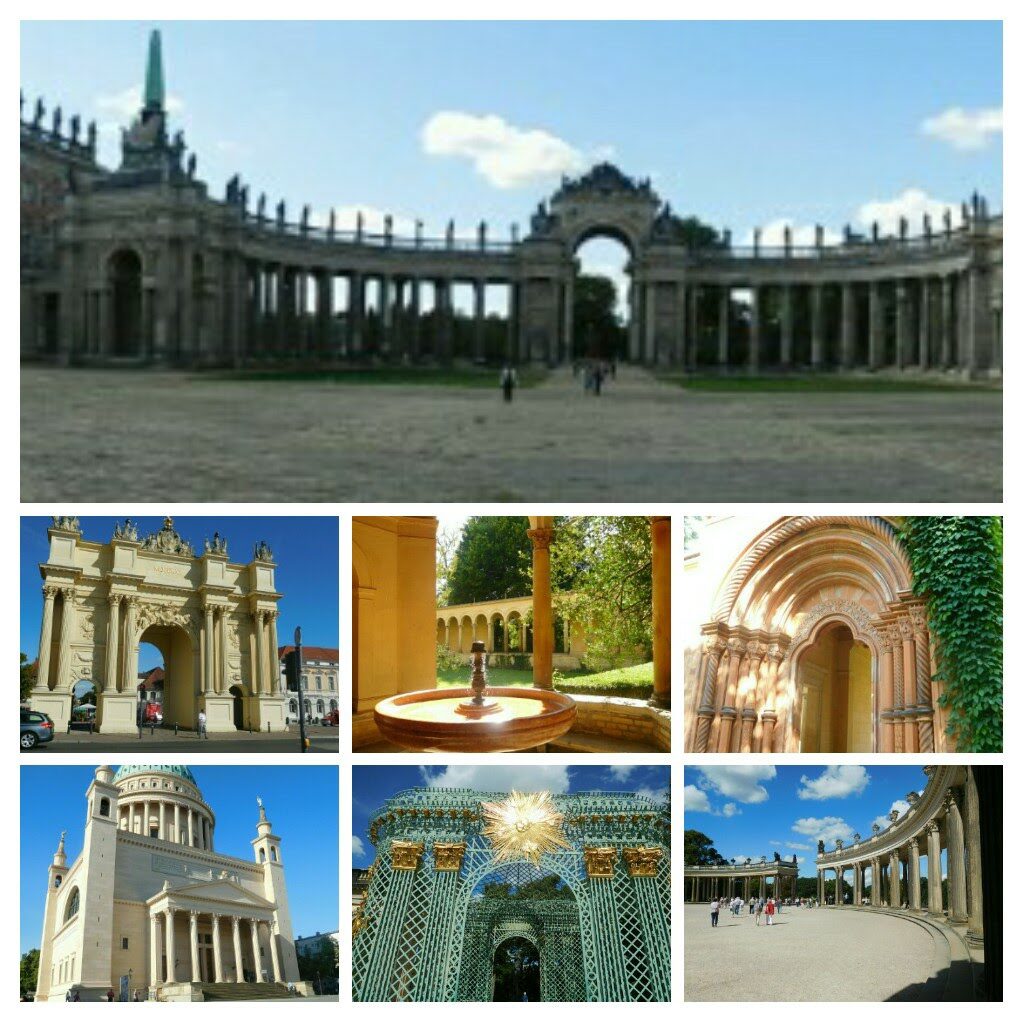
We chose to eat our cut lunch in the lovely gardens of the Sanssouci Palace and then made our way back through the old town to the train station and returned to Berlin. The day’s outing was an enjoyable experience and Potsdam will be remembered for its opulence and quirkiness.
Enjoying our stay in Berlin, we attempted to extend our time here by another night but unfortunately our present accommodation was unavailable. We still had some spare time before collecting the car in Frankfurt, so after some discussion and research we decided to travel to Dresden by train for a couple of days.
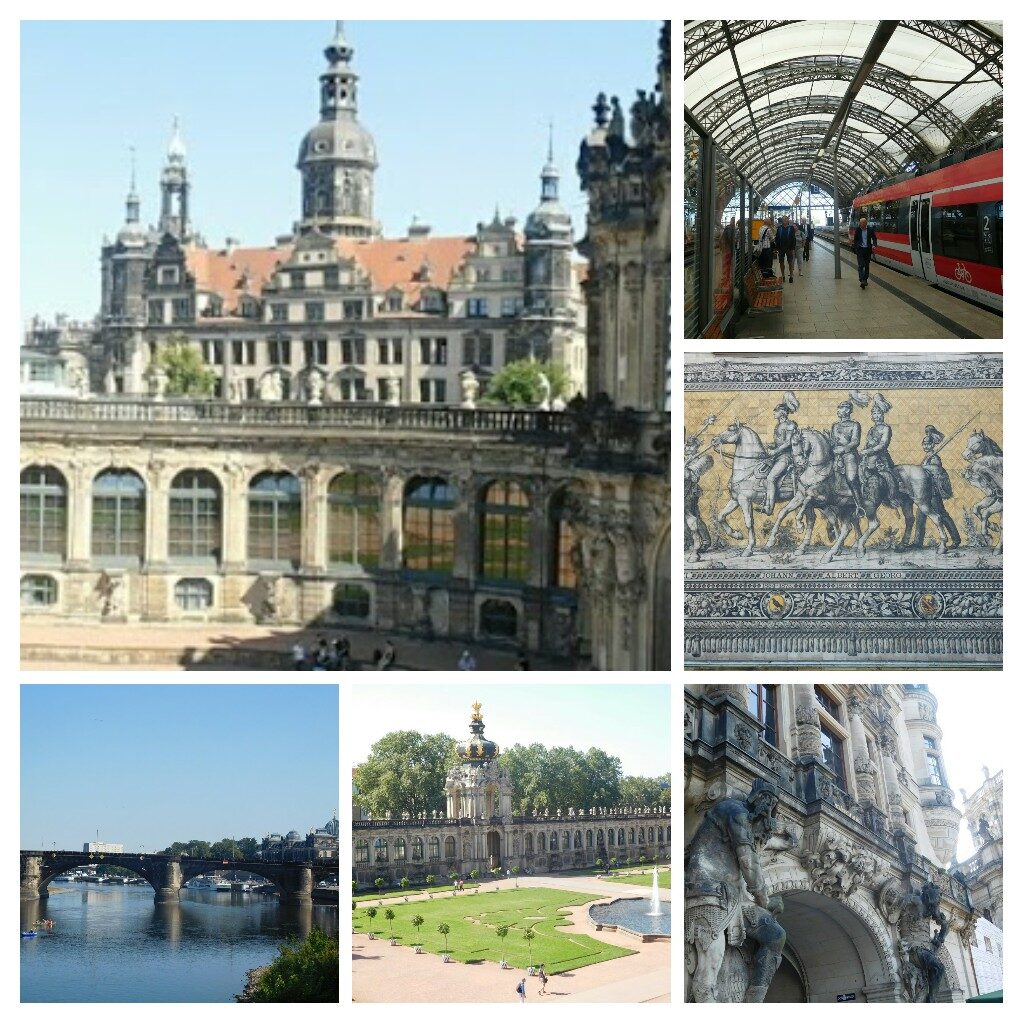
Dresden was a pleasant surprise. The hotel was well located not far from the train station and luckily we were able to drop our suitcases and start exploring before the stated check in time. Like in Berlin, riding bikes seemed to be the preferred mode of transport of all ages around the centre of the city and even though the main shopping mall was void of cars, we needed to be wary of the cyclists. Amidst the shopping areas and cobblestone streets, we found many platzs or open areas filled with people enjoying a water feature, monument or piece of artwork.
Dresden was flattened during WW2 and has been slowly rebuilt still in the original baroque style in more recent years. The Zwinger Place is very grand with beautifully manicured lawns forming interesting symmetrical patterns best viewed from the upper level. Like all palaces, the main entrance is extremely impressive and they certainly did not hold back on the number of intricate and imposing statues on display everywhere in the grounds. The concept ‘less is more’ was certainly not their focus when trying to impress everyone of the times.
Stone or metal detail found on some of the older buildings are generally darkened toward the top (possibly due to age, grime or affected by fire) and in contrast there maybe a rich gold figure or symbol glistening very brightly in the sun. These features are generally found on churches or buildings high up at the top of an arch, dome or spire and can be seen easily from any distance.
Just like on the Berlin to Dresden train trip, we heard many announcements over the PA in German lasting quite some time as we were approaching the next stop. The English version followed which was either the abridged version or otherwise the Germans waffle on to get the some message across. Sometimes we suspected we may not have been getting the full story though.
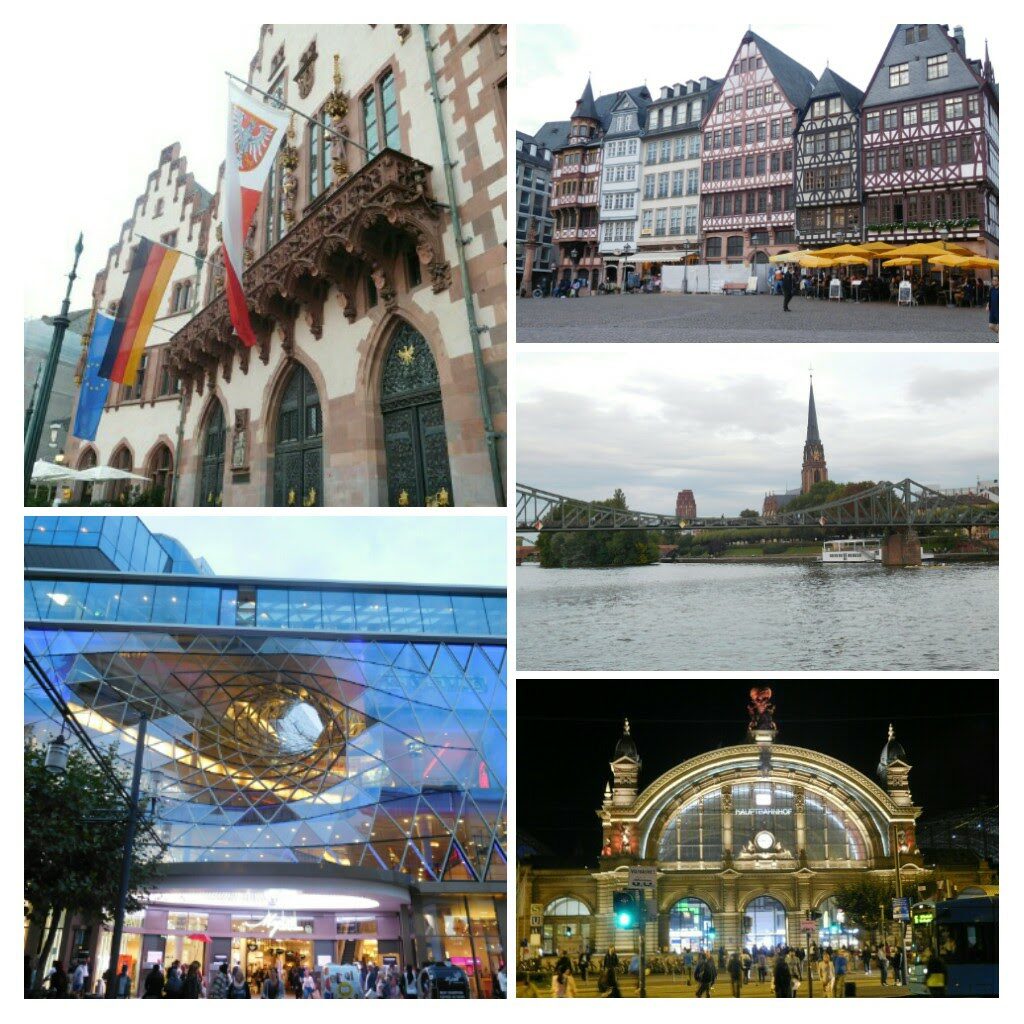
Arrived into Frankfurt at 18:37. The hotel was conveniently right next to the central train station, so we dropped off our bags and went out to explore for a 2 hour Tania tour of Frankfurt. Amazingly we were comfortable that we had seen enough of the city as we needed to…it is just another big city. Very close to the shopping area there were people everywhere enjoying the wine festival featuring wines from the Rhineland region, so naturally Graeme had to try a Riesling. Either side of the roads there would have been between 400-500m of tables, chairs and stand up bar tables crammed with people enjoying the evening. There were also food stalls offering a variety of traditional foods so we took a risk and selected a couple of dishes just like the locals. We had curry wurst (cut up bratwurst drowned in tomato sauce, mayonnaise, onions and sprinkled with curry powder), swenck steak (pork steak in a bread roll) and a hamburger which was remarkably like a hamburger.
With map in hand, we started heading back to the hotel and to Graeme’s surprise we were walking down through the red light district. Seedy looking dudes were hanging around on the footpaths and suggestive graphics were displayed on the night club entrances as we passed. What an education for him.
Arriving back at our room at the Centro National Deluxe City Hotel, we discussed the direction of our next day’s destination. After some research we decided on Dusseldorf where we could use local transport to see other nearby places of interest, so 3 nights accommodation was booked at the Hotel Astra.
Before leaving in the morning to collect the car, we had the best breakfast selection of cereals, yoghurt, fruits and of course meat slices and bread rolls.
Not familiar with the fare structure we required for the public transport, we attempted to purchase return tickets to the city from the machine at the local tram stop. To confirm our choice, we checked with a German speaking local waiting at the same stop to find our attempt was incorrect. Panic, the tram had arrived and we all jumped on board to sort out the situation. Her broken English was better than our ‘no’ German but we bought new tickets and she informed us we could have them refunded at the train station. Finding an English speaking assistant we were not only reimbursed but we also purchased tickets for the next 2 days which we could not have done on our own (included local trams, buses, trains and regional trains!).
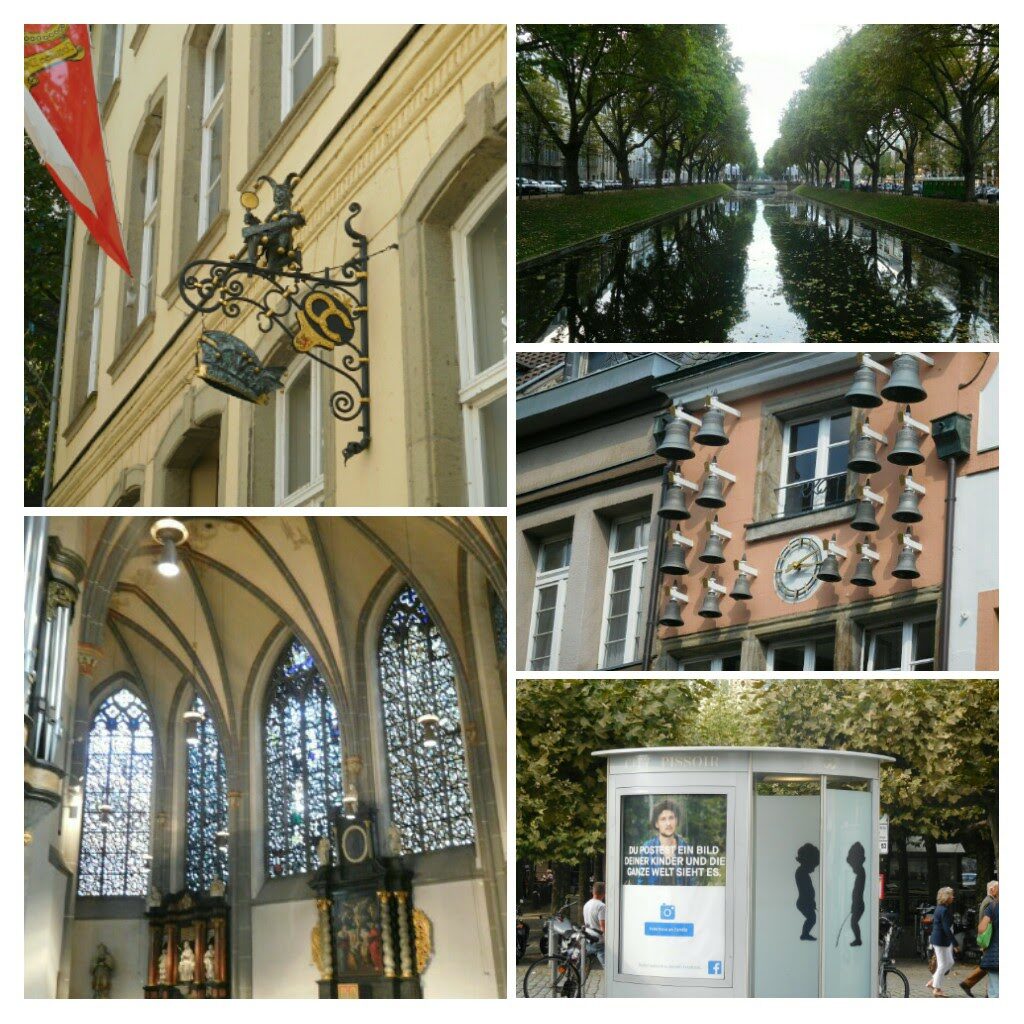
Where Frankfurt took 2 hours to navigate, Dusseldorf offered us so much more. 5 1/2 hours later we had walked the old town, the high end shopping streets known as Konigsallee in the newer area and along the riverfront…the mighty Rhine.
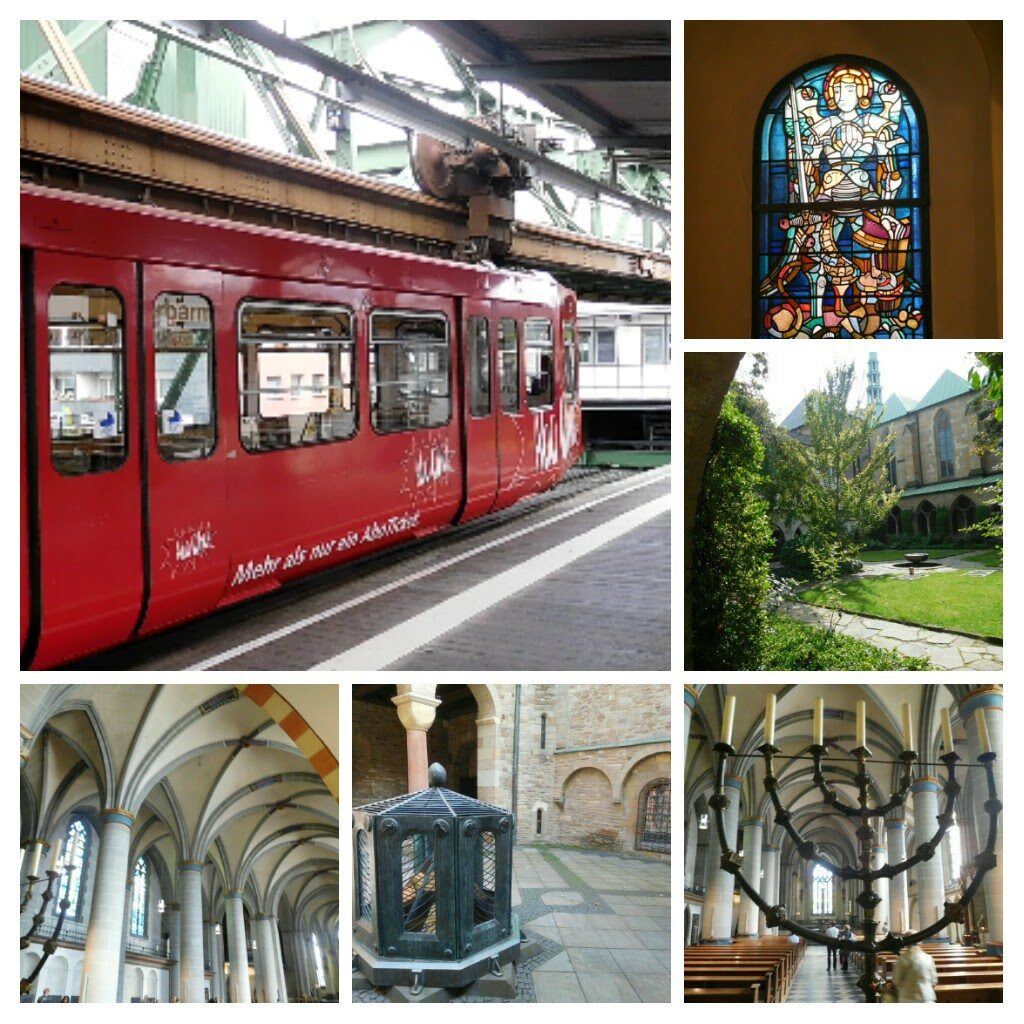
Germans are not very religious but they seem to have a lot of churches of many denominations. Essen was worth the visit if only for this church.
We headed back to the train and travelled onto Wuppertal arriving 15 minutes after the information office closed at 2pm…how would Tania cope without a map! Fortunately a hotel was helpful and the stress level reduced.
We traversed the many streets and experienced rain for the first time on our trip. Scaffolding covered different buildings which took the edge off the visit a bit. Heading back toward the train station we came across another mode of transport that followed the Wupper River, a suspension mono rail built in 1900. The 13.5 km long rail system which is part of the reginal transport system, offered a one way trip covering 20 stops and departed every 15 minutes. Another example of fantastic German engineering.
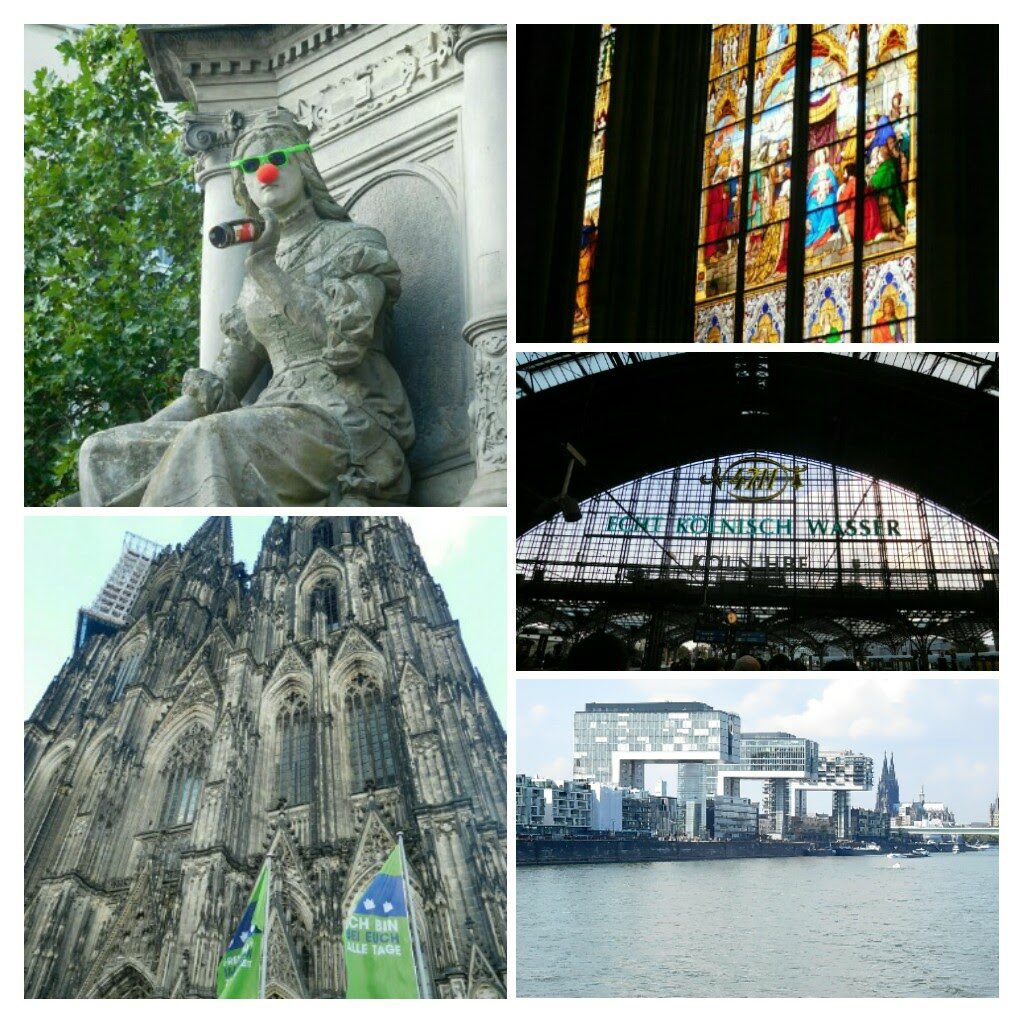
Cologne is a large city so the easiest way to see as much as possible during part of a day is to take a hop on hop off bus tour. The 90 minute trip was informative although some of the trees in the lovely tree lined streets blocked the items of interest the city had to offer…frustrating !
In addition to the bus tour we also purchased a 1 hour boat ride on the Rhine. The upper deck of the large boat filled quickly and the beautiful sunny weather made the experience quite memorable. We were surprised just how wide the river was and the on board commentary gave us an overview of Cologne’s waterfront history.
Being a Sunday there were people everywhere enjoying a variety of buskers scattered throughout the city area, a local market not far from the river, a free organised concert, food stalls, restaurants, bars and coffee shops. The place was buzzing.
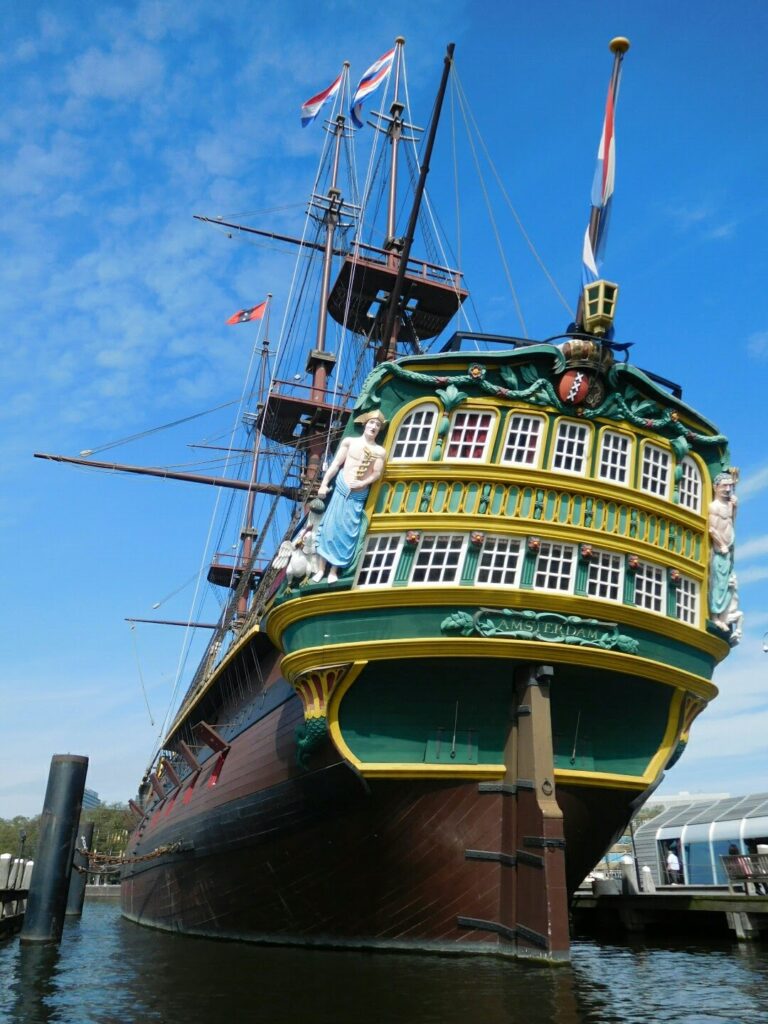
We bought a 3 day public transport ticket at the hotel and after a 30 minute bus trip we had arrived in the city centre.
The first thing we noticed were an amazing number of cyclists everywhere. The constant activity on the dedicated bike paths meant you needed to be very aware of your surroundings whenever you stepped off the footpath. You took your life into your own hands just crossing a road. The cyclists were often speeding along talking on their phone and ringing their bell to warn you of their approach. At busy intersections they had to stop to let those cyclists crossing their path the opportunity to do so. Amsterdam is flat and as petrol is about A$2.40/L it is any wonder why bikes are so popular.
Canals are everywhere but unlike Venice, the main ones form a series of parallel lines in a loose horse shoe shape crossed by smaller ones which then form a grid like pattern throughout the city.
Amused by the activity on the water, we decided to join a 1 hour tour of the canals. The network of waterways allowed us to enjoy the city from a lower level looking up toward the interesting styles of housing, offices, museums and shops etc. Just like the transport at street level, we were often lined up behind other boats at a busy intersection waiting to enter another canal. There were lots of bridges everywhere carrying mainly cyclists and people but we noticed the number of cars using them was remarkably low. Some bridge styles varied and some had large colourful flower pots suspended on the side railings which looked amazing from a distance.
The flea market was quite different, the massive flower market was colourful selling every kind of tulip bulb and a variety of other flowers, the diamond factory was very educational and just people watching was most amusing.
We spent 2 days investigating the interesting city walking the streets but never once considering hiring a bike to travel further afield. They have an interesting set of road rules they follow and no-one wears a helmet.
With prostitution legal here we joined a 2 hour walking tour of the red light district to experience Amsterdam’s colourful night life. Our guide gave us a snapshot in the life of a working girl and took us past only a few of the 400 windows where for a minimum of €50 (A$75) for 15 minutes a deal could be done. Although, we were also informed the average visit normally lasted only about 6 minutes so during a successful 10 hour shift a girl could have up to 16 customers.
We saw a variety of sex shops offering an array of aids and bond age outfits etc, a condom shop selling nothing but condoms, bars offering live sex acts, a peep show for €2 (A$3), a day care for the workers and a PIC shop (Prostitute Information Centre).
The statistics were mind blowing…we both need to get out more!
We have learnt not to buy a brownie from a coffee shop unless you want a buzz for the afternoon and the constant smell of those smoking marijuana fills the air along with the smoking of normal cigarettes. Everyone here seems to smoke.
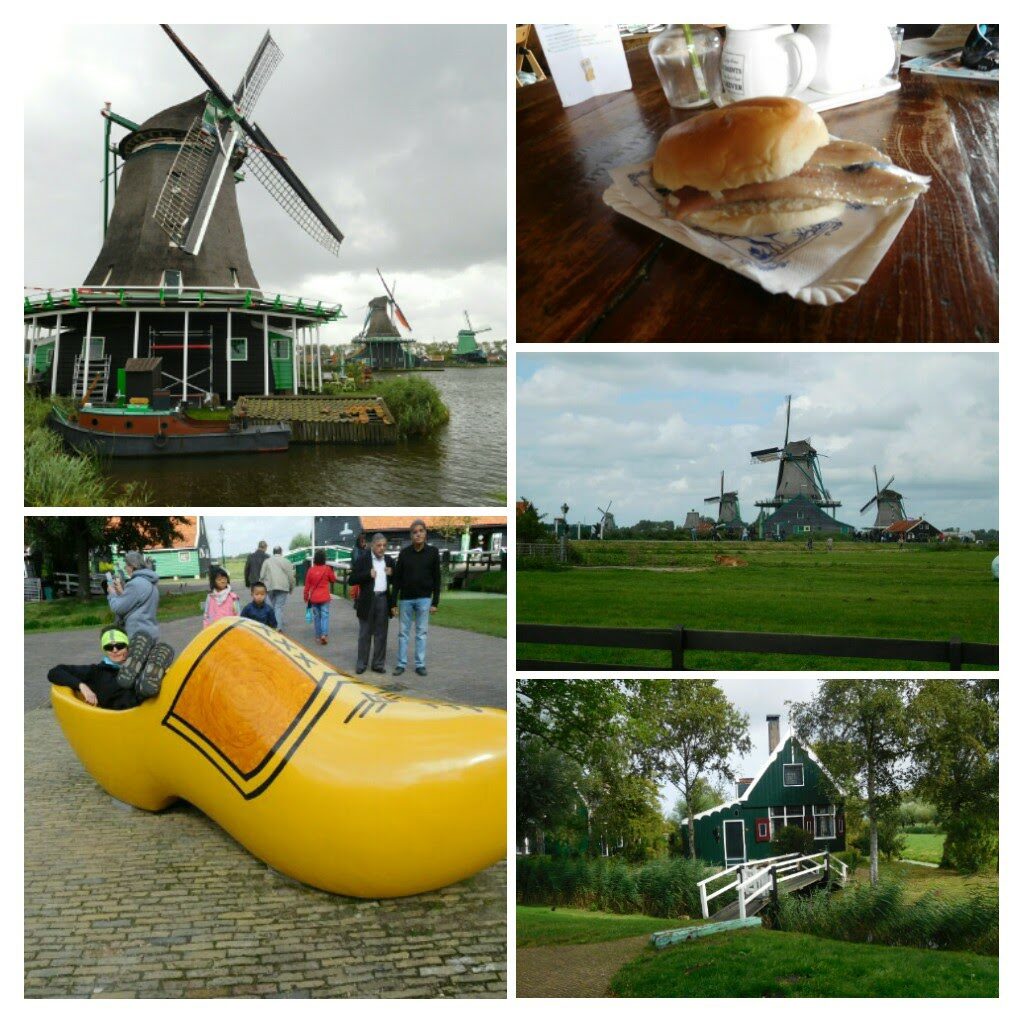
We visited working windmills that saw wood and grind oil, flour, spices and dyes for paints etc. which were most fascinating. Whilst watching a log being sawn, the speed of the wind changed multiple times affecting the speed of the saw blades cutting the timber. The day was windy which meant the windmill blades were constantly moving at a graceful speed.
Back in 1600 there were 1000 windmills but today only 13 remain. Due to industrial progress over the years the windmills started to disappear and were gradually replaced with steam turbines and electricity, but the district retained its industrial focus well into the 20th century. An area of the village including the mills was located on top of a dyke with the adjacent lush green land being about 2 metres below sea level. The dyke contains a large volume of water which allows business and farming to continue here.
We had planned to visit other areas of regional Amsterdam, but the Zaanse Schans was so interesting and had so much to see that we spent all afternoon there. A very good way to end our Amsterdam visit.
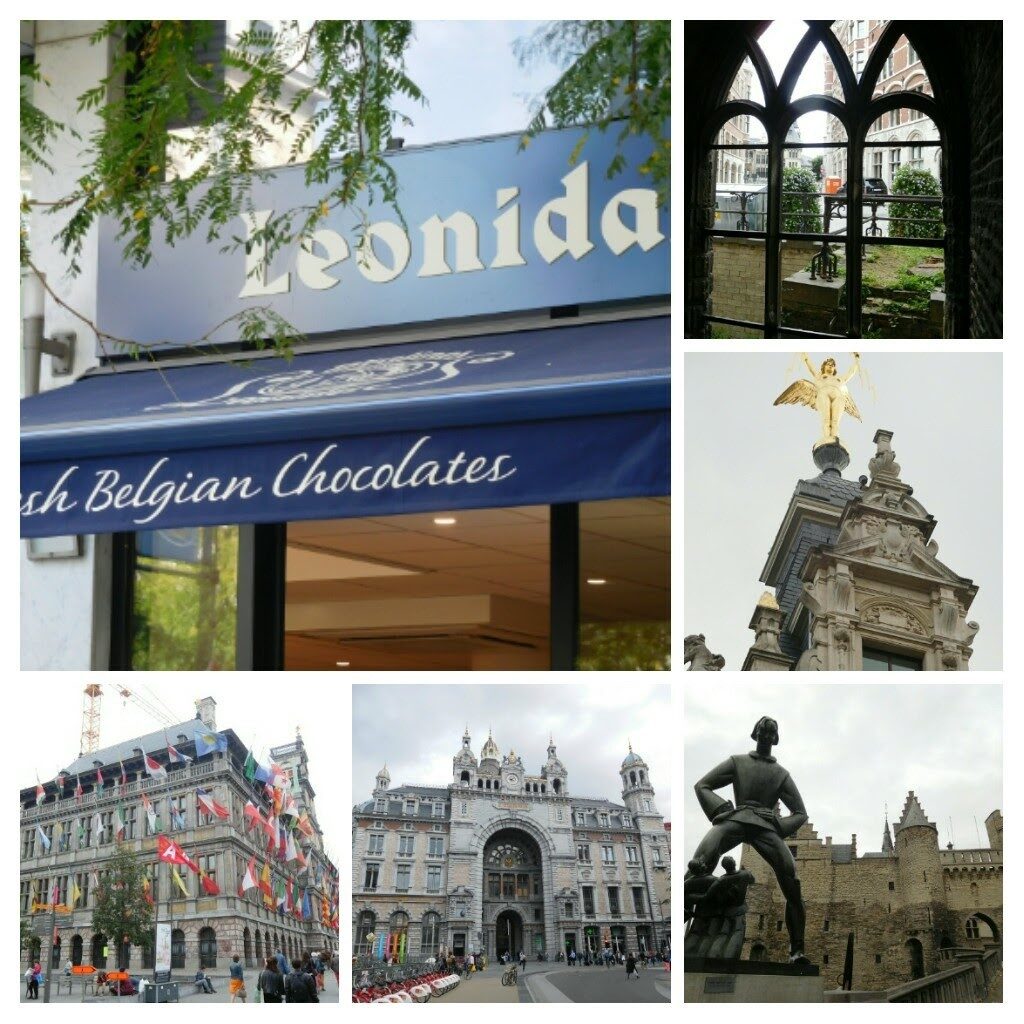
We headed off towards The Hague, went through a market then a quick visit to Rotterdam on the way to Antwerp in Belgium, our 5th country. Antwerp is a port city on the River Scheldt and we will remember the town for the quaint buildings and the numerous Jewish men we saw wearing the Jewish hat (see picture above), some with a shower cap-like cover to keep it dry as it was raining. The underground car park we used not far from the hotel was also unusual having a roundabout 75m in after entering and before the entry boom gate.
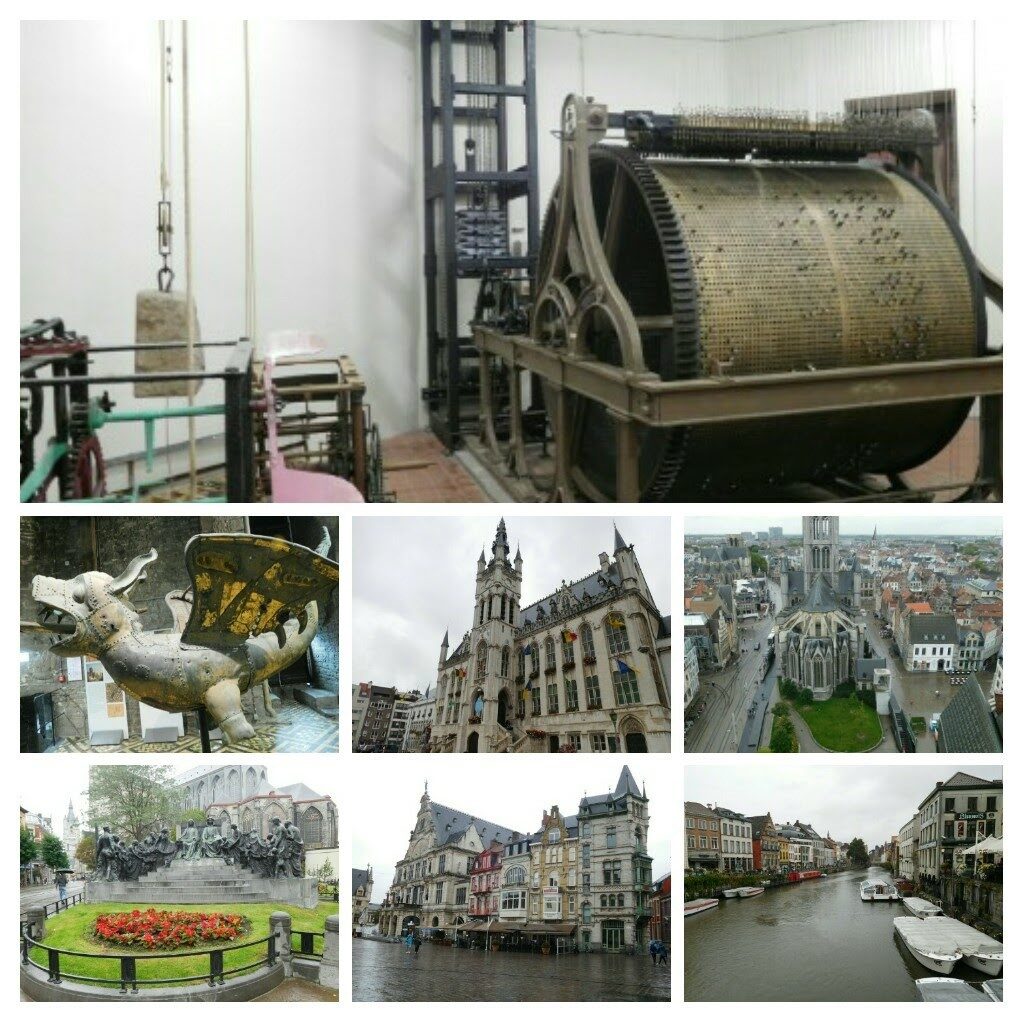
Ghent is located in NW Belgium where the Leie and Scheldt rivers meet and today is a university town. Again an old town of churches and big buildings with a medieval architecture theme, it was the 14th century Belfry clock tower that we found was amazing. We experienced annoying rain during the day so with our wet weather clothing on this was not going to stop us. Climbing to the top of the 91m tall tower (the largest in Belgium) meant we not only stayed dry for awhile but we had a fantastic view of the city and nearby waterway. Fortunately for us the 54 bell carillon didn’t chime when we were at the top.
One challenge for us today was working with a map written in Dutch (closer attention should have been taken when we were at the information office instead of also focusing on the nearby Starbucks for a coffee). Even though a lot of the old buildings we saw along the way were impressive, we sometimes found an information board nearby in multiple languages showing its original design before renovations or fires that had occurred.
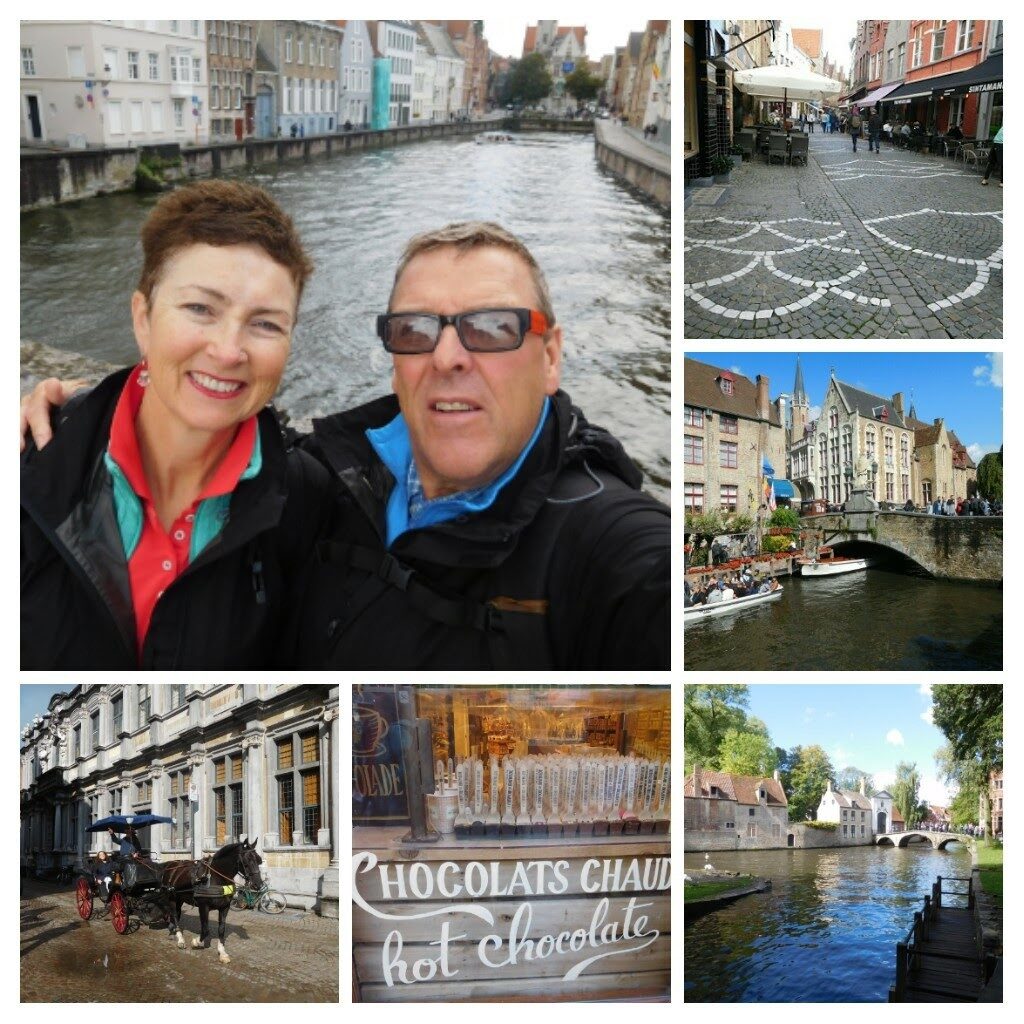
We spent an enjoyable day walking kilometres through their cobbled stone streets and past pretty canals. The whole town of medieval buildings maintains the style of a bygone era with very little redevelopment having occurred…it is like stepping back in time until you realise the retail shops at street level are current. Reality check!
There are market squares and green belts with water fountains or a canal in numerous areas around the greater central area we walked….so pretty. Another belfry from the 13th century with a 47 bell carillon was located in Markt square which chimed every 15 minutes and heard from quite a distance. The Markt area also had horse drawn carriage rides taking tourists around to the places of interest with a personalised commentary.
One church of note was not the Church of Our Lady which houses Michelangelo’s sculpture ‘Madonna and Child’ but a random church in the back streets a little further out. On entering we were a little surprised to see a large rectangular pond (approx. 5x3m) with stepping stones and fake lilies where the congregational seating would generally be placed. A little further in was a swing with the seat made from a chunky tree trunk suspended from the high ceiling located where the pulpit would normally be !! We decided this was our kind of church, a little random and quirky.
We are heading to Brussels tomorrow and then who knows where ? We are following a fairly loose itinerary but nothing is set in concrete so we will need to keep looking at what places we want to see along the way and then work out the best route to see them all. The challenge though is to make our way back to Frankfurt by October 27th to return the car, pacing ourselves so we don’t rush too fast or too slow through all the destinations on the wish list.
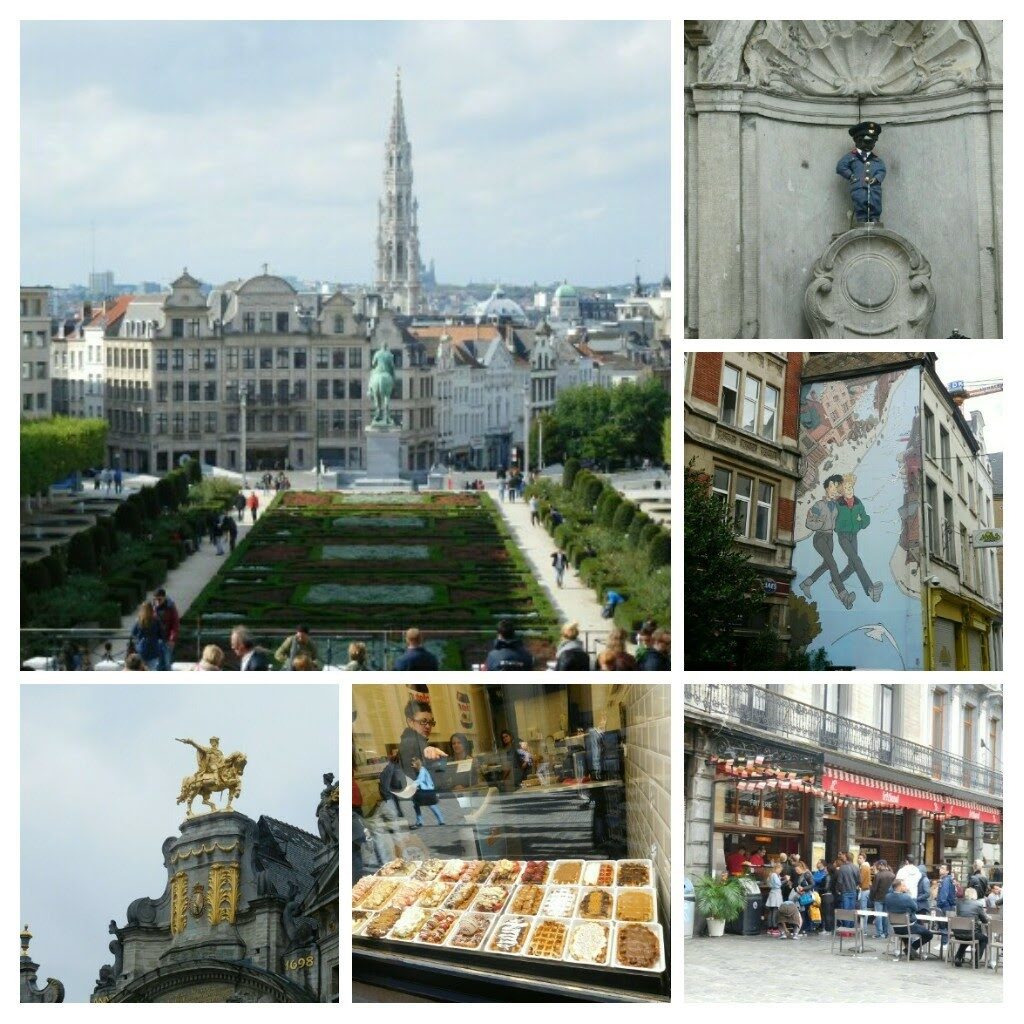
The train station was close by and after again trying to work out which ticket we required, we headed into the city to look around. It was Sunday and there were people everywhere enjoying food and walking the interesting streets. Brussels was once located on the river Senne but during the 19th century when the population grew considerably the river had become a serious health hazard and its entire course through the urban area was completely covered over.
Grote Markt (they leave out the ‘e’) is definitely the place to visit with the grandest of buildings on all 4 sides of the amazing square from the 17th century. They were all massive, adorned with carvings and a lot of gold detail everywhere. So specky. The architecture throughout the city is interesting especially Les Galleries Saint Hubert which is a gallery or shopping arcade 213m in length and built in 1847. This building preceded the present and similar style shopping arcade in Milan, the Galleria Vittorio Emanuele II which is simply stunning to say the least. When we visited Milan in 2015 we stumbled across this grand arcade on the way to the tourist information to obtain a map of the city shortly after we arrived in by train.
To gain some knowledge of the local area we decided to take a free walking tour with our guide Rick from Spain. Well nothing is free but like the one we also took in Berlin, you pay whatever you think the two hour tour was worth. 5 kilometres of walking took us past the places of interest around the city centre. With about 260 days of rain Brussels experiences a year, we were lucky to have sun shining through the clouds.
After the tour we backtracked for a delicious fresh waffle and frites, which are hot chips served in a paper cone, topped with plain or a multiple of flavours of mayonnaise and eaten with a fork. It is crazy just how many people line up at the window of a street cafe to be served. The call it ‘fast food’ but we were told by the guide that people can wait in line for ages at lunchtime at their favourite outlet.
One thing we found interesting with Belgium is there is not one specific language spoken but 3 languages (Dutch, German and French) as they border each of these countries. It’s amazing to hear locals and those in hospitality switch from one language to another when conversing with numerous different people. We sometimes struggle with our one language….English !!
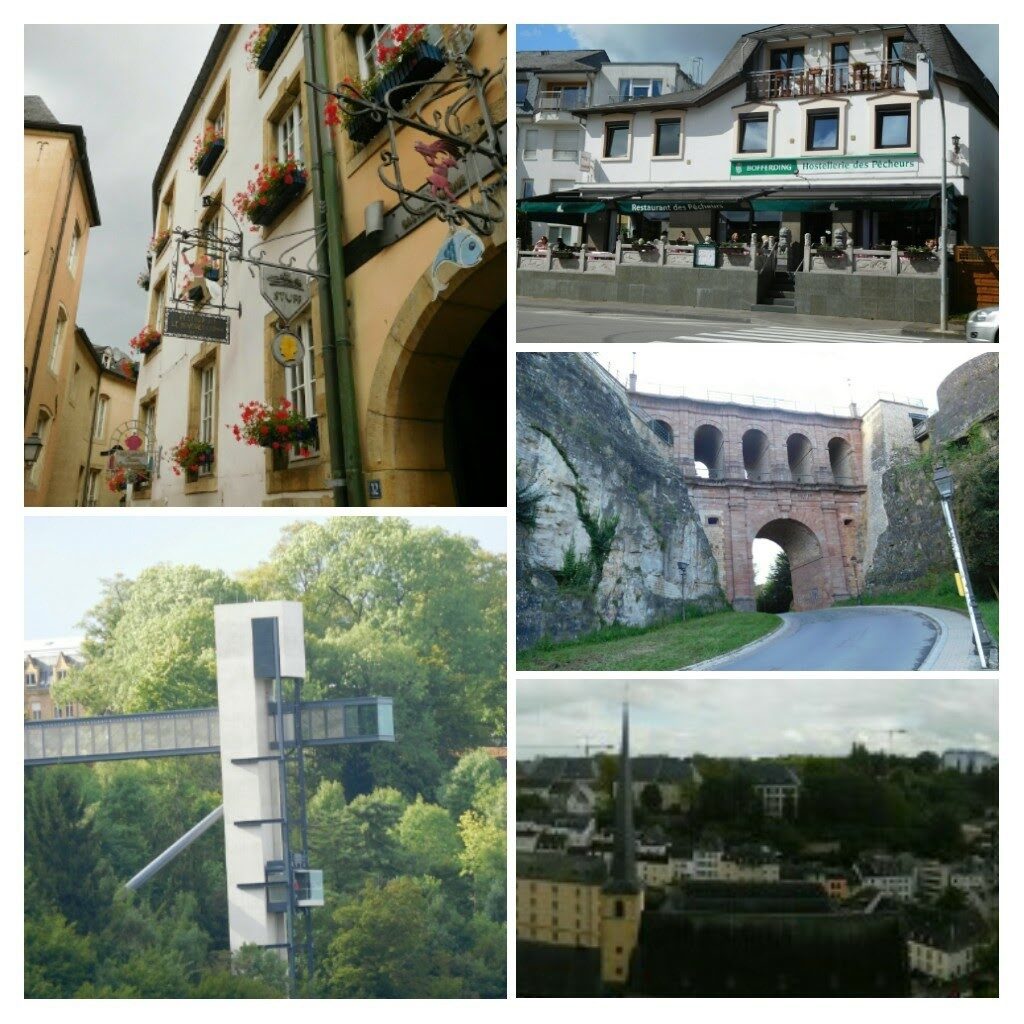
Our hotel is run by Chinese and our room is located above a Chinese restaurant which was doing a booming lunchtime trade. Ordering a serve of take away spring rolls and special fried rice ourselves, we walked to the nearby bus stop and headed into the city to have a look around. The surrounding countryside along the way was lush green with vineyards going up the very steep hillside….very pretty and similar to the Barossa Valley in places.
Luxembourg City is very much a large city with a medieval history that caught our attention, so we went to investigate. There was once a fortified castle built in 963 on the Bock promontory which consisted of a vast complex of tunnels and galleries forming an underground military defence system. It originally had 3 fortified rings with 24 forts and a 23 km long network of casemates (the latter started being built in 1644). These casemates sheltered thousands of soldiers and their horses, workshops, kitchens, bakeries, slaughterhouses and other infrastructures. The actual castle no longer exists when it had to be dismantled in 1867 due to the neutralisation of Luxembourg. Overtime entrances to the casemates were sealed but still 17 kms of tunnels remain over several stories and penetrating up to 40m inside the rock face. The tunnels we followed were narrow in places and the staircases very steep. What a place to have been in during battles and wars !
Craving for a simple vegetable dish for dinner after the selection of our recent meals, we decided to eat back at the hotel. On arrival we found hardly an empty table in the place! It was weird to hear French speaking Chinese looking staff and some of the dishes we saw on other tables nearby were nothing like those on our menus we have at home.
The szechuan chicken and vegetable dishes we chose came out on cast iron hot plates and were placed on a hot plate warmer placed in the centre of the table. The serving size of each was enormous and not a chopstick in sight !!
No more than 3 minutes on the road and immediately exiting the bridge, to our surprise we were directed off the road by a guy standing in the middle of the road in a fluro vest. He simply asked to see our passports and we were confused by the request but obliged, not understanding the reason. The man then informed us we had entered Germany and asked if we had anything to declare. We must have looked vague as he then suggested if we had any drugs, fire arms or money? He was obviously a customs officer but it was not initially obvious to us. Who would have known…we did not notice any signage in his outdoor office !!
We had to open the car boot and show him the contents of one suitcase and fortunately all was good so the officer allowed us to continue without checking anything further. With the European Union having open borders we certainly didn’t expect customs to be anywhere but at an airport.
With a legal top speed of 130km/h on the motorway, we had about 220km ahead of us today and an expected 2 1/2 hour drive to Strasbourg.
Just a side note….. There is a motorway etiquette throughout the countries we have travelled and it works very well keeping the traffic moving. Rarely motorways have been 2 lanes but generally are a minimum of 3. Travelling in and out of Amsterdam though there were 7 lanes each way ! You enter a motorway at the same speed everyone is travelling and those in the immediate lane automatically move across to let you in. Trucks and slower vehicles must use the slow lane and everyone else the middle lane. The top lane is purely used for overtaking and once you have completed the move you return to the middle lane immediately. Everyone complies and the traffic moves smoothly without any obvious road rage. Drivers are polite and let you in which is so different to home.
When the top lane is clear and you pull out to overtake those ahead of you, sometimes out of nowhere you have a car right up the back of you. Generally a Mercedes, BMW, Audi or Jaguar is tail gating and after we hurriedly return to the centre lane they then pass us disappearing out of sight…speed limit, what speed limit !
Back to today…. Our journey to Strasbourg had been uneventful but about 11 km before we were to arrive and running close on time, we then started experiencing immediate major traffic issues. Before we knew it the 2 and sometimes 3 lanes ahead of us were stationary resembling a carpark with mainly trucks in one lane and cars in the others. The lanes of traffic were as far as the eye could see and when we moved it was at a snail’s pace. Traffic slowly approached the different exits of the motorway whilst more traffic tried to enter the motorway. 55 minutes later we had crawled just 10 kms before eventually turning off toward the city centre of Strasbourg. Our ETA had blown out and the motorway traffic continued to crawl onwards.
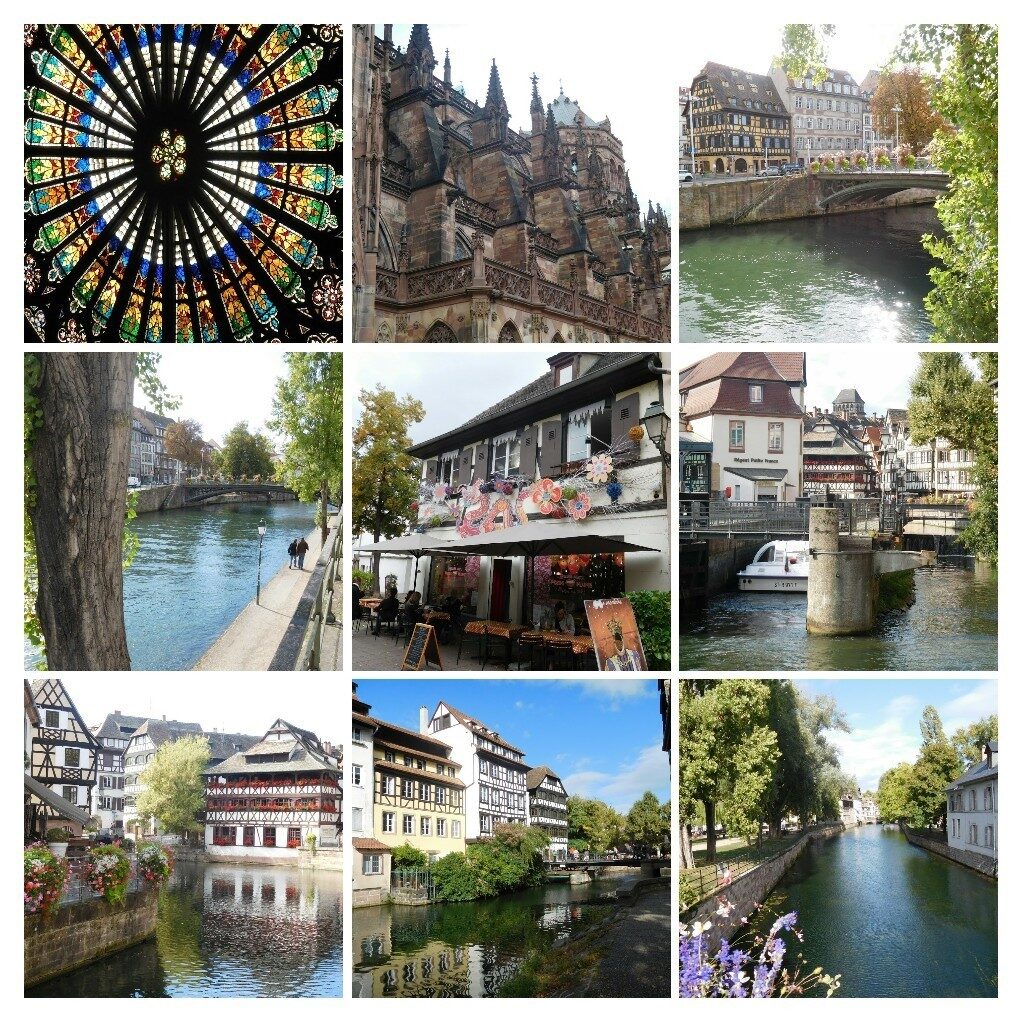
We were lucky to find a large carpark not far from the central train station, parked and walked into the city centre. Strasbourg is located in France on the Rhine River near the German border and we noticed signage around the city in both languages. We followed a walking trail and found ourselves at the Gothic Cathedrale Notre-Dame which was full of tourists admiring/questioning/worshiping the features of the church and all it had to offer. Along with the normal stain glass windows, organ and pipes, high ceilings, pulpit etc. that you would expect to find, this church had an astronomical clock (nearly 300 years old) which happen to chime every 15 minutes….what a draw card, and it did !!
The Ill River flowed rather fast around a small island in the Petite France Quarter where medieval bridges were often adorned with flowers. As with other places we have visited with waterways, there are always tourist boats on the move. We watched a barge-like boat full of people travel up through the lock driven with precision through a very narrow area. Along the canals there were lots of half-timbered houses from the 16th century along the cobbled stone streets which gave Strasbourg lots of charm.
Colmar was our stop for the night so after an enjoyable visit in Strasbourg we found our way back onto the motorway to join the evening traffic.
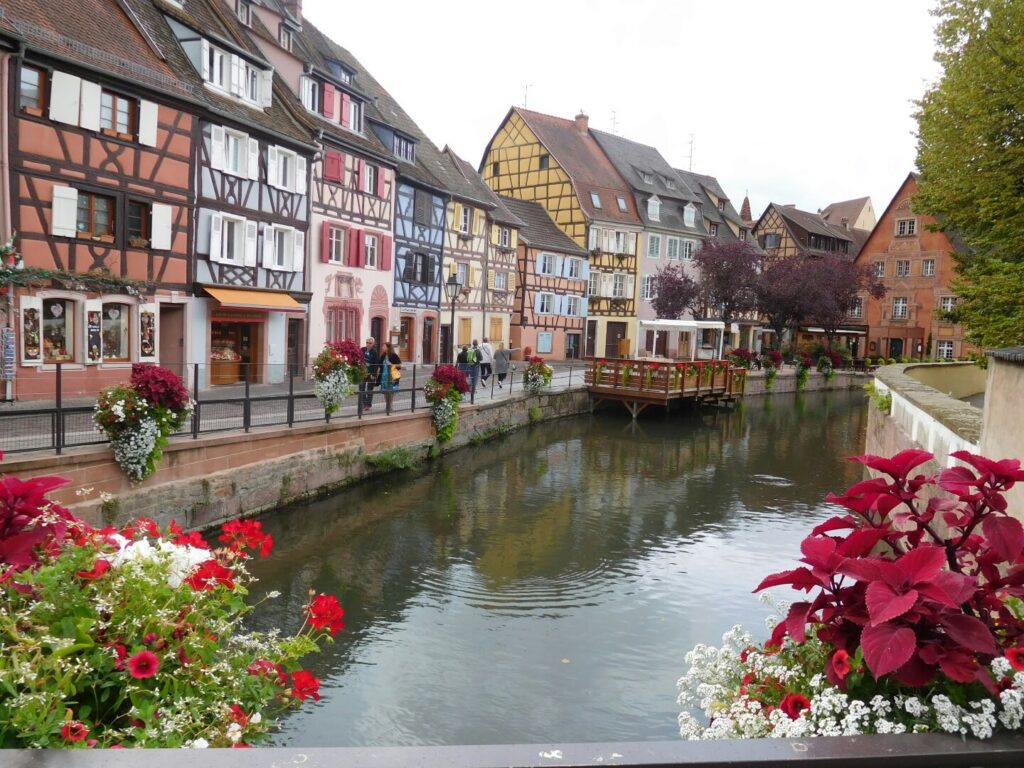
Colmar’s tourist information office, even on a gloomy and drizzling day was very busy sorting out the many tourist’s enquiries. We followed a self guided tourist trail around the town and found more cobblestone streets and half timbered medieval buildings very similar to those in Strasbourg but on a smaller scale. The canals in the ‘Little Venice’ area were lined with colourful houses and their floral detail added lovely colour to a gloomy and wet day.
There seems to be a theme with the style of places we find interesting…the old towns often dating back to the 16th century…nothing like what we have in Australia! !
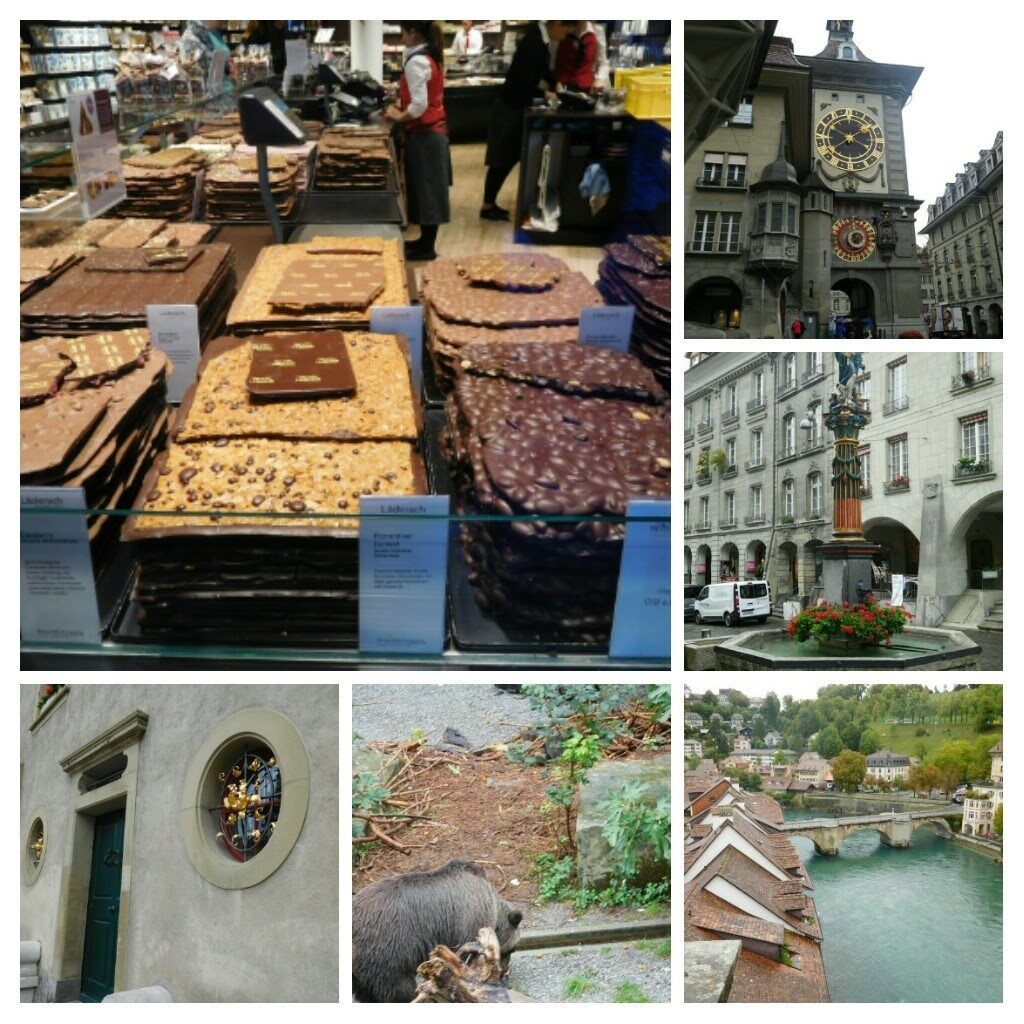
After leaving Colmar and on the way to Bern in Switzerland we noticed there was no traffic coming toward us on the other side of the motorway. Stella had mentioned a little earlier that ‘there are problems with inquisitive drivers ahead’ which made us smile with such a random statement. What did she mean by that?
Travelling a little further on past a bend in the motorway, we saw that the long trailer of a big truck had rolled over blocking all 3 lanes of traffic. A crane had somehow gained access to the accident and was attempting to possibly right the trailer. As we continued driving onwards we passed 10 kms of stationary cars totally unaware of the reason for their predicament…ahh, the inquisitive drivers statement !!
At the Swiss border we were stopped and had to purchase a toll sticker for the car which was a one off charge allowing us to use all the tunnels along the motorway throughout our time in Switzerland. In a country where mountains are everywhere we are keeping count of how many we encounter. The tunnels so far have varied from 2 to 3 lanes wide, straight and snake-like and the longest today has been 6.3km long (the lengths are indicated on entry).
We drove on and into the city of Bern where we spotted a central car park on the other side of the road. We turned off in the attempt to head back but found all the one way streets in the vicinity a challenge to achieve this. After constantly being confronted by signage preventing us turning the way we needed, a possible illegal U turn put us in the right direction. We were eventually inside and parked, and after a couple of photos to help us return to where we had parked, the wet weather gear was on and we were underway.
Our 5 hours of exploring was made easier with Bern’s 6kms of undercover arcades. We explored the Old Town and were able to walk down the longest covered shopping promenades in Europe, protected from the rain.
It was nearly 2pm and we noticed there was a crowd gathering ahead with umbrellas and cameras in hand. At the western gate of the city we saw an amazing 15th century astronomical clock above on the old clock tower. A few more minutes passed when mechanical figures appeared to announce the current time and then the crowd below immediately disbanded. One o’clock would have been a disappointment if you were distracted for a moment but 11 or 12 o’clock would have definitely made the viewing worth while even in the rain.
The nearby fast flowing Aare River forms a semi circle around the Old Town and so amazingly clear that you could see the pebbles below the surface quite a distance inwards. We crossed the river at the outer edge of the city and found a bear park, the symbol for the city. The many bears were enclosed in a very natural environment bordered by the river and having great viewing areas for the tourists.
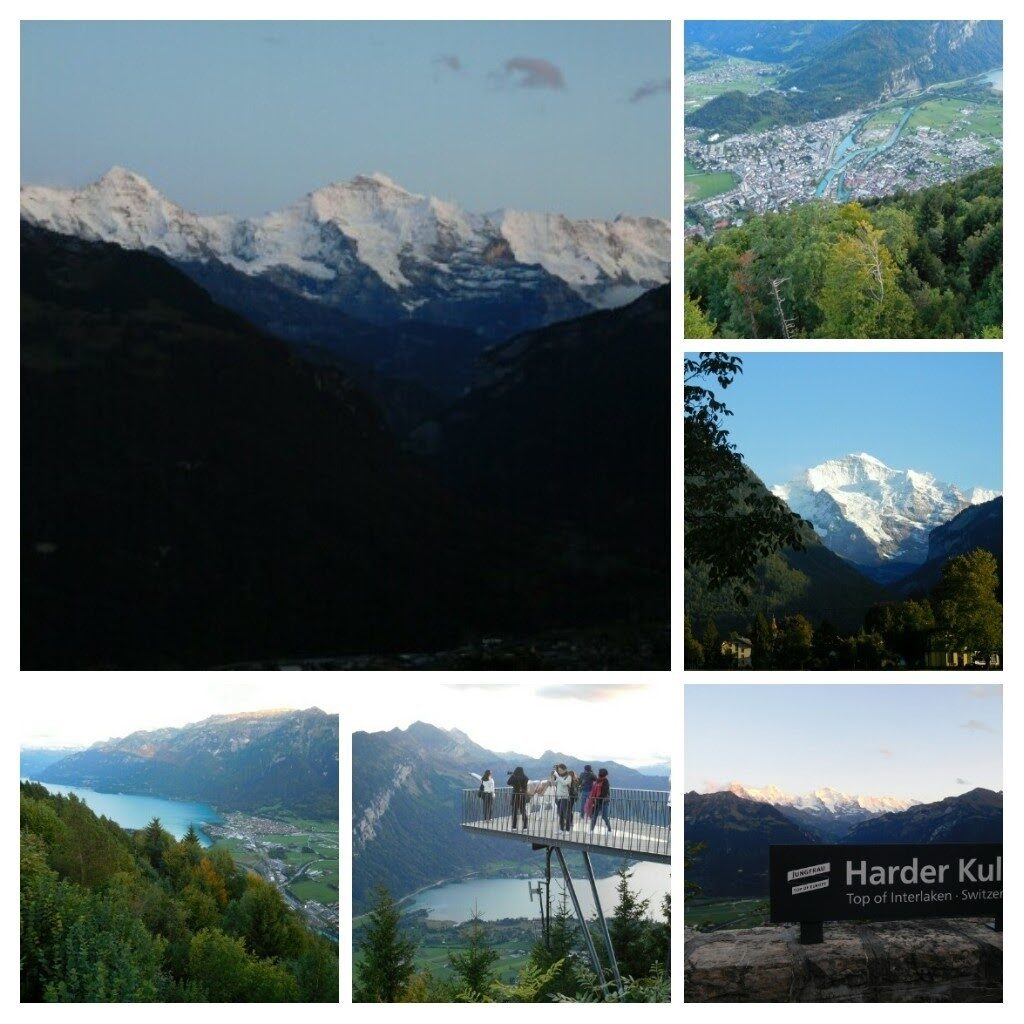
We needed to pinch ourselves to realise we were actually here!
We arrived at our quaint typical Swiss accommodation and immediately walked for a cable car (funicular) train ride to the top of a mountain called Harder Kulm (1322m above sea level). The Harder railway was built in 1908 enabling a 10 minute ride to the top with a 64% gradient. The viewing platform was supported by a steel construction, extending out over the valley with a glass insert showing the immediate landscape below. The air was certainly cold and windy and the timing of our assent meant we would also enjoy the sunset. The views in all directions were stunning and the 3 snow capped peaks, the Eiger, Monch and Jungfrau glowed in the distance.
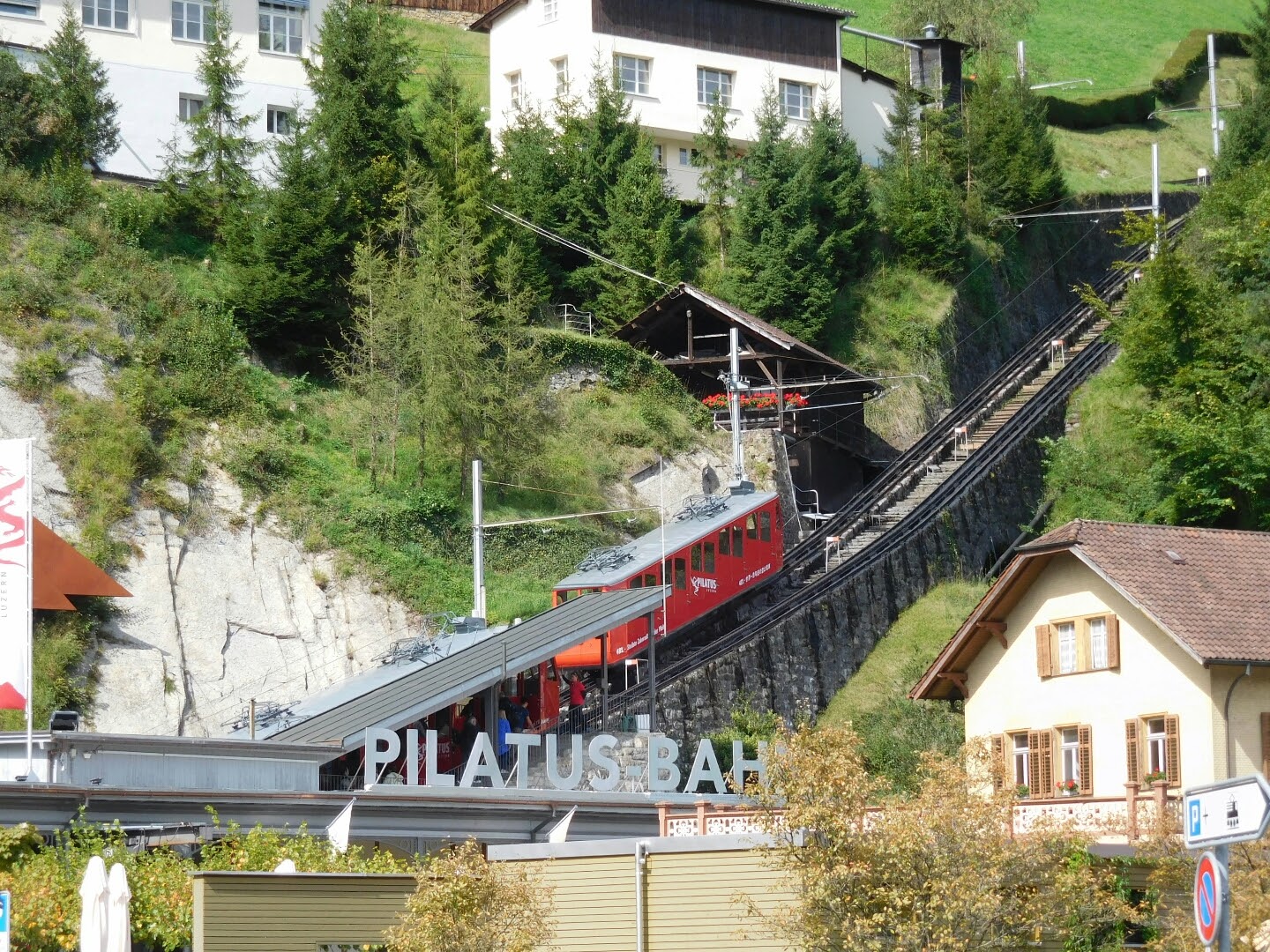
The railway was built in 1889 and after being electrified in 1937 it resulted in increased travel time. We travelled for 35 minutes up the side of the mountain at a speedy 9 kms/hr along the 4,618m track. The steepest gradient we saw posted along the way was 48% with the average being 35%. How crazy were all of us putting our faith in the 2 horizontally rotating cogwheels gripping the rails !! As we ascended the views back toward the town were fantastic, the trees were growing upwards at acute angles to the mountainside and the rugged terrain had switch back tracks with the odd walkers and a cyclist making their way either up or down the 2073m high mountain.
At one point we waited about 5 minutes at a divided track for the carriages that were coming down the mountain to pass us. We noticed there was a sound of bells ringing in the air as the nearby free roaming cows were eating the lush grass. Each cow had a large bell attached to a wide leather strap which constantly moved as they ate…all we needed now was Heidi.
A few minutes before arriving at the top, the clouds started moving in and before we knew it we could not see a thing, the Hotel Pilatus-Kulm was hardly visible. Everything was white and the mountains had disappeared….what a disappointment! We left the warmth of the building and climbed the stairs to the observation deck where the air was freezing. We saw ice on the benches, icicles under the eaves and balustrades and there were tame black birds with bright yellow beaks sitting on the railing….nothing else was visible.
The next train was not due for another 40 minutes and as the outside conditions did not look like improving, we waited patiently in line in the warmth for our return journey. Having the opportunity to sit at the front of the carriage was a bonus as it meant the photo opportunities were excellent as the clouds began to disappear when we started to descend the vertical rock walls.
What an opportunity to ride the steepest cogwheel railway in the world…it was certainly steep, as well as the cost A$100 return each !
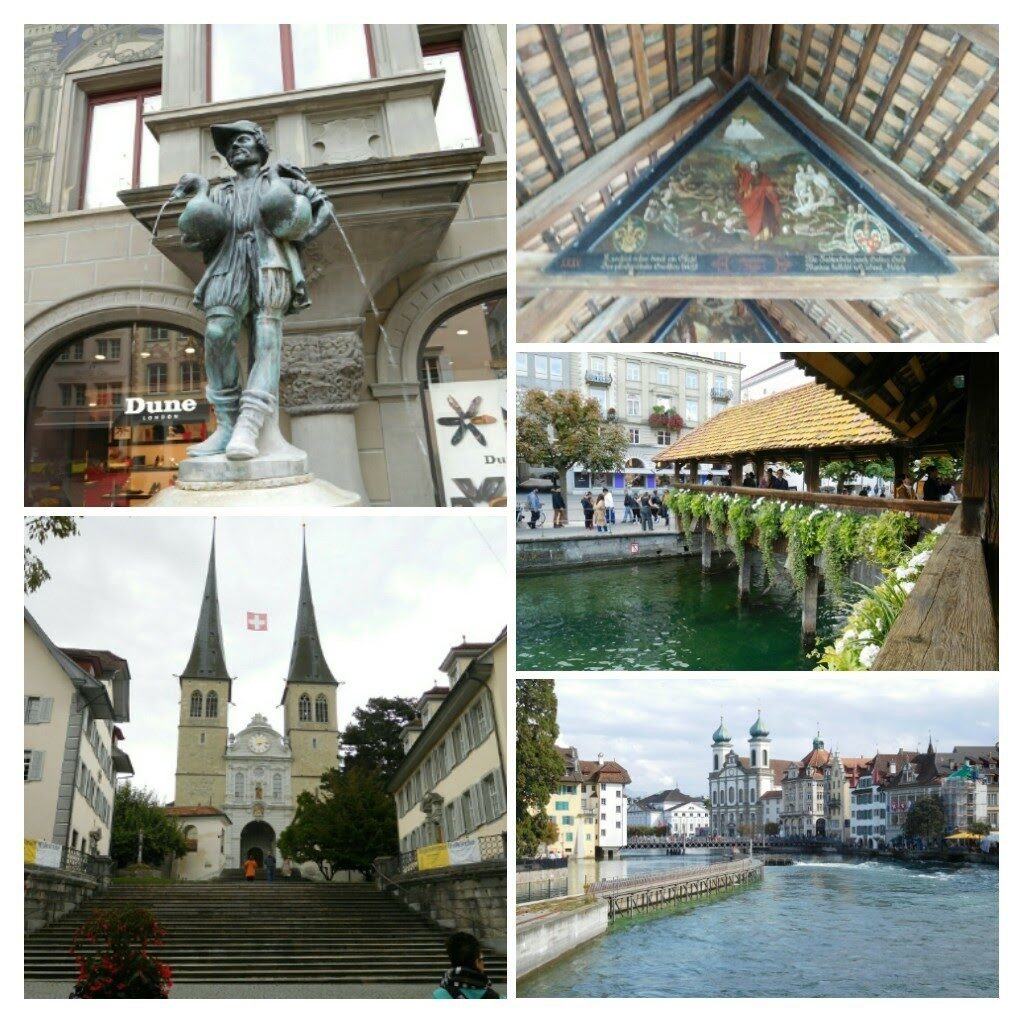
Being a tourist we were entitled to a city pass which gave us free public transport on buses and trams. Staying not far at all from the city we caught a bus and headed in to find the streets full of people sight seeing. Lucerne is located amidst the snow capped mountains on Lake
Lucerne and the self guided map took us around to the fascinating places the town had to offer. There were interesting buildings everywhere, some with their walls adorned with eye catching fresco scenes. Old town squares were dotted around the city with the old busker singing and playing music entertaining those around.
We walked along the Mudegg Wall, a 14th century rampart and climbed 4 of its 9 watch towers that are open to public. After climbing multiple staircases in each of the towers the views over the Old Town, lake, river and mountains made it well worth it. The town’s oldest clock dating from 1535 was on one of the watch towers and oddly enough it was set to always chime one minute before all the other clocks in the town. Whilst exploring the wall, we stumbled across a Swiss longhorn being played nearby which was a great surprise.
The extremely fast flowing Reuss River cuts the town into 2 and has multiple bridges connecting both banks. Two in particular were interesting, both were covered over wooden bridges and both built in the 14th century as part of the city’s fortifications. One bridge had 67 painted panels of macarbe artwork, a lot of them with skeletons in battle scenes and the theme for the other bridge’s painted panels were scenes of Swiss and local history. Adjacent to one bridge was an octagonal tower, over 34 m in height and built around 1300. It has been used for many things over time such as an archive, treasury, prison and a torture chamber.
To our surprise in the centre of the city we saw people wake boarding and surfing in the fast flowing (rapid like) river using a bungee cord attached to the bridge railing. In full length wet suits they jumped into the freezing cold water, holding on and waiting for the current to stretch the cord to its maximum before they popped up out of the water and rode the waves until the cord relaxed.
We timed it perfectly to visit a Baroque style Jesuit Church which was renowned for its great acoustic qualities and fortunately for us a choir was practicing when we arrived. The sound resonated beautifully without the need for microphones so we sat for awhile to enjoy the music.
The Saturday morning market in the city was set up either side of the Reuss River and after a slow start to the day, we meandering through the stalls that were selling fresh produce, flowers and brick a brac. Unfortunately by the time we had made our way to the fish market area it was nearly midday and they were in the process of packing up.
We saw Swiss knives and Swiss watches everywhere but being in one of the most expensive cities in the world our spending was curtailed, so no Rolex timepiece this holiday. Not so curtailed though that we could not go past a Swiss chocolate shop to taste some of their specialities…yum !
A side note…. We became members of the Ibis hotel chain after our second visit to one and have found the style of accommodation fairly consistent for our needs. The rooms are simple and generally roomy but sometimes the size has been quite compact !! One amazing thing we have found during our stays is that the hotel allows dogs for an additional charge (A$15.00/night)….a very unusual concept for us when you see a dog being lead in on a lead heading for the elevator.
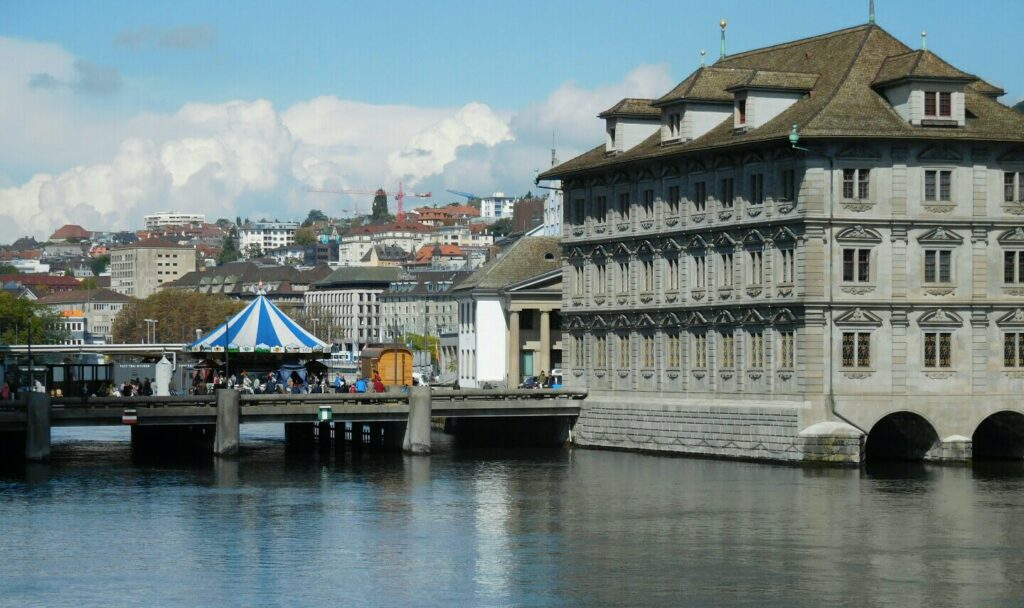
Another self guided walking trail took us along the Limmat River, through back street lanes, market squares and past Lake Zurich which, like Lake Lucerne, had lots of graceful white swans entertaining the passers-by.
The peaceful stroll around the streets in the sunshine was often interrupted by the sound of loud car engines from the high end sports cars such as Porsches, Ferraris and Lamborghinis. Driven by relatively young guys, possibly in the banking industry (but only an assumption), they seem to travel around the city in pairs showing off their toys. With a 50km/h speed limit in the city centre all they could do was speed from one red light to the next.
In the heart of the city we came across Lindenhof, a park that not only offered excellent views over the city but it was full of people playing chess with large wooden pieces and enjoying multiple games of bocce. We also came across the largest tower clock face in Europe located on St Peters Church and after entering, we sat for awhile inside to listen to an orchestra practising for an upcoming performance. Again the sound produced by the musicians in a location like this was lovely and so clear.
Walking along Bahnhofstrasse on a Sunday where all the posh brand names can be found and not a single shop was open ! This most expensive shopping street in the world had very familiar names store after store and some quite random ones as well. Our budget would certainly not stretch for shopping in this street !
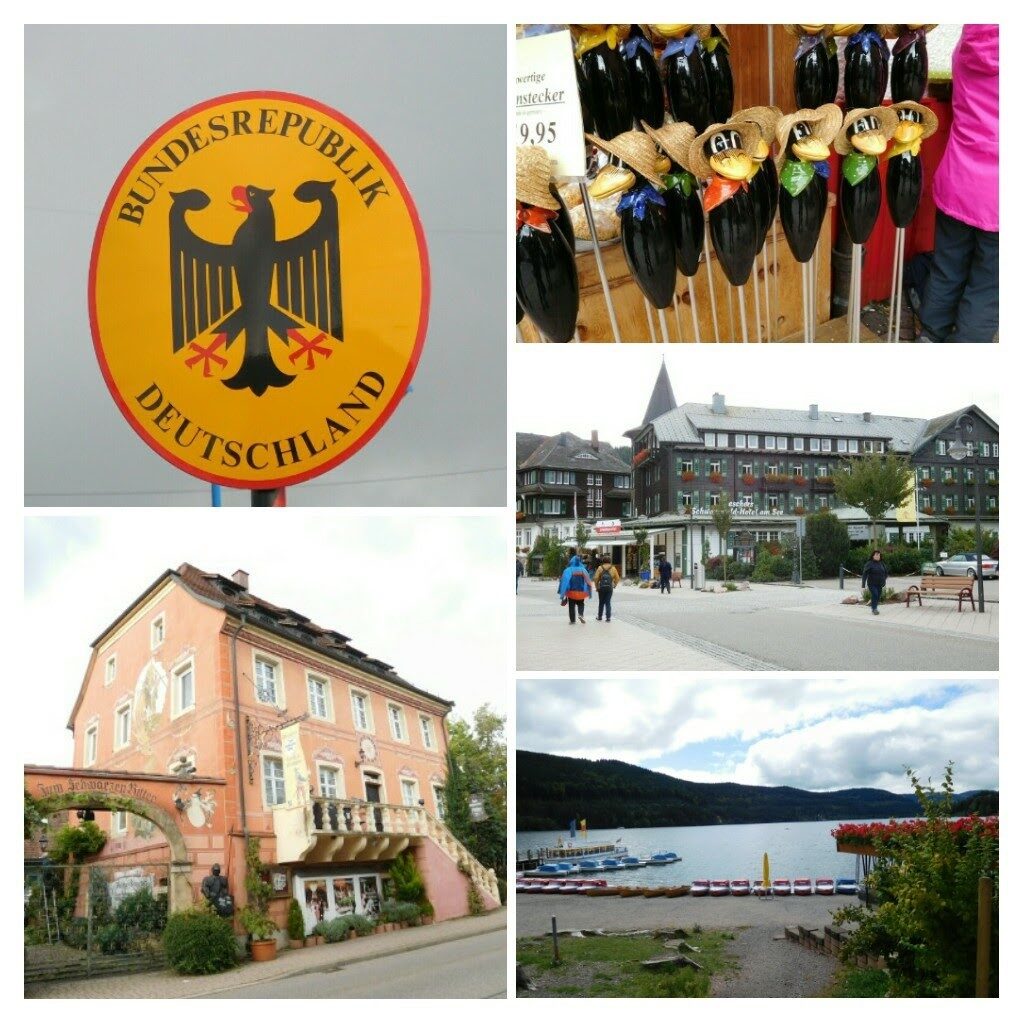
Now back in Germany and before our night’s stay in Freiburg, we headed toward Lake Titisee in the Black Forest area. The pretty village is nestled in amongst green forest and low mountains and the 2km long natural lake offers boating activities of all kinds and a cruise. There is an 8km trail around the lake offering the walkers a pleasant view over the valley, and for us a lovely cake shop not far away that also serves coffee.
What a tourist attraction, we found the bustling town was full of coaches and parked cars…people were everywhere, some even in the cuckoo clock shops !
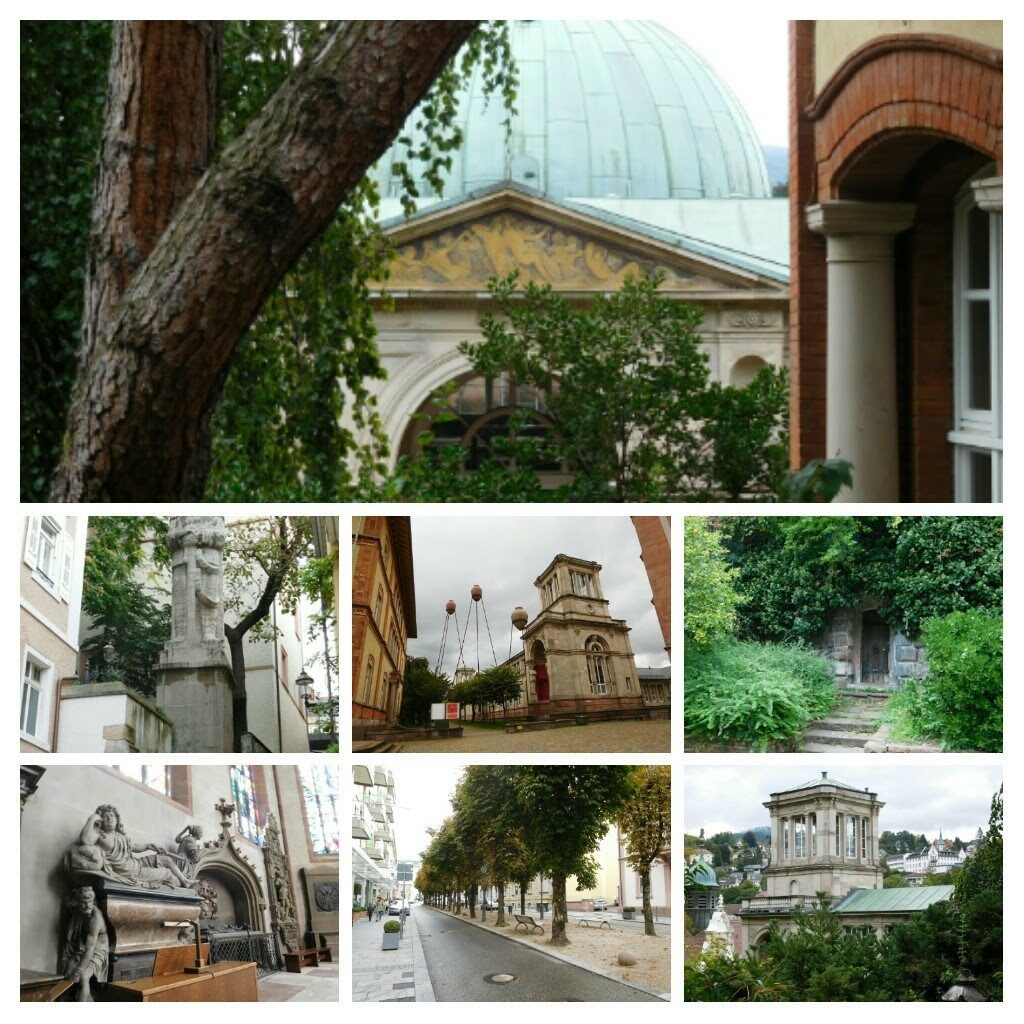
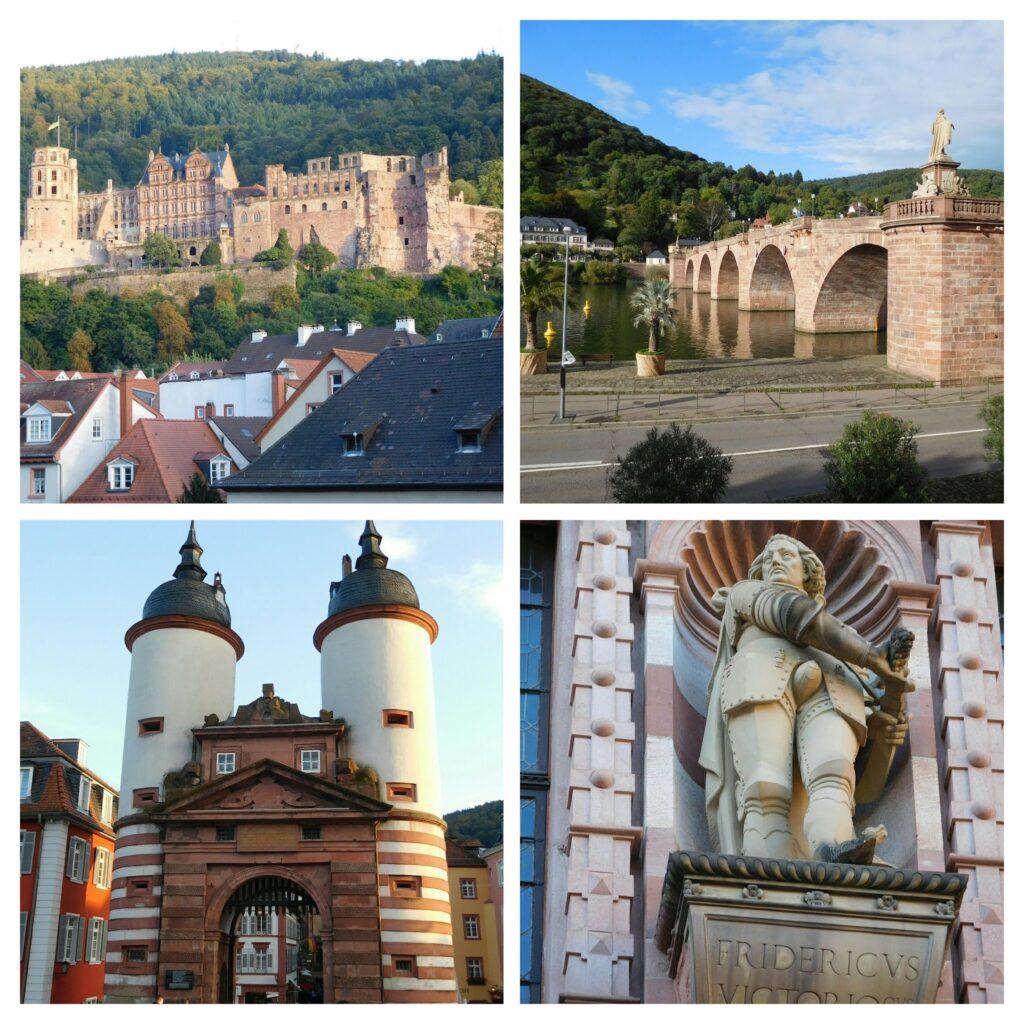
The castle which dominates the view from the Old Town is a mixture of styles from Gothic to Renaissance with the first building erected early 1200s. After fires, lack of maintenance and being destroyed several times during the 30 Years War both the castle and gardens were rebuilt in the early 1800s, but today a good portion of it is now in ruins. Fortunately we were able to walk around a good portion of the castle and the views over the city, the river and beyond were simply amazing.
The cellar’s claim to fame is the Heidelberg Tun or wine barrel which is just gigantic and the largest in the world. Built in 1751 from 130 oak trees, it’s capacity is 221,726 litres with a dance floor on top (just what every cellar wants) !!
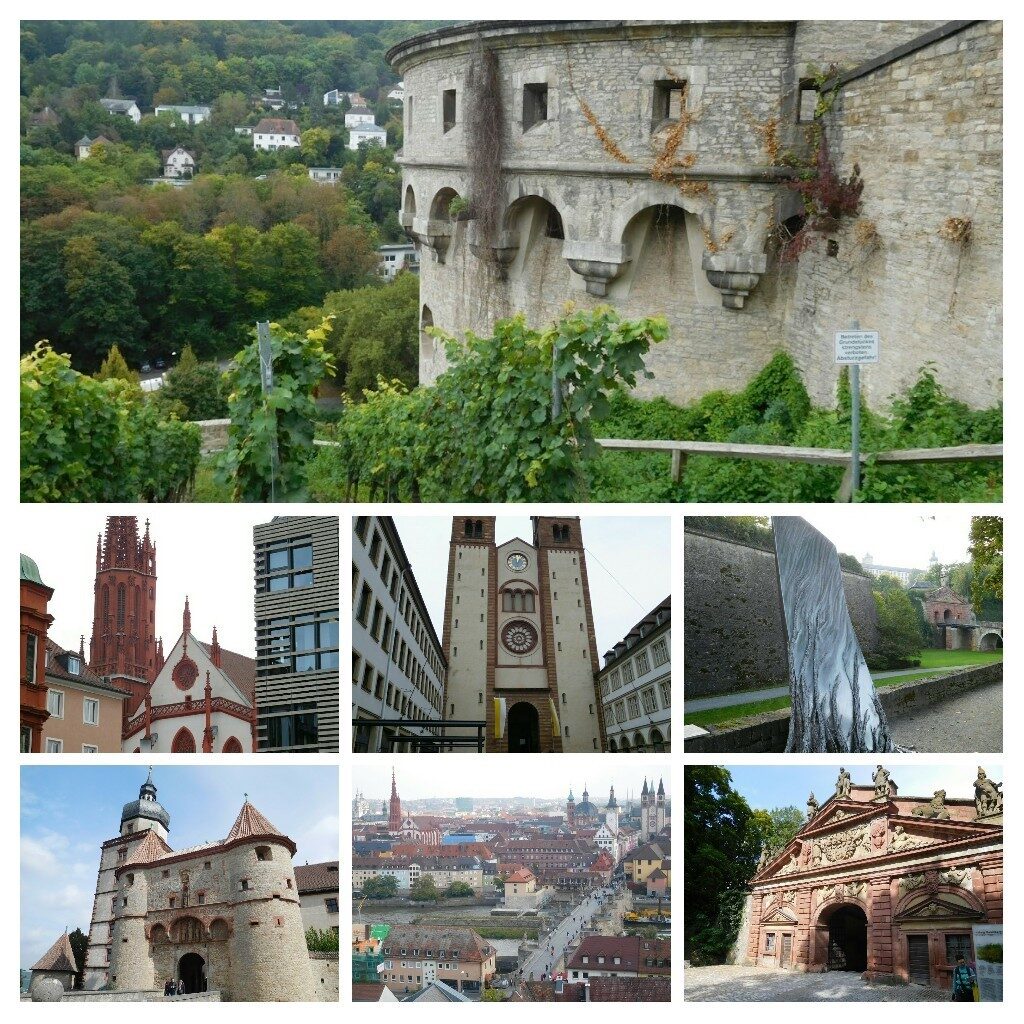
On our way to Rothenberg we drove to Wurzburg and found a public car park in the centre of the city. We passed lots of churches and other buildings along the walk but resisted exploring as the Fortress Marienberg, yes another castle, had made an architectural statement high on a hill.
After climbing an amazing number of stairs we finally reached the fortress and the views below were breathtaking ! Restoration was underway with scaffolding and fencing therefore unfortunately restricting access in areas. The battlement walls were thick and as steep as and the surrounding vineyards the same. The vines would have been at least on a 45 degree angle making harvesting quite challenging I am sure.
The Residence Palace, built in 1720 looked very impressive as we drove past it earlier looking for a park in the city. We realised a little too late as we drove past that the front grounds are so large that they are presently used as a public car park. We could have felt like guests at the Palace had we stopped in time, but a missed opportunity.
The old bridge crossing the River Main was built in the 15th century and was a great vantage point for us to watch the river boats and barges negotiate the lock. We are amazed again at the speed of the current and have found that every river in Germany we have come across makes the Torrens look like a creek !
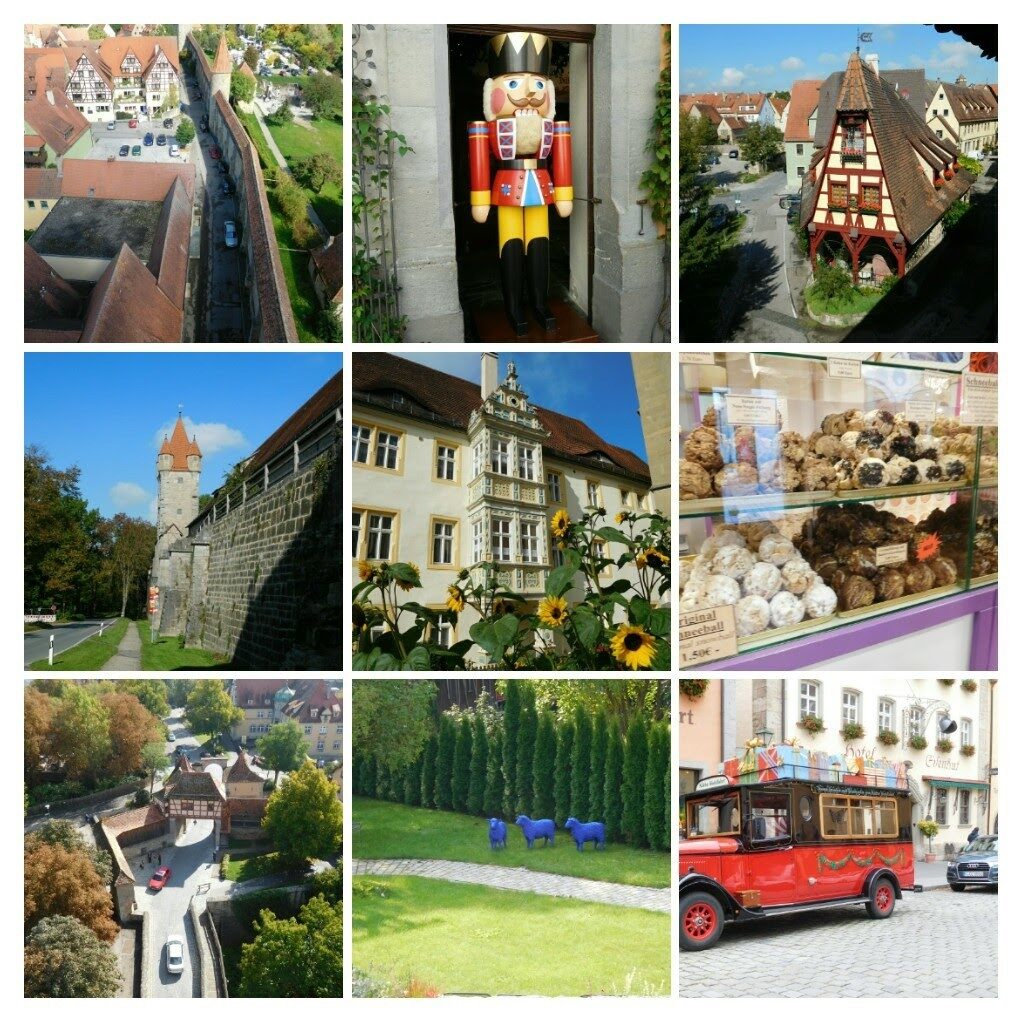
We were able to walk along 2.1km of the 3.6km massive stone city walls giving us fantastic views over the town’s quaint roof line and cobblestone streets. We climbed 103 steps up one of the 42 gatehouse towers for a 360 deg view over the town and surrounding countryside. Everything outside the walls was green as far as the eye could see. Inside the walls the houses, some half timbered, were colourful, well maintained and often with flower filled window boxes. Many buses were parked outside that had brought in tourists from riverboats and those on coach tours…along with us there were tourists everywhere enjoying the town.
Harry was our guide during the afternoon on a 2 hour walking tour of some of the city’s streets, all very narrow and interesting. He entertained the 25 of us with information about how Rothenburg came to be the best preserved town in Germany. He mentioned there were no satellite dishes allowed, street parking was nearly non existent and the strict rules controlling changes to both the inside and outside of properties were to maintain the town’s originality (exemplary preservation laws). All windows were wooden, the roof tiles were all shaped like a beaver tail and the walls of the houses were quite colourful.
After dark we walked as short distance back into town to the Marktplatz to join the 100 or so other people for the Night Watchman’s Tour. George, dressed in a long black cape, broad brimmed hat and carrying a halberd and lantern, was our guide for 1 hour. He took us around the streets telling tales, bringing the past to life through the eyes of a Night Watchman (the 3rd most lowly paid job, but one of the most important). George told us how the town began, continued to grow, trading of goods, the black plague, devastation during the 30 Year War, partially bombed in WW11, plunged into poverty, subsequent tourism and as a consequence has not changed or developed over time.
The Master Builder’s House (Baumeisterhaus) or House of Tradesmen was built between 1270 and 1300 is now over 700 years old and amazingly still in its original condition. As the average height of a person was under 5 foot we noticed the ceilings were quite low, the bowed walls were made of straw and dirt, the rooms were small, the floors were made of packed clay downstairs and timber upstairs. The occupants over the years were varied….coopers, yarn dyers, weavers, tinker, shoe maker, potter, basket maker, soap maker, plasterer, pewterer and a bricklayer. Because a hermit lived in the house and didn’t need electricity or running water during the time others were modernising and changing the insides of their houses, the historical character has been maintained.
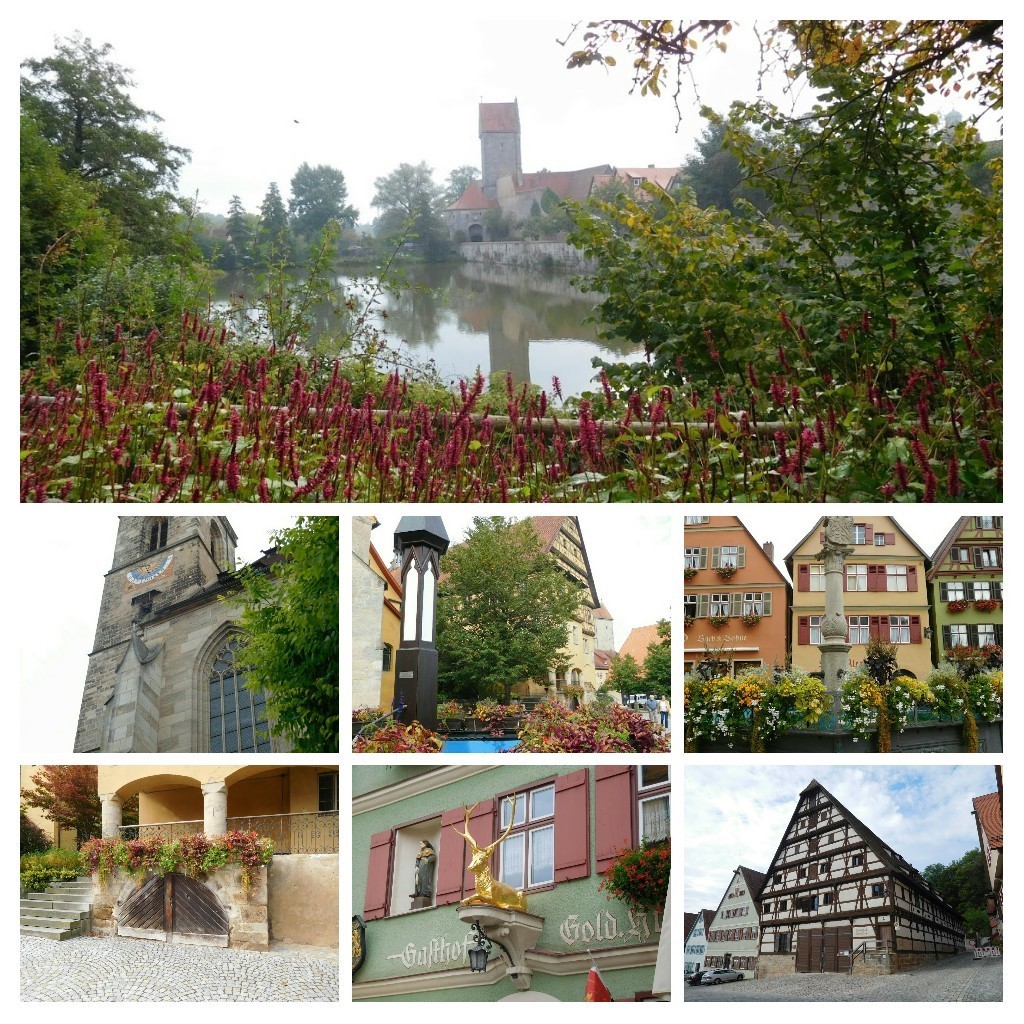
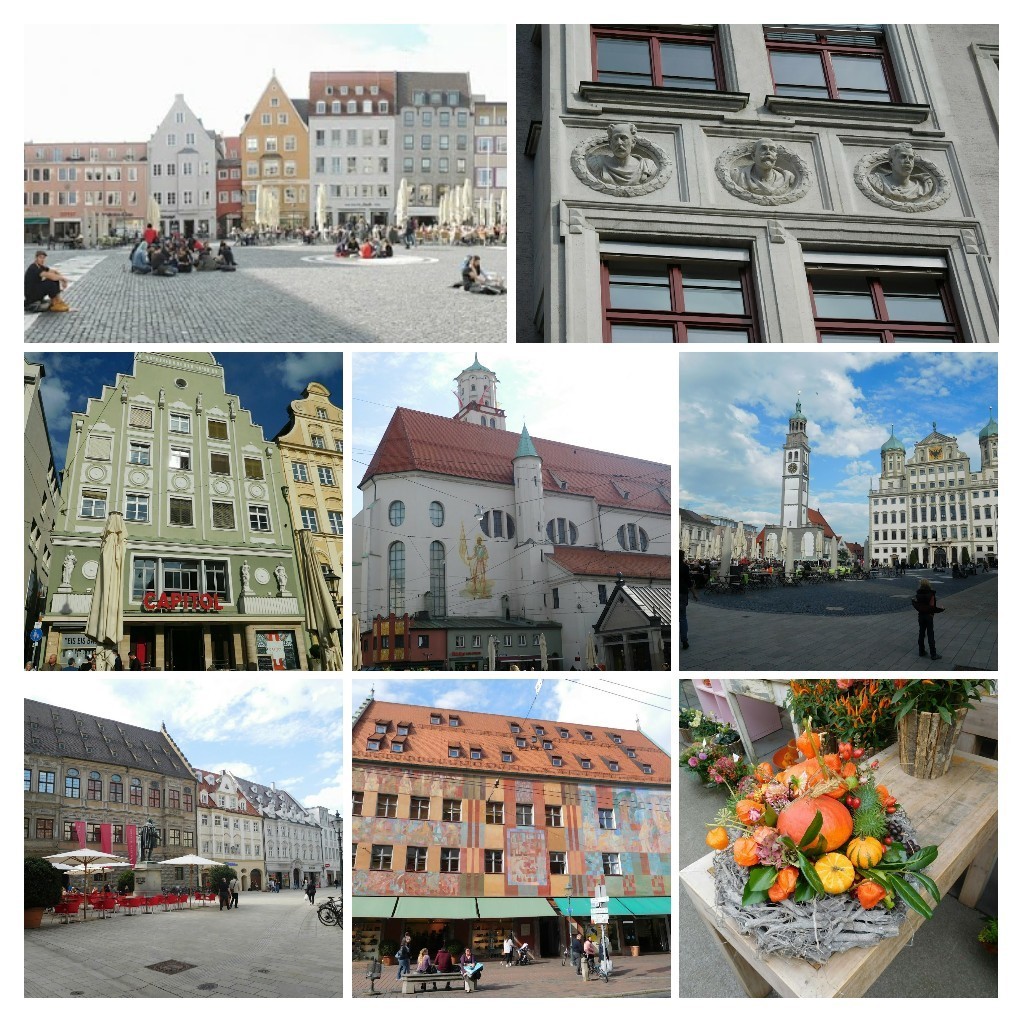
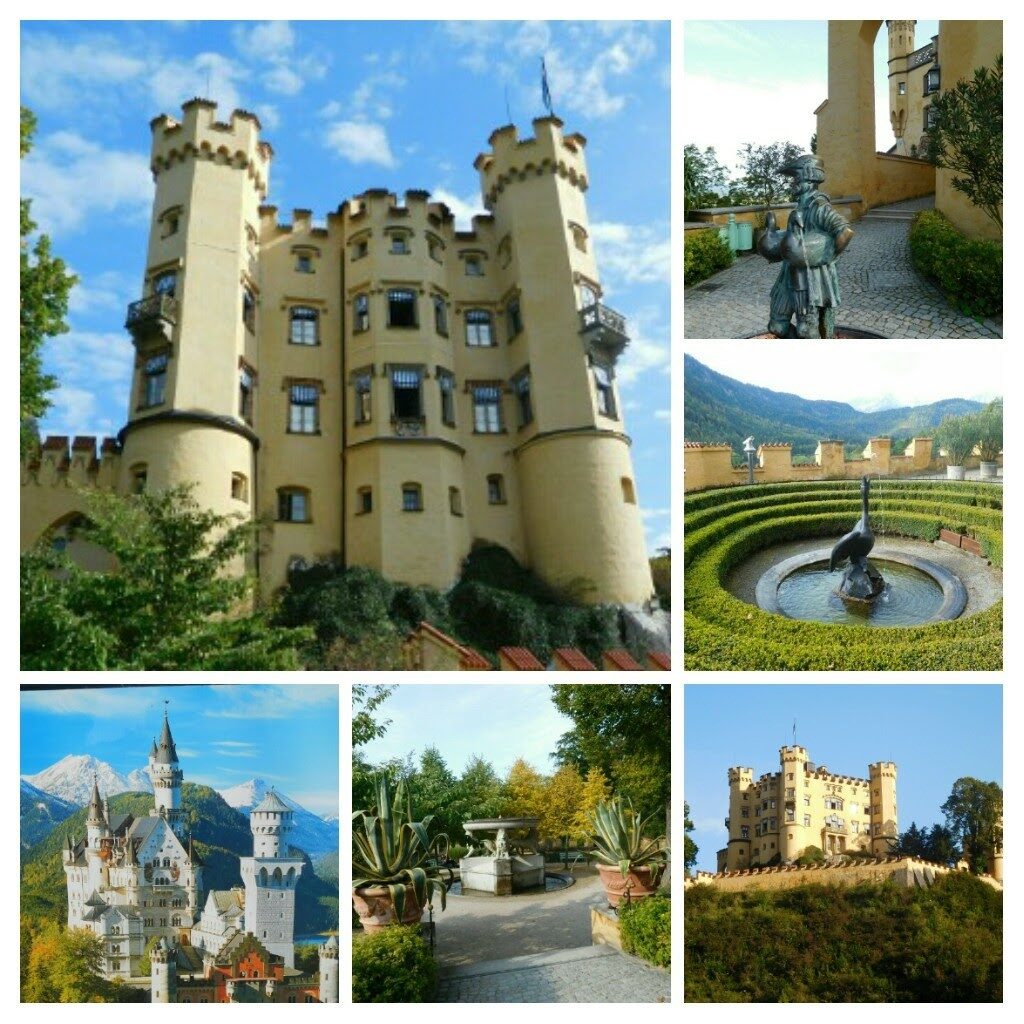
Two castles in close proximity and not enough time to view both of them as well as the museum of the Bavarian Kings…what a delimma ! The yellow castle or the castle believed to have inspired Walt Disney’s iconic symbol. After discussions with recent visitors to both castles and reading reviews on line, we decided on Schloss Hohenschwagau, the yellow castle. Self guided tours inside either castle were not allowed so we lined up for tickets. We were given the timeslot of 10am for the tour in English and so after enjoying the lush green castle surrounds, we made our way up the winding path past massive old trees to the entrance. A brochure mentioned about 6,000 tourists visit the castles daily explaining the need for the TV screen displaying the time slot numbers shown on our tickets. On the dot of 10am our tour number was flashing and the group of us went through the turnstiles to begin the 40min tour of Hohenschwangau.
This was the summer and hunting palace of King Maximilian ll of Bavaria built in the 19th century. The Gothic style castle and ornately furnished rooms are the same today as they were when the family stayed there. All the walls in every room were adorned with colourful paintings applied directly onto the wall surface depicting Medieval legends, wars and life at the time of the King. As we worked our way around 3 floors of the impressive palace with the guide, out of every window the views of the countryside were breathtaking. The castle’s nearby large aqua coloured lake is simply gorgeous supporting birdlife and amazing reflections of the snow covered Austrian Alps from just over the border…what a place to visit !!
Working our way through the museum was most interesting as we listened to the audio guide depicting the lives of the Bavarian Kings through the ages until WWll. As with the castle tour, no cameras or photography of any kind were allowed inside which means the memory of what we saw today will only be viewed in brochures and possibly on the internet.
When Maximilian died, his son King Ludwig ll who loved living in the area, designed his Neuschwanstein Castle located not far away and high above his parent’s castle. Unfortunately before the complex building design was complete, Ludwig died and never had the chance to live there. People flock to see this particular castle as it is the exterior that everyone recognises (Cindarella’s Castle at Disney World) even though reviews state the interior of the castle is inferior to the yellow castle.
Shortly after leaving the castle we crossed into Austria, our 9th country and headed to Innsbruck for a 2 night stay.
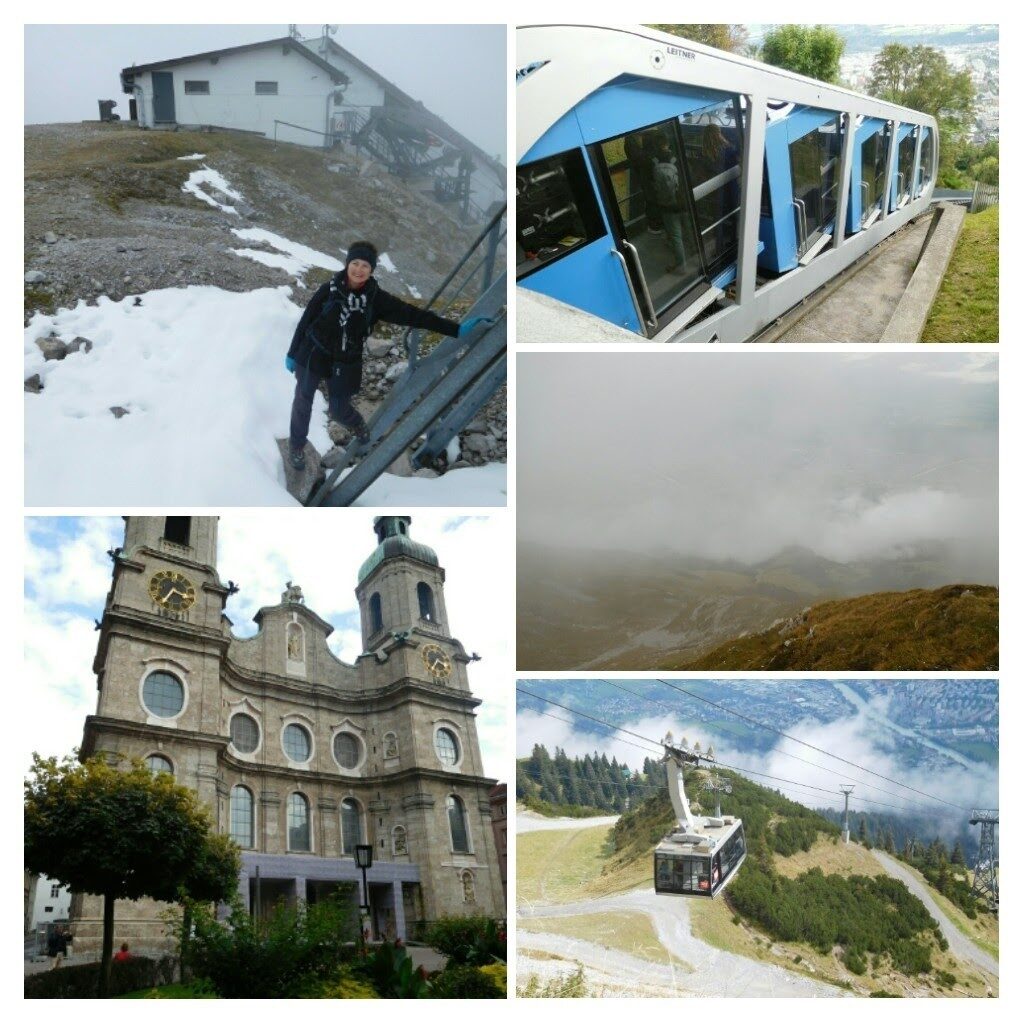
Our lovely accommodation is quite rural and about 10km from the city centre so we drove into town to have a look around. The Inn River is not as wide as other rivers we have seen but it snakes around the city, is fast flowing and milky blue in colour.
The Old Town area was full of tourists enjoying their Sunday morning, cameras in hand capturing the interesting sites. We walked around admiring the architecture and the quirky adornments and frescoes found on the sides of some of the buildings. In the main shopping area we noticed the old buildings had covered over walkways offering protection for the public from the elements. The streets in the Old Town formed no particular pattern and often curved in a way to show the interesting facades ahead and sometimes a bustling square coming up. Cafes and souvenir shops were everywhere.
With Innsbruck located at the base of a mountain it offers all kinds of activities for the sightseer and the adventure lover. The Nordkette is the southern most mountain chain of the Karwendel and is part of Austria’s largest nature park. The range of mountains are located just north of the city and are extremely steep, heavily wooded, rugged in places and snow capped.
We had decided to head to the mountain top for a view over the city but the main issue was the moving cloud cover. All morning we had been watching the weather conditions whilst walking around the town hoping the top of the nearby mountains would be revealed. Would this be another disappointing adventure like Pilatus Klum in Switzerland when the blue ski changed to white 5 minutes before we arrived at the top ? Was the hovering cloud going to be kind to us ? We thought what the heck, regardless what we find it is all about the experience.
After purchasing our tickets, we caught the Hungerburg Funicular from Congress Station in the old town up to Hungerburg in just 8 minutes. We had crossed the Inn River, travelled through a couple of tunnels and continued up the first section of the very steep ride. Arriving nearly half way up at 860m above sea level, we were lucky there was no cloud cover to spoil the 180deg views of the city and surrounding countryside from the viewing platform…what a photo opportunity ! Some travellers stayed here to enjoy the restaurant, cafe and museum that this stop offered.
To travel to the top of the mountain we then had a short walk to the nearby Nordkettenbahnen cable car station with fingers crossed for clear weather. We put on our jackets, gloves and hats in preparation of the coolness of the summit. In the cable car (gondola) with us were walkers with poles, dogs, cyclists and sightseeing hopefuls. I have read the mountain also attracts paragliders, rock climbers, downhill mountain bikers, freeride skiers and snowboarders…all crazy people.
The views from the cable car were great and varied. Below in the distance was the city, immediately below us again was a wide clearing with hikers, runners and cyclists traversing the extremely steep terrain via the narrow uneven tracks or the switch backs, and then above us was cloud…bugger ! As we traveled a bit further we noticed a ski lift located a little closer to the top that I am sure would be busy during the winter months.
We could have got out at Seegrube (1,905m) along the way (also offering views and a restaurant) but Hafelekar was our destination at 2,256m. The air was chilly but there was no wind so the conditions were comfortable and with snow covering the ground in places we cautiously entered the viewing deck. The same kind of black birds that we saw at Pilatus Klum were also present and tame enough to be hand fed by tourists.There was cloud cover present, wispy as it was, and then after a short time the city below appeared. We were thrilled that we could see what they call the Capital of the Alps in the distance. The mountains beyond yet again were even higher than us and eventually our patience paid off to see their snow capped tops free of cloud. Photos will capture the moment but the depth perception of what we saw can only be appreciated in person.
Had the day been even clearer, we would have had 360deg views and been able to see more of the nature park on the other side of the mountain we were standing on, but fortunately it was clear enough to walk the short paths to viewing points dotted around the summit. The changing conditions offered us something different to experience the further we explored. It was amazing how fast the cloud cover opened up to expose an area and then rolled back in within moments totally blanketing the same area. The contrast of the surrounding bare rock face, green grass and snow deposits gave a magical feel to the whole experience.
Shortly before we decided to leave we were on the terrace at the nearby cafe and noticed a downhill cyclist answering questions whilst preparing for his decent. Mentioning his actions were crazy, an Australian accent was then detected and moments later he took off down the steep slope ! The slippery, rocky surface was just what a thrill seeker would wish for and the mountain offered this. Just prior to boarding the cable car for our return journey, a guy with a unicycle got off and immediately proceeded to accept the challenge of the mountain also…even crazier than the Aussie !
We spent well over an hour in total at Hafelekar experiencing an impressive view of the surrounding countryside and a lasting impression of Innsbruck and Austria.
Check-in was not for another 3 hours so the first stop was to the nearest shopping centre to find a hairdressers for a much needed hair cut. Four weeks is the general turn around for a hair cut at home but before we left in early August, we both chose a closer cut than normal for ease of being on the move whilst overseas. We were lucky enough to walk into a salon without having to wait and before too long the transformation from the 7 week woolly look to a more familiar style was taking place. To our surprise we have now found out that the European #2 clipper comb gives a closer cut than the Australian #2 clipper comb ! Hey, what can you do when one side of the head has just been clipped amazingly close to the scalp but to continue onto the other side to achieve balance. We left the salon hoping the nearly exposed scalp would not suffer possible sunburn !
The language barrier was fortunately not as bad as it could have been as my stylist could speak 5 languages fluently and 2 not so…English being the latter, but we coped. It could have been a similar problem to the hair cut we had when last in Europe in 2015 when the staff could not speak English and we could not speak Italian. Hand gestures and help from some other nearby patrons were all that got us through.
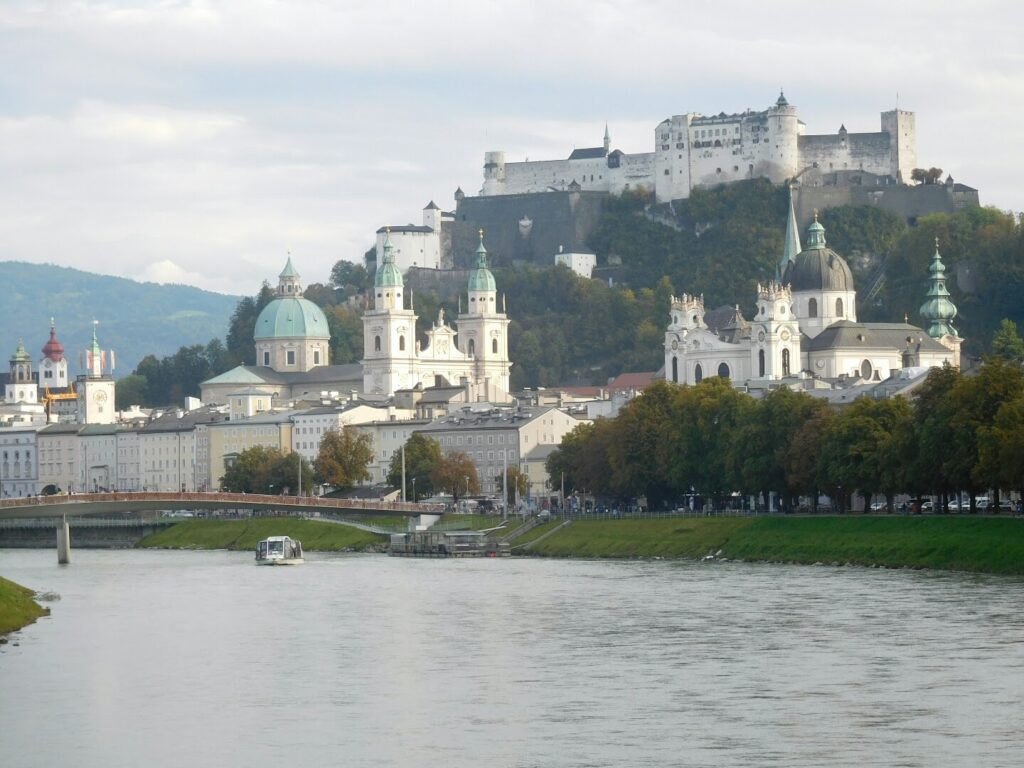
After a bit of pampering we were again looking a million dollars (or Euros) so it was now time to take the bus a short distance into town. The pretty city is cut by the Salzach River, again wide and fast flowing, and the many close by bridges made it easy to cross to either side. As we started to walk around we noticed a few of the squares near the Dom Cathedral were packing up after celebrating St Rupert’s Day Fair over the weekend just gone…being one of their biggest traditional festivals of the year we unfortunately missed it by a day.
Salzburg’s architecture throughout the Old Town is varied and consists of Gothic, Renaissance and Baroque styles. The amazing shopping street Getreidegasse is quite long and full of interesting and some very classy shops. In the past most of the population were illiterate and so the symbols that hung outside over the door of the building indicated the business inside. Today this tradition continues especially in this street although now the retailer’s name hangs out on a bracket making it self explanatory. The golden arches of McDonalds is one that is easily identified and evident by the number of patrons inside.
The Hohensalzburg Fortress is located high up on the Festungsberg hill and is the most imposing sight visible from anywhere you are in Salzburg. At an altitude of 506m the castle is one of the largest medieval castles in Europe which began as a fortress in 1077. The first very basic design had a wooden wall but expansion of the castle continued to occur over the centuries until the mid 1800s resulting in a present day rabbit warren. We took a guided audio tour of part of the castle to inner rooms, the torture chamber and lookout tower before we then wandered around museums, interesting displays and areas not otherwise blocked off and presently being maintained. The accessable viewing areas we found that look over the city in every direction have sheer drops immediately below making scaling the walls impossible.
Since 1892 a funicular (Festungsbahn) has been operational down the side of the castle, originally driven by water but has since been electrified. The steep incline to the castle gates was a challenging 10 min walk up steps and then a slippery rubble surface but the ride down to the town was only 1 min in the funicular !
Around every every corner in the town there seemed to be a church (and we visited many) or museums but St Peter’s Cemetery and The Catacombs were certainly something different. The oldest tombstones dates to 1288 with the central burial plots having metal ‘head stones’ and not the traditional ones made of stone.
The hills are alive with the Sound of Music…..yes we researched the availability of the tour before we booked our accommodation in Salzburg to avoid any disappointment…and we weren’t…it was most enjoyable.
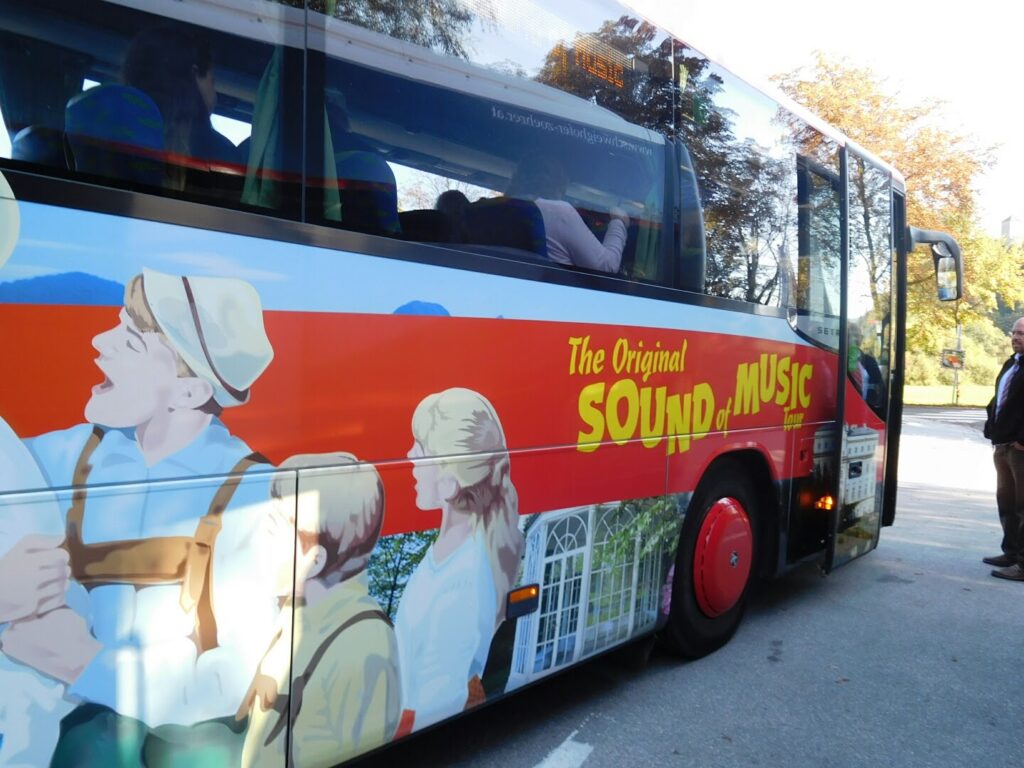
Mirabellplatz was the meeting place for our tour which was only metres from the Mirabell Gardens where ‘Do Re Mi’ was sung on the steps during the film. The large coach was completely full with 60 tourists from many continents and weirdly enough 4 sets of seats, all behind each other were from Australia – Brisbane, Melbourne, Sydney, Perth and us with a couple of random others toward the back. How could this have happened as we lined up before time and then randomly sat on board !
The 4 hour coach tour took us to all the historical and architectural locations used during the filming of the movie in and around Salzburg along with lots of funny and interesting anecdotes from the tour guide. Set in 1938 the 1964 Sound of Music movie showed in Austria for only 3 days then closed due to lack of attendance possibly due to the fact that it was an American musical based on a true story which the Austrians already knew !
After visiting the many picturesque places and eating the tasty apple strudel recommended at Frau Braun’s cafe in Mondsee, it is now time to re-watch the whole film again to appreciate the local scenery and how Hollywood manipulated what was not there.
Another tour we enjoyed was the trip to the Salt Mines to understand why they used to call it ‘white gold’. We had an early start heading to Germany by the old border crossing and travelled through the Bavarian Alps on the way to Obersalzberg and the salt mines.
On arrival we donned traditional miners’ overalls and entered the mountain straddling the seat on a little train travelling 650m inwards to experience the continuous mining of the 500 year old mines. With a constant 12 deg C, we made our way through some of the many tunnels with the audio tour and computer generated graphics informing us of the interesting facts about the underground world of mining salt over the years. In 1900 they manually cut into the rock face progressing 6cm each day and in 2000 the use of machinery had increased it to 2m per day.
Twice during the tour we descended further into the mine by sliding in groups of 4, down a wooden slide consisting of two 40m long parallel rounded beams just as the miners did 500 years earlier. We took a raft ride on the 100m x 40m underground mirror salt lake which is 2m deep and located 130m below the surface. After the 1 1/2 hour tour we boarded a funicular for a ride back to the waiting train for a further ascent of 600m back to the entry. The guide’s English was not fantastic so unfortunately asking questions about the experience was a little difficult.
We later stopped for lunch in Berchtesgaden which was a quaint little town and whilst walking we found a quote on a bakery window being close to our hearts-
‘Dessert is like a fell good-song…the best one makes you dance’ (Edward Lee)
We took a difference route on our return to Salzburg through countryside where the trees were starting to turn with the approaching Fall and had the opportunity of a glimpse of Hitler’s Eagle’s Nest perched high on a summit.
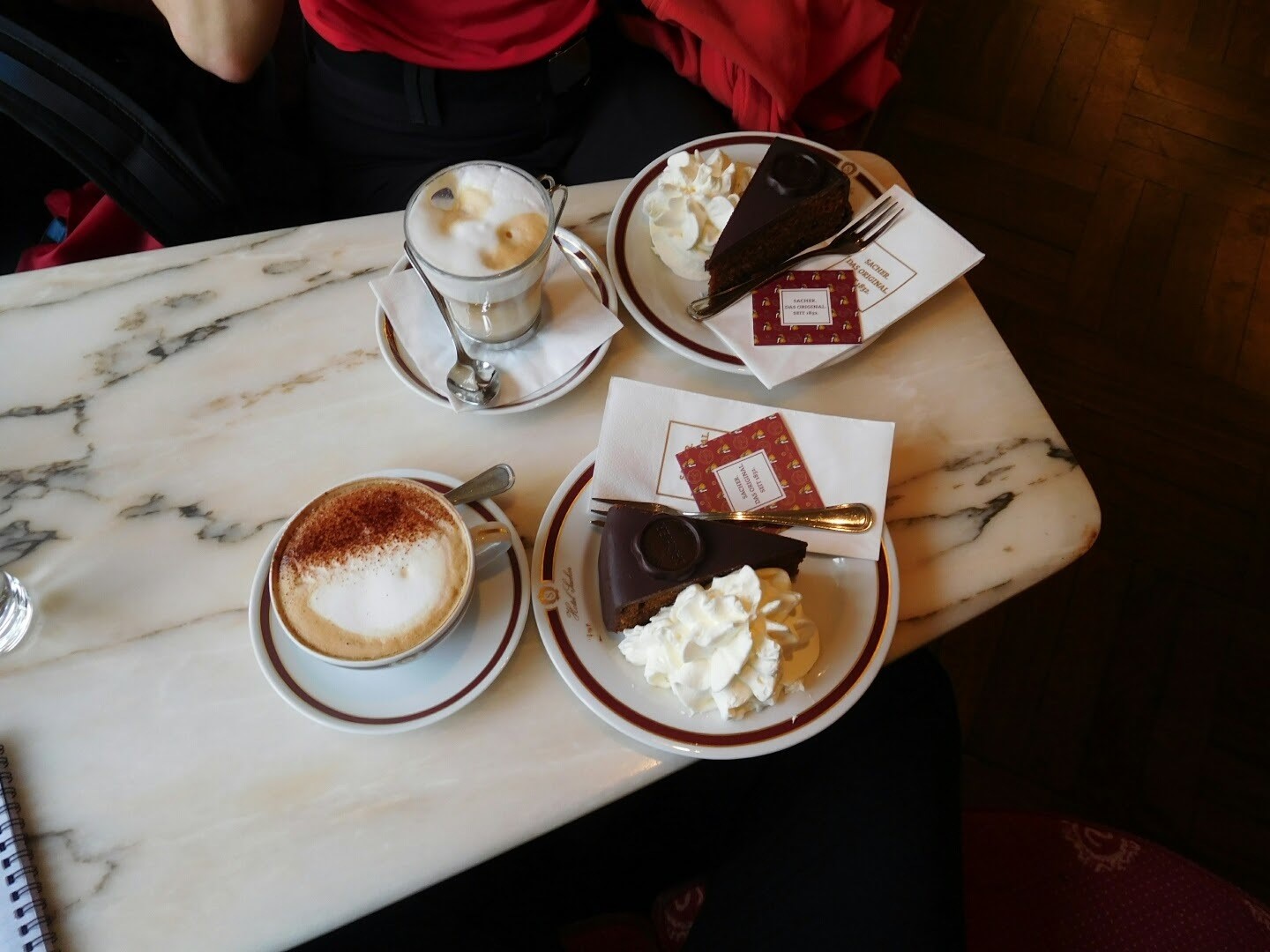
Before walking back to our hotel for a catch up of things before we leave for Bled tomorrow, was stopped at the classy Hotel Sacher Salzburg for a world renowned Sacher-Torte…very nice.
The drive from Salzburg to Bled took us across the border into Slovenia whilst we were actually travelling halfway through a 7.8km long tunnel. Unlike crossing into other countries, there was no obvious border signage which meant that this was a missed photo opportunity.
The previous 5 days spent driving around mountainous Austria was definitely made easier with all the tunnels we used along the way. Fortunately we had purchased a 10 day road toll pass, called a vingette, when we first entered the country so the 28 1/2 tunnels we travelled cost us equivalent to A$13.50. What a bargain.
Now in Slovenia, another toll pass was required so we purchased the 7 day minimum for A$22.50 at the first petrol station we passed after the border.
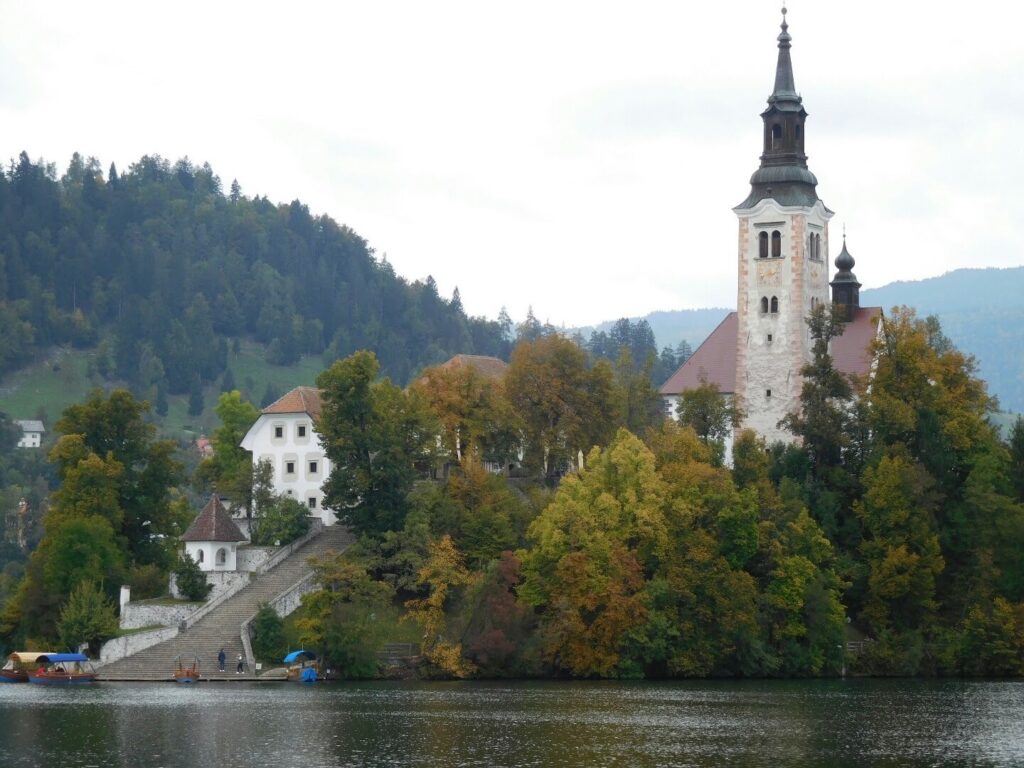
Bled is known for its pretty glacial lake which is 2.12km x 1.3km and 31m deep. We spent part of the afternoon walking around Lake Bled’s 6km long walking trail which offered great views over the island and Bled Castle.
From the shore line we could see the island’s lush green perimeter which partially covers the church, a bell tower and other small buildings but the 99 stone step staircase is very visible and impressive rising out of the water heading up the side of the island.
We chose not to venture over, but to reach the island you could either hire a row boat and row yourself or ride on a flat bottomed Pletna boat, a style specific to Bled with its origins dating back to 1590.
Instead of a boat ride we decided to head to the local cafe to taste the famous Bled cream cake, recommended by an Aussie tourist we met in Salzburg. Anyone may think we are eating our way through Europe trying all kinds of cakes and pastries specific to an area…why not !
The popular cake has a flaky pastry base, a layer of vanilla custard then a similar depth layer of whipped cream, topped with more flaky pastry and finally dusted with icing sugar.
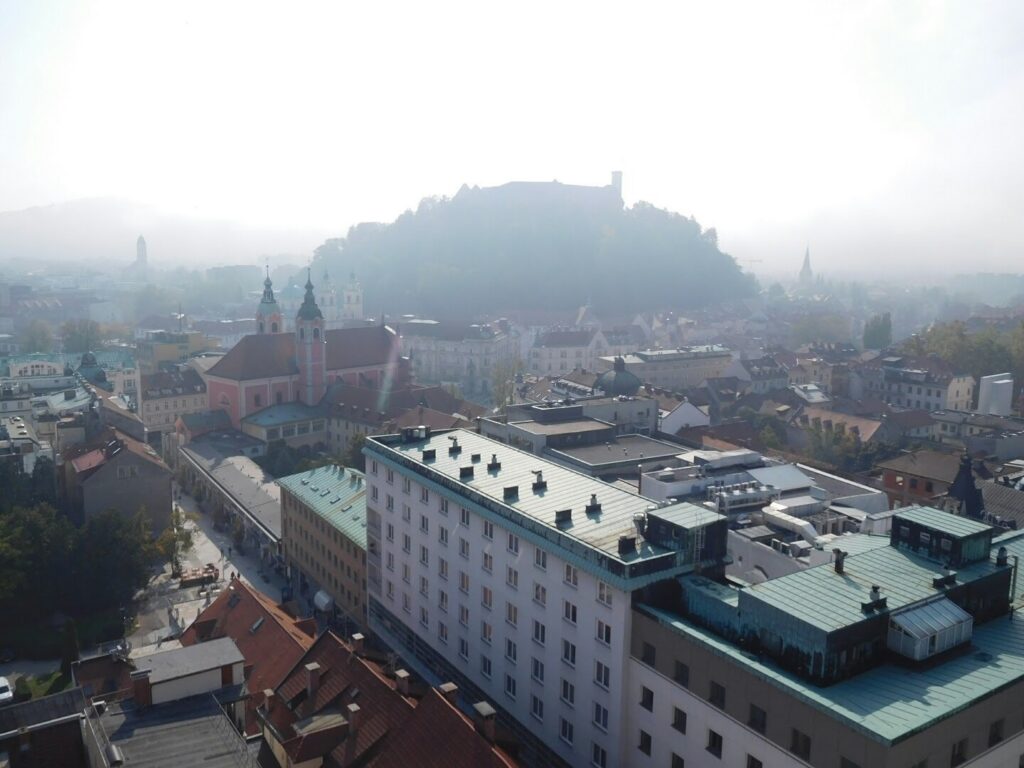
We crossed the Ljubljanica River over the Triple Bridge which took us into the Old Town and an interesting selection of market stalls awaited us immediately on the other side.
The food smells were fantastic from stalls offering a wide selection of hot street food, sweet delicacies and drinks. There were fruit and vegetable stands, flowers, craft, clothing and shoes. The crowds of people were everywhere moving slowly and checking out everything on offer.
We were in a city that had a castle so we made our way up the funicular to check out the Ljubljana Castle perched where else, but high up on the hill. After years of demolition, changes and renovations to previous older buildings on the site dating back as early as the 11th century, the present castle design was a result of building occurring in the 15th, 16th and 17th centuries.
The audio guide offered interesting information as we wandered around for 4 hours to the different areas of the castle, with the highlight being the watch tower which now offered clear views across the city.
The castle has been a military fort, seat of Provincial authorities, prison and social dwellings for the poor but now accommodates conferences, cafes, restaurants, cultural displays and a history of castle experiences over the years. It’s present appearance since it’s revitalisation is a modern twist on an old fashioned castle that allows access to all levels by stairs and lifts for all ages and capabilites.
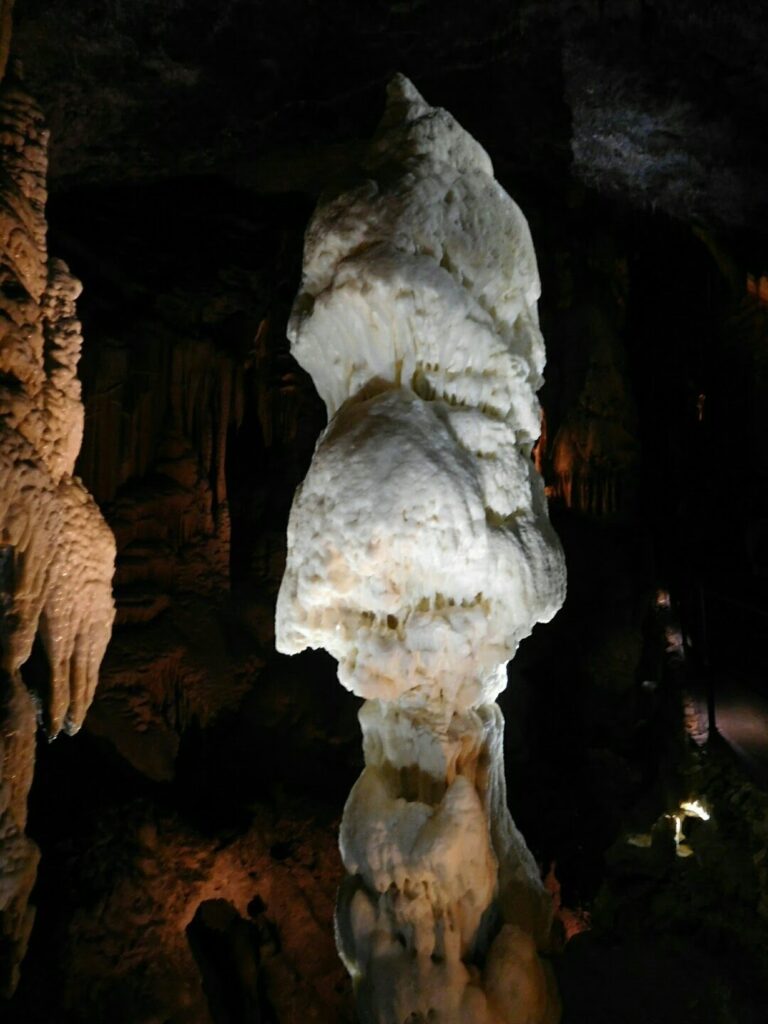
We arrived at the Postojna Cave complex and had the option of visiting any of the 4 attractions which included the Postojna cave, subterranean animal display, interactive history museum and the castle. We chose all options but visiting the castle even though it was different to any other castle as half of it is built into a cave and half outside.
The animal display and history museum were both extremely interesting where they collectively linked the story of the beginnings of cave formation and the inhabitants. We spent quite some time wandering around trying to absorb all on offer.
The guided tour of the cave started with a 15 minute open train ride taking 120 visitors at a time 2.26km into the mountain. Initially we passed through a few rock tunnels which then immediately opened up to spacious areas of the cave displaying all stages of stalagtites, stalagmites, columns, curtains, crystal clear ponds, etc, etc. One area not far in was the spectacular ball room where many chandeliers hung from the ceiling in a big open space used for balls and musical performances. Travelling by train enabled us to cover more areas throughout the cave before we alighted and were given an overview of how the cave system began. The guide took us through 1.5km of very well designed and wide walkways as we marvelled at everything around us. The scale of the attraction was far greater than we had ever experienced before. The colours of the abundant cave formations were varied due to impurities carried in the water as it found its way through the ceiling openings over the years and unfortunately man’s impact can be seen during a time when entering the cave was not regulated.
After 1 hour of exploring on foot, we caught the train back to the surface thoroughly enjoying the entire experience.
The caves were AMAZING !! Enough said.
We drove onto Sezana for the next 2 nights.
Postojna Caves overview…
- longest show cave system in Slovenia with 24.34km of cave passages
- 115m deep 2nd longest cave system in Slovenia (Migovec System 37.2km, 975m deep)
- volume of cave passages measures 1.7million cubic metres
- subterranean flow of the River Pivka links all of the once thought to be independent caves to form the Postojna Cave system
- ceiling thickness ranges from 30m-110m
- 11deg C constant temperature in the cave
- natural air flow from multiple cave openings and high humidity
- 1818 the value of the cave was acknowledged
- 1819 organised tourism occurred and a show cave was set up when the passages were linked together to form a single cave by way of a footpath and the Russian bridge
- 1872 railway tracks laid for a 4 person carriage hand pushed by a cave guide
- 1904 electricity replaced candles and oil lamps
- 1924 1st petrol powered locomotive to carry 20 passengers
- 1956 battery powered replaced petrol trains due to emissions which were damaging formations. Batteries still power the 6 trains today which can transport up to 14,000 visitors each day around the cave
- 1945 increase in numbers of visitors post WWII
- 1967 circular double track railway built along with a hotel and catering
- 1819 there were 104 visitors
- by 2016 there have been 37,000,000 visitors
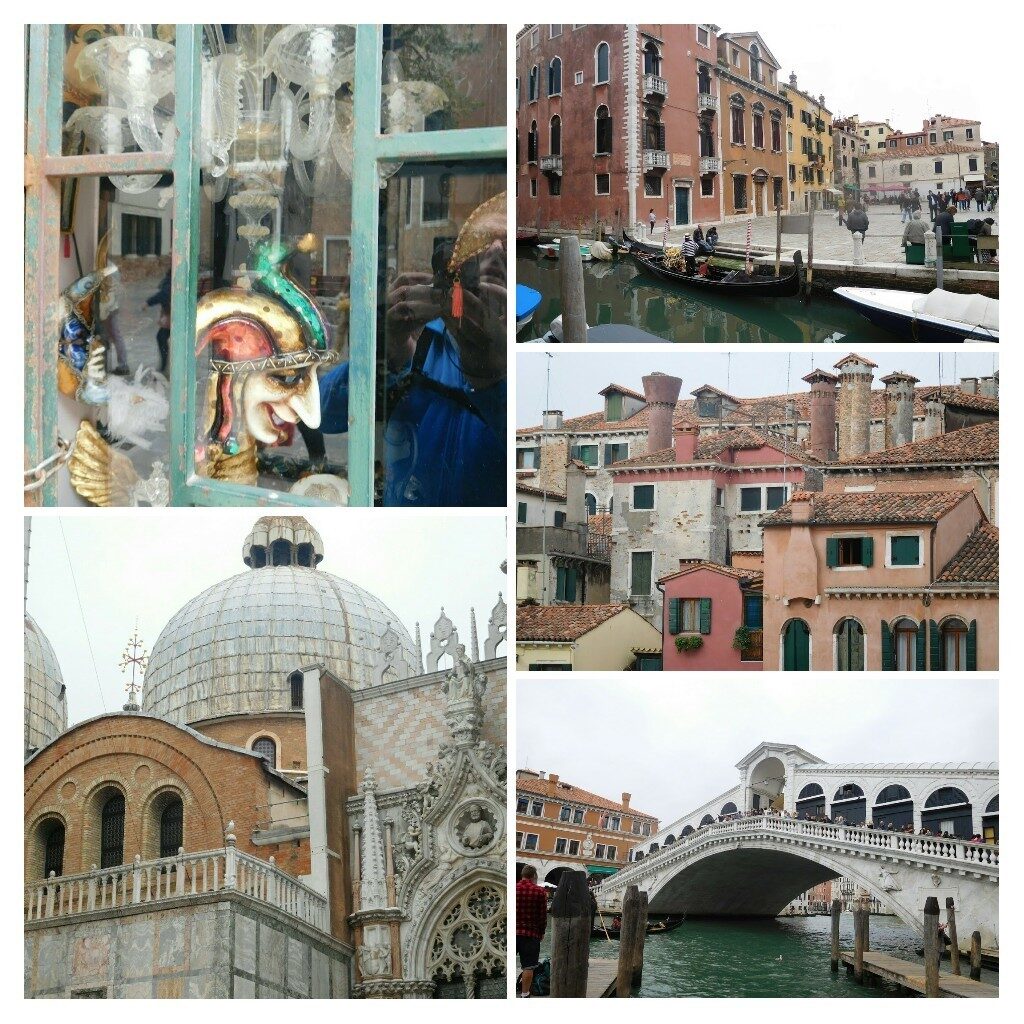
After a 1 1/2 hour train trip we arrived at the Venice Santa Lucia station and obtained a map from the first hotel we passed.
Mental note…next time bring the map from home or buy another coloured map, as photocopied versions are definitely not clear enough to navigate with.
Our return journey time had been chosen so we knew we had 10 hours to look around Venice and being a Sunday we anticipated a crowd. Arriving early we found it easy to meander through a maze of irregular streets, squares and bridges but as the day progressed the number of people increased and the pace reduced.
With our limited time we chose not to travel to any outer islands this visit but stay around the centre. Nothing had changed since we last visited in 2015 and fortunately again we were not inconvenienced with flooding due to a high tide (due in a week’s time though) where elevated walkways are erected to allow access over the lower lying areas. We were also pleased to find the Rialto Bridge was not under repair this time so we were able to cross it and enjoy it’s elevated view over the Grand Canal and surrounding cafes and shops.
It was enjoyable revisiting Venice again, agreeing that Farini makes the best pizza slices, Fanny has the best selection of gloves with JB Guanti Gloves coming in second, the Italians know how to make pasta and people watching whilst drinking coffee is an interesting past time.
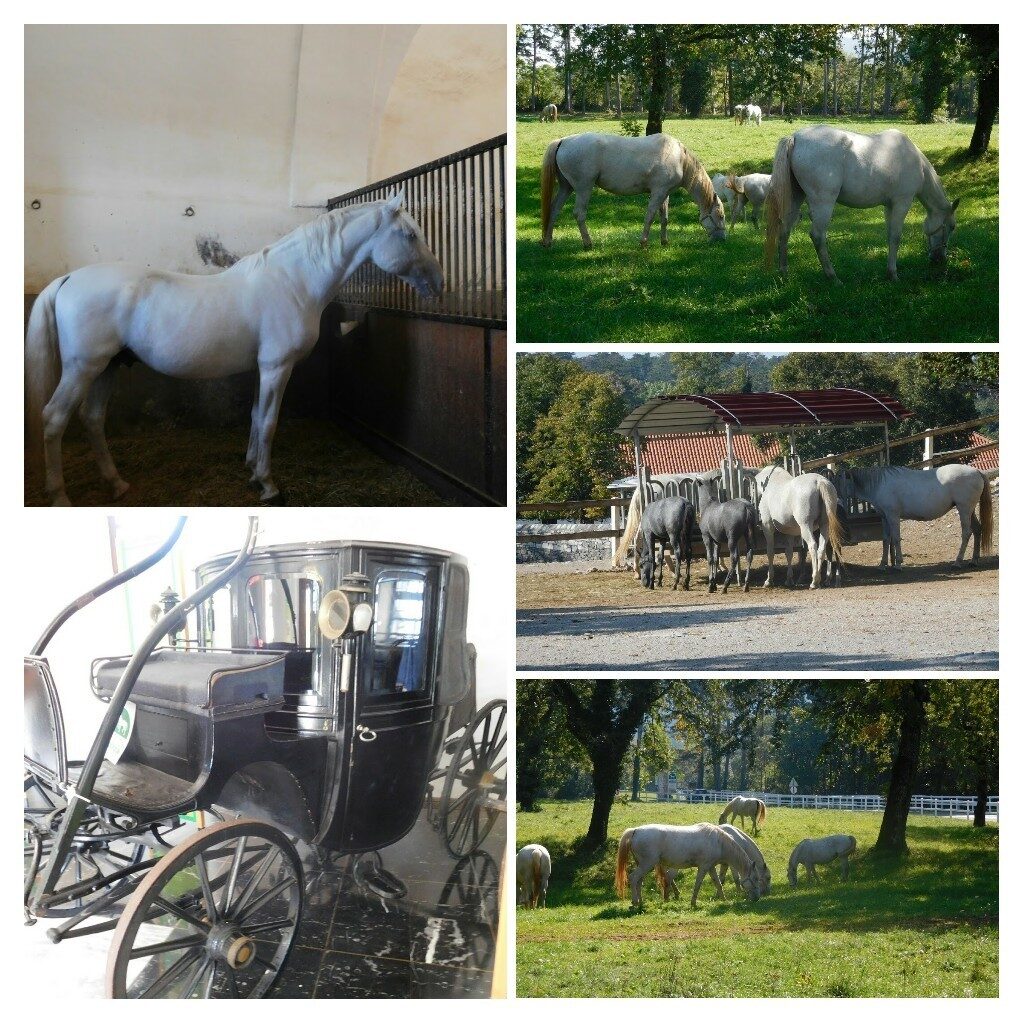
The Lipizzaner horses are also bred in other stud farms around the world and in 1975 they came to Australia for the first time. Today Australia has around 500 Lipizzaner horses which is about 10% of all those worldwide.
The horses in Lipica are bred with the stallions only being trained ultimately for dressage. Each year about 8-10 most promising stallions aged 3 1/2 are schooled for 4-5 years when they learn accurate movement, different forms of walks, turns and jumps. There are different levels of schooling such as the Classical Riding School, High School, and if the stallion has what it takes, then the School Above the Ground is where they learn the aerial kicking or capriola. Those stallions capable of mastering all the required elements perfectly usually have achieved this skill by the age of 10 years. They generally perform until aged 20 and are known to live for another 10 years, which is 10 years longer than the general horse population.
Mares prior to foaling and those stallions who don’t make the grade, would be trained and used for special events and for pulling carriages. A mare with all the right qualities could have up to 10 foals in a lifetime and after the first foal is born, she no longer ‘works’ but has a more leisurely life at the stud farm.
We saw the oldest and best performing stallion who was presented to Queen Elizabeth II who, at Her request, asked that he be left at the Lipica Stud Farm for a life time of care. Positioned at the end of 8 available stalls in the grander stable, he has the largest stall area and this location also gives him the opportunity to look across then at the other stallions ‘beneath him’. When he is led out into the yard past where the mares are stabled, we were told (and watched him on a film clip) how he prances along and puffs out his chest like a show off !
A tour guide initially took us around for an hour to the different areas of the stud farm and then we had the opportunity to continue on our own enjoying the horsey experience. The carriage and Lipica museums, the different stables, training field, horse yard with the white mares and their black foals, and the grazing pastures were all fascinating in helping us better understand the Lipizzaner horse breed.
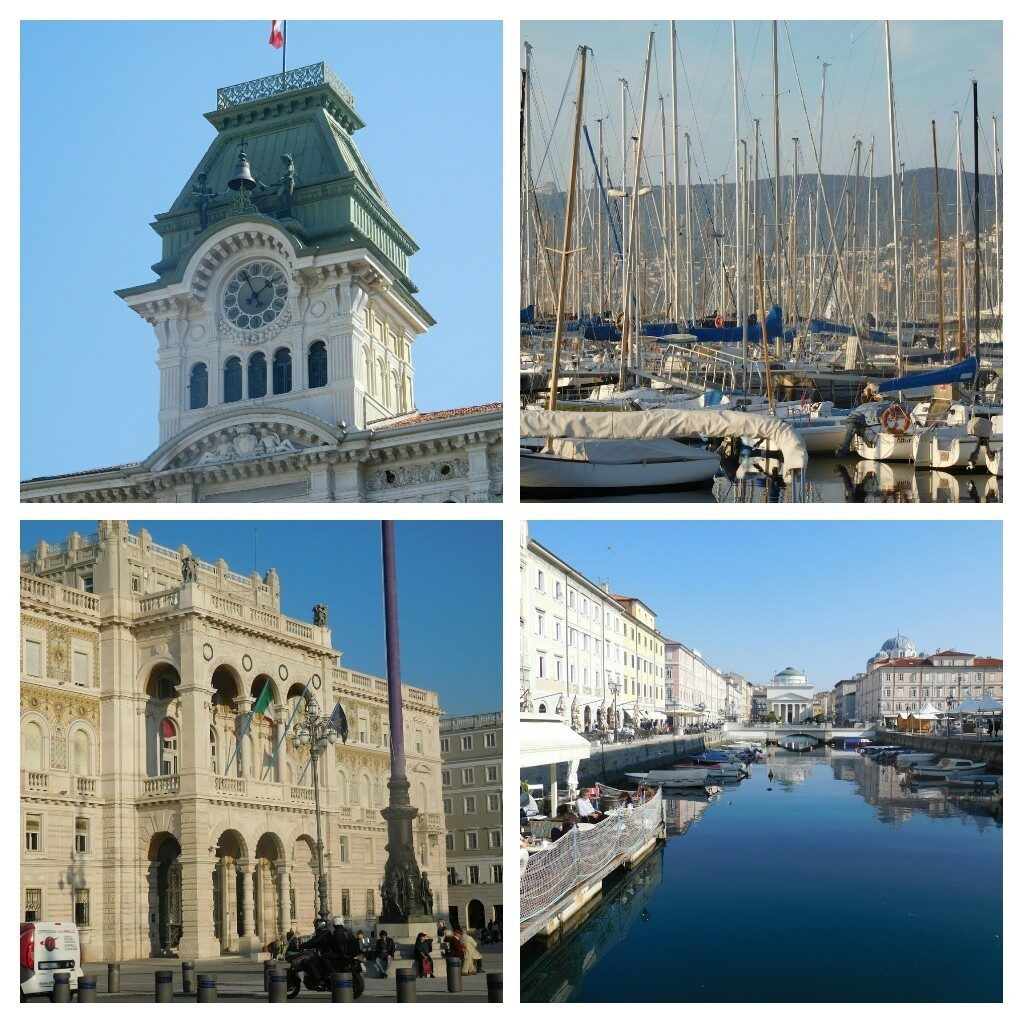
What we did enjoy was the long walk along the water front past the marina and the many old maritime related buildings. There was a sea of sailing boat masts as far as the eye could see and boats with motors upped the numbers in the marina. One unusual thing we noticed was the lack of any sea birds around the port and the water was glassy without any obvious current. Along the shoreline there was a hive of activity setting up 45 or so marquees for Trieste’s historic international sailing event the Barcolana Regatta for next weekend…trying to find a car park then I am sure will be a nightmare.
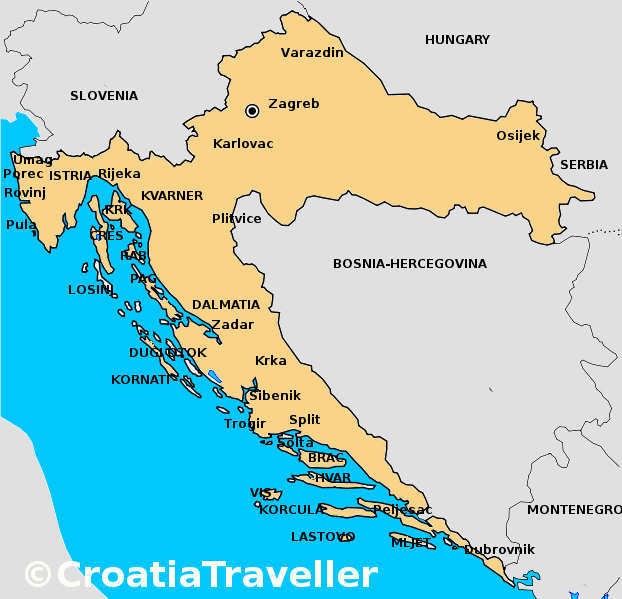
Whilst in Trieste we met some New Zealanders who suggested a couple of towns to visit in Croatia and so we took their advice and headed off today with no final destination or accommodation organised.
Not long after we were on the road we approached what looked like a toll station but was in fact border control. Two booths were located close to each other along the drive-through lane with the word STOP indicated on the ground adjacent to each booth. With cars following behind us we moved forward to the front booth and were asked for our passports. Unaware of the protocol, the passports were then handed back to the police in the first booth before being returned to those in the booth next to the car. Because Croatia is not part of the European Union where countries have open borders, Slovenia had to first stamp the passports before Croatia could process our entry into the country.
Porec was a quaint sea side town located on a small peninsular jutting out into the sea. We spent a couple of hours walking around the narrow cobblestone streets, along the paved foreshore and past the many moored yachts.
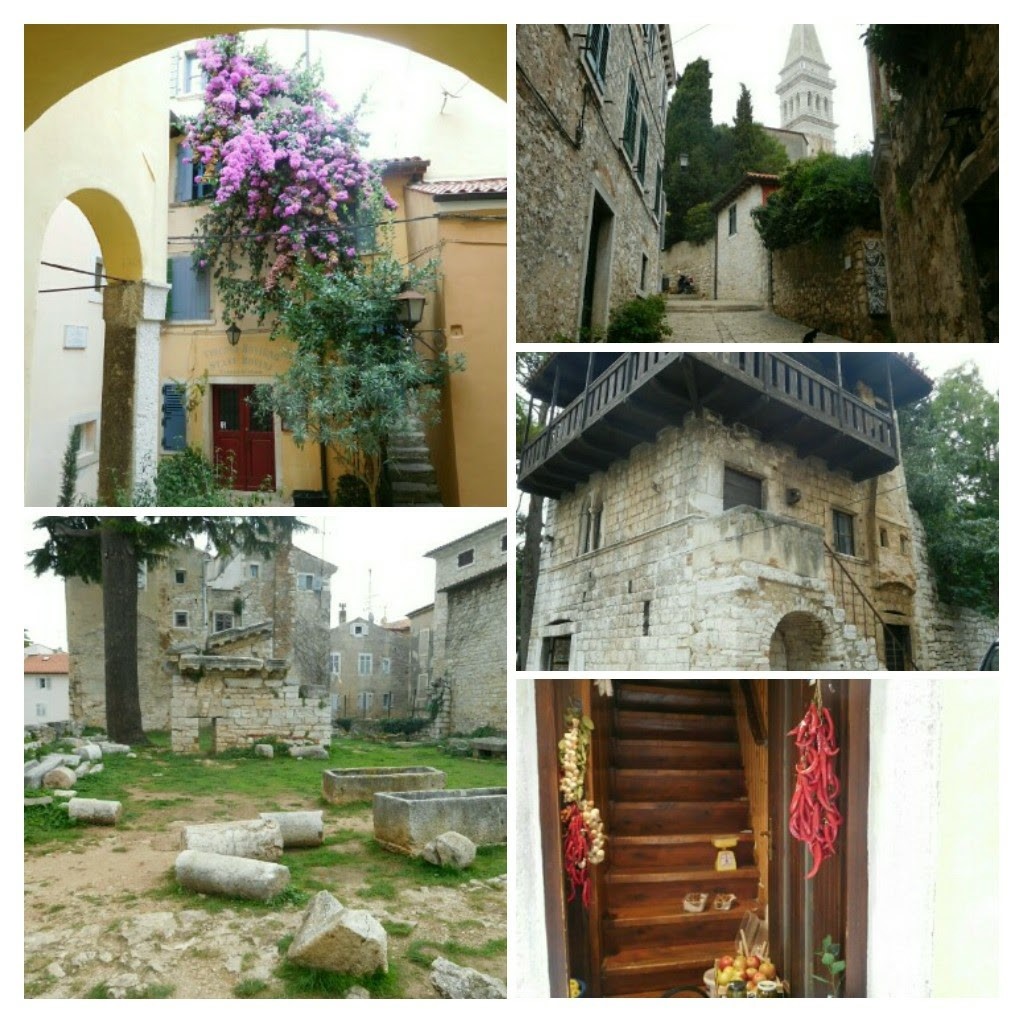
Rovinj was the second sea side town we drove into and initially had trouble finding a car park with the road works and number of people being quite challenging. We walked around the foreshore to the Old Town passing lots of small fishing boats and many out door restaurants along the way. The streets in the Old Town were for pedestrians only and had large highly polished cobblestones adding to its old world charm. Some lanes had steps and others just a steep gradient with smaller side lanes offering us a glimpse of life in Rovinj. Passing many interesting small businesses and different craft shops along the network of walkways, we made our way up to the old church at the top and for a great view of the ocean on 3 sides of the town.
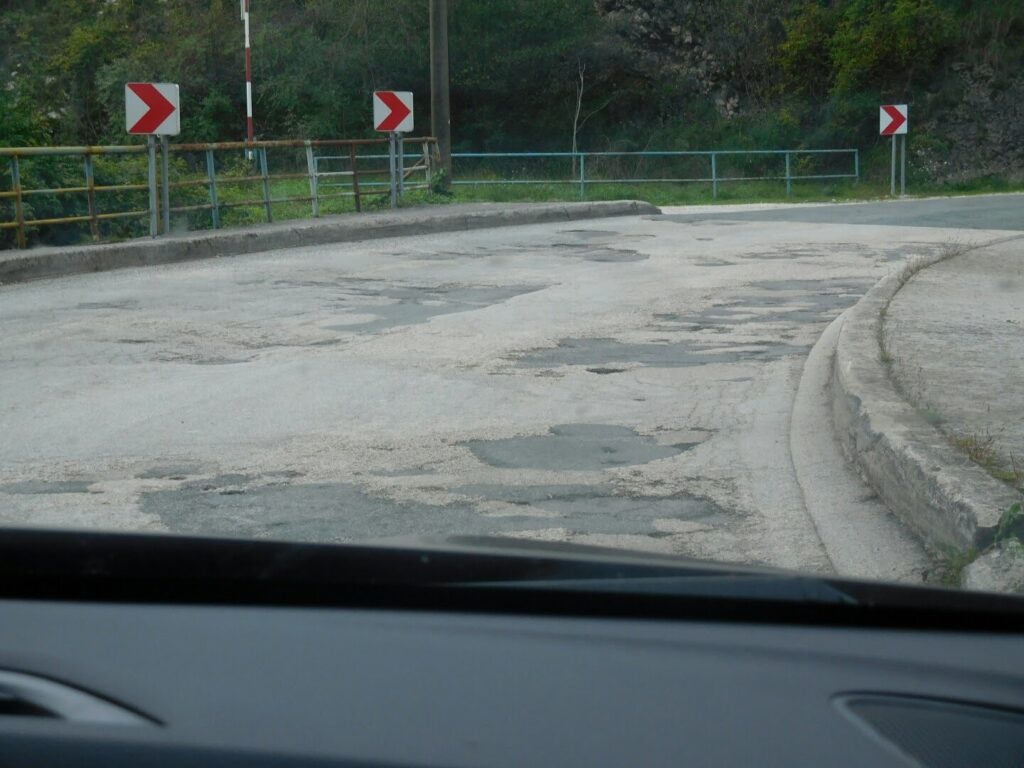
Along the motorway we could not believe the amount of signage regarding the constant speed changes, approaching road works, tunnels and what to expect at the next exit. There were flashing lights at the entry of each tunnel and sometimes traffic lights to manage the number of vehicles entering them. The rain was becoming heavier and as we drove out of one of the many tunnels, to our surprise there was a mechanical man on the side of the road in a fluro coat waving an orange flag obviously warning of the weather conditions.
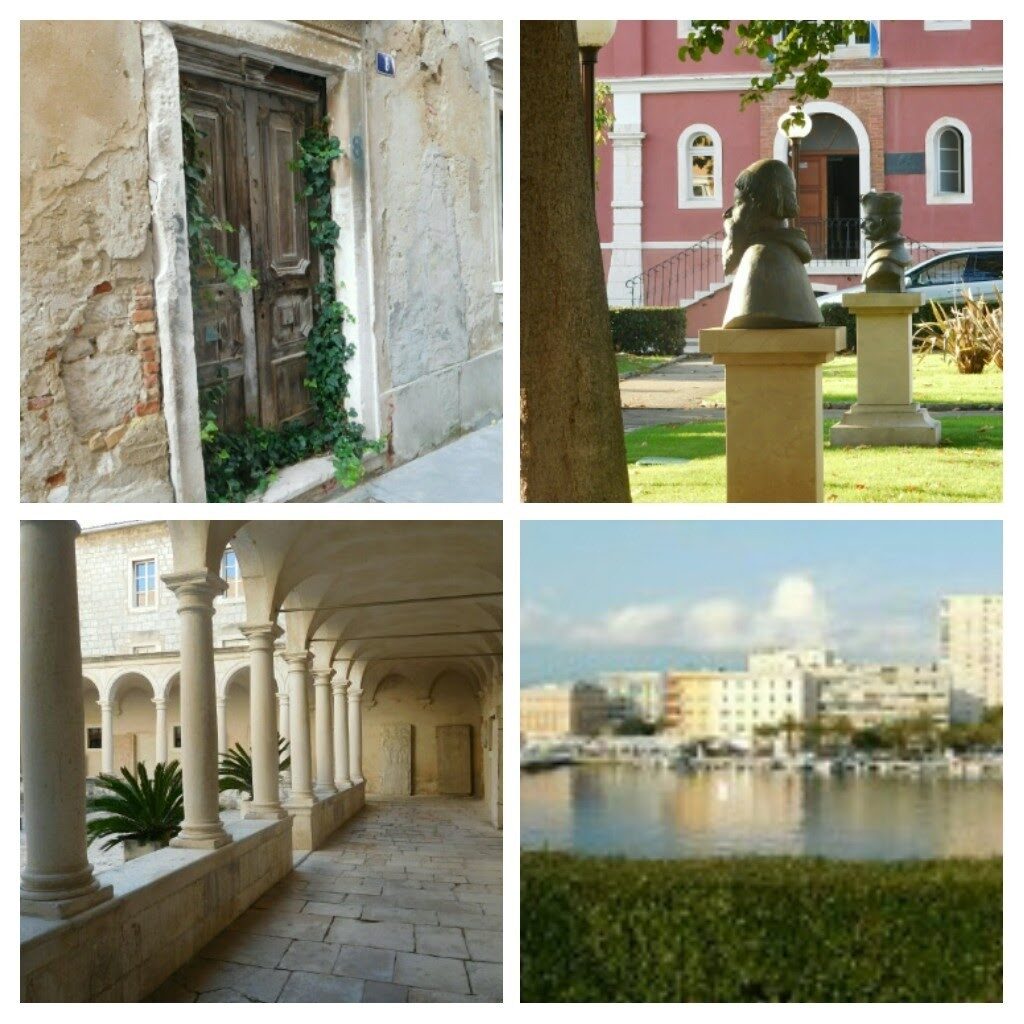
After feasting on a fantastic breakfast selection, we had a late start and drove 3 1/2 hours straight through from Opatija to Zadar. The section of motorway today was 2-3 lanes wide the majority of the way with very little traffic the entire day. Croatia so far has been quite mountainous and evidence of that was the 29 tunnels we drove through, anything from 120m to just short of 6km. The landscape one side of a tunnel could be a lush, wooded mountain side and the other side quite different. Sometimes the vegetation was then quite a bit sparcer, or even a semi barren rocky terrain.
Our 2 bedroom apartment in Zadar was very spacious and comfortable. After staying in so many hotels consisting of a small bathroom and a room with a bed and possibly a table and chair, this accommodation was big enough that we could have had a large party. The sad thing is that the size of the hotel rooms actually work OK for us and we don’t have our friends here with us to have that party.
We had an easy 1.5km walk into the city but found Zadar in general very strange. The suburban area we passed had 2 storey housing with garden yards, but as we walked toward the city centre there were many multi storey apartment blocks in very shabby condition. There was no central CBD with offices or shopping ! We crossed the bridge to the Old Town located on a small peninsular and walked around the streets visiting the ruins of the Romans and Venetians, city gates, churches and palaces to name a few. Like other places we have been to, the irregular pattern of the town streets makes navigating your way around without a map practically impossible when visiting for the day. The large worn cobblestones in the wide pedestrian walkways had become so highly polished over the centuries that when the sun shone down particular streets, the surface took on the appearance of a golden mirror.
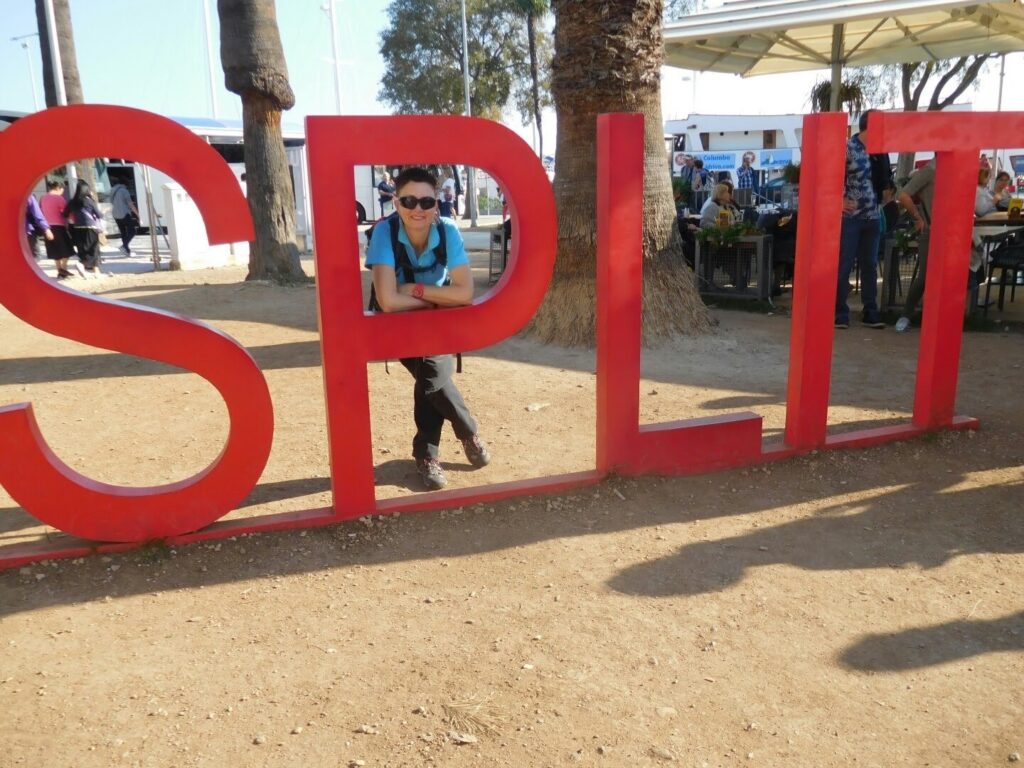
We climbed up the 60m, 12th century bell tower attached to the Cathedral of St. Domnius (regarded as the oldest Catholic cathedral in the world that remains in use in its original structure) for a great panoramic view of Split. There was so much to take in and looking down on the city itself, made it easier to see over the years how the newer buildings have been incorporated into the remaining Roman ruins.
There were 183 steps to climb, starting with highly polished stone steps that passed through the walls at the base of the tower and were so incredibly steep (about 45cm high). Once on the inside of the tower we made our way up the metal stairs that somehow clung to the inside of the tower and in places, the steps crossed the large open window spaces…a little scary ! You would not want to have an issue with heights as the very central area is void of anything at all putting a lot of faith in the fittings holding the staircase in place. The climb was worth the effort but when the feet were back on the ground, all was good.
The Palace’s imposing wall is a back drop to the many cafes and restaurants that back up to it and face the water front where again no cars have access making the stroll down ‘The Riva’ or promenade very easy. The open air seating along the water front had great views of the tourist ships in the harbour and was full of people eating and enjoying the great weather.
After spending the afternoon walking around Split, we headed on another hour to Zadvarje for the evening before making our way to Dubrovnik in the morning
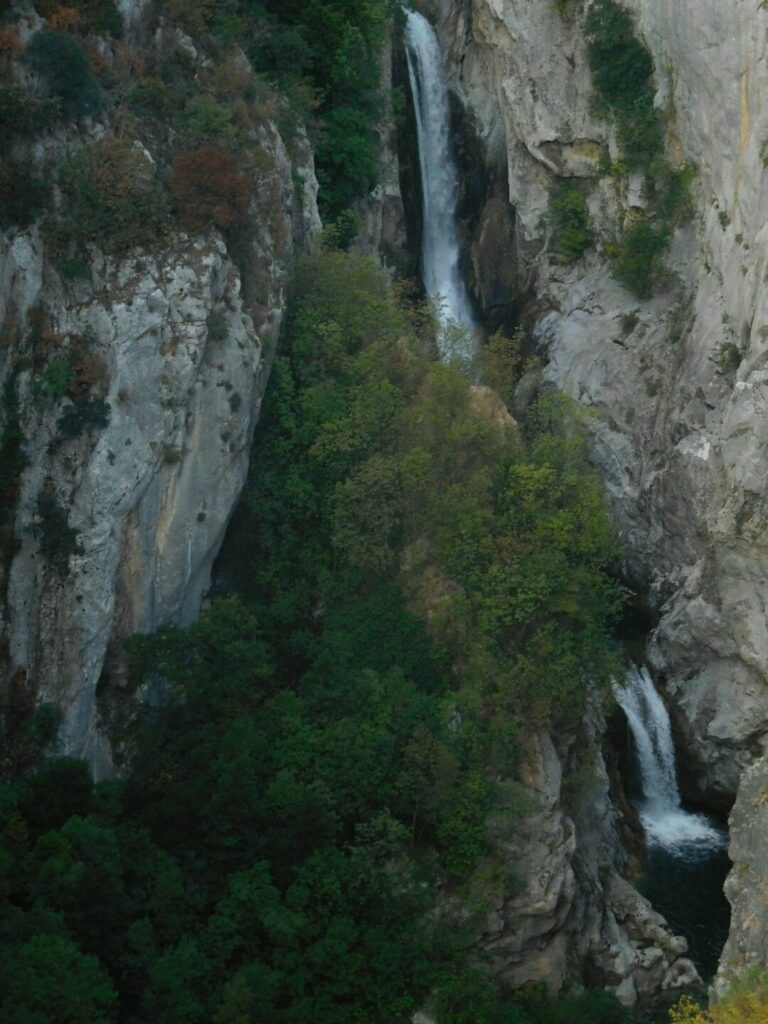
Croatia is a country that is very long and skinny and hugs the Adriatic Sea, so skinny that we needed to cross through Bosnia-Herzegovina along the way. We approached the border control station where we found both countries being represented and 3 booths located side by side in close proximity. The 1st booth was Croatia’s Customs, the 2nd booth Croatia’s Emigration and then the 3rd booth was Bosnia-Herzegovina’s Emigration. The first 2 booths were empty so we continued on to the Bosnia-H Emigration where the Police requested our passports for scanning.
We continued driving on through what is called the Neum Corridor for 9 km and then before we knew it, Croatia was ahead of us and another border control.
Leaving Bosnia-H and entering Croatia we encountered a 20 minute line up with cars waiting in 2 long lanes for processing (buses had their own lane). We eventually worked our way to the front of the line where the Bosnia-H Emigration scanned the passports, moving on the Croatian Emigration stamped the passports and the Croatian Customs booth was empty.
The winding coast road began to open up with great coastal views where yachts big and small were enjoying the water and sea breeze. As we neared Dubrovnik we noticed in the distance the Franjo Tudman bridge, a cable-stayed bridge across Rijeka Dubravacka near the Port of Gruz. It was an imposing structure and after crossing, we made our way to the accommodation for the next 3 nights. The location was perfect with everything within walking distance or the bus stop was just a couple of minutes walk away.
It was a short bus ride into the city and Old Town where we found one of Dubrovnik’s drawcards being an intact walled city with a maritime history. The Old Town’s large limestone cobblestones again glistened in the sun, but this time they formed a loose grid-like pattern helping the navigation process. The many narrow pedestrian streets crossing the 3 main parallel streets began to rise steeply with steps, so steep that the climb up continued on for what seemed forever. Just outside one of the gates was a marina full of smaller fishing and tourist boats, and a sea wall with tourists seated and enjoying a view of the open sea.
We wandered around what would have been a strongly fortified city in the day and agreeing that we are now definitely all churched out and getting close to being Old Town-ed out also !
Next day (Saturday), Tania had a relax day while Graeme headed back into the Old Town for a walking tour of “Story About The War” – referring to the siege that took place on Dubrovnik from 1991 to 1994, during which 56% of the Old Town was destroyed. Hard to comprehend such things could occur in such recent times – but they continue in other parts of the world today. As always, the conflicts are religion and ethnic group driven … so tragic. Anyway, Dubrovnik was able to re-build and by 2010, it was restored to the state it was in prior to 1991. The rest of the day was a time out day just catching our breaths after some hectic touring. Tomorrow we have booked a full day tour to Mostar, Bosnia.
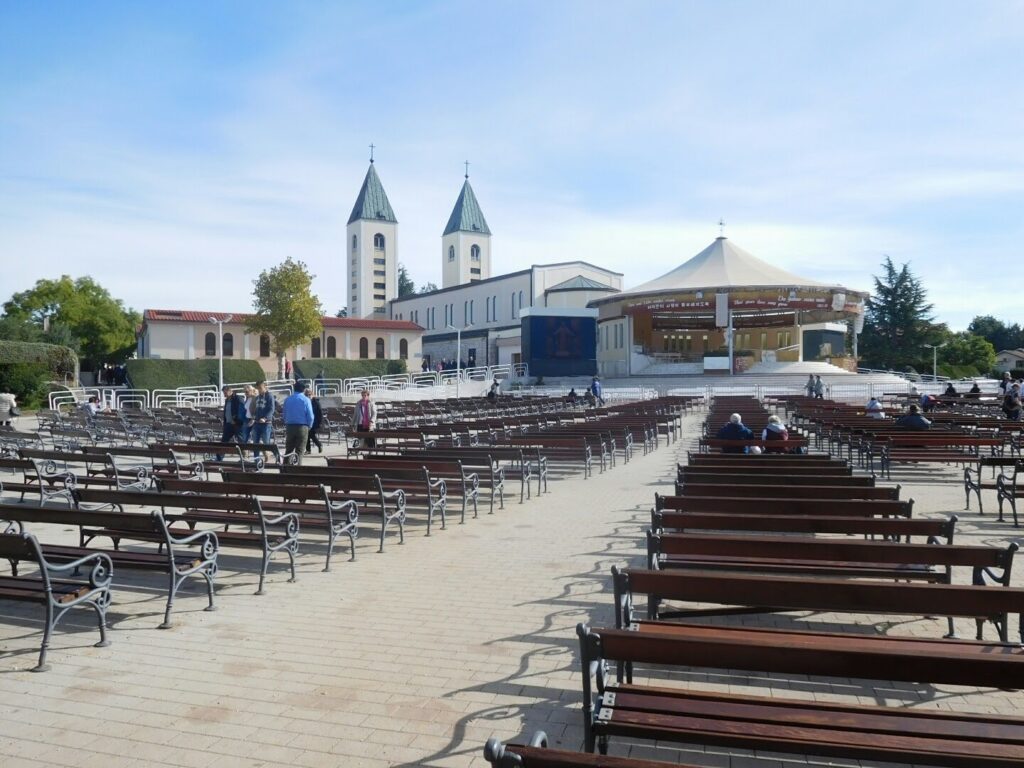
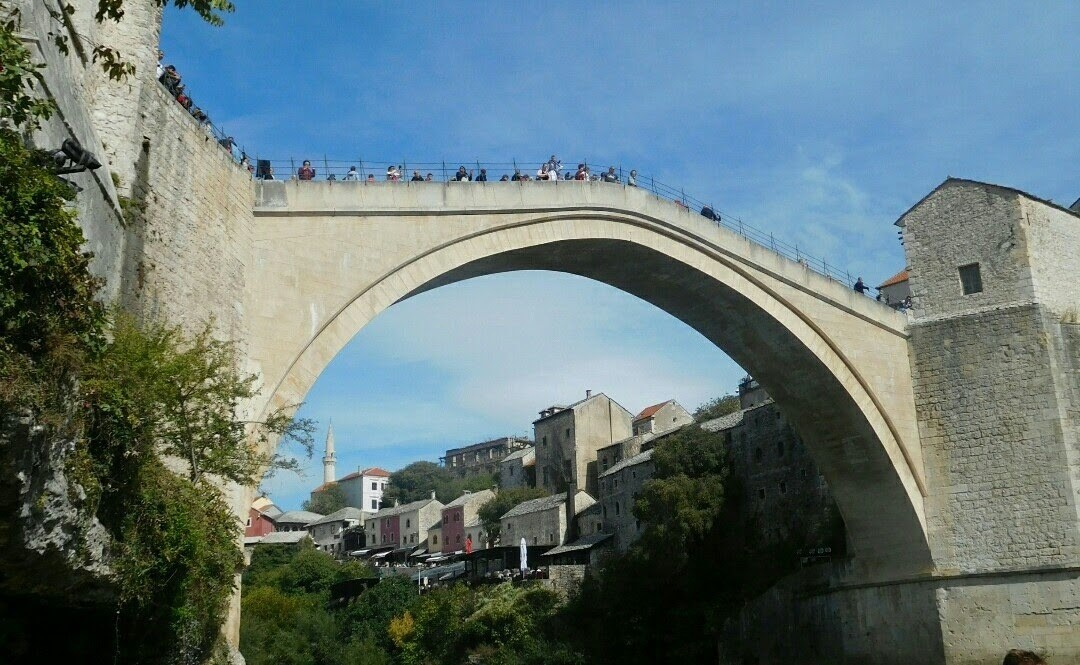
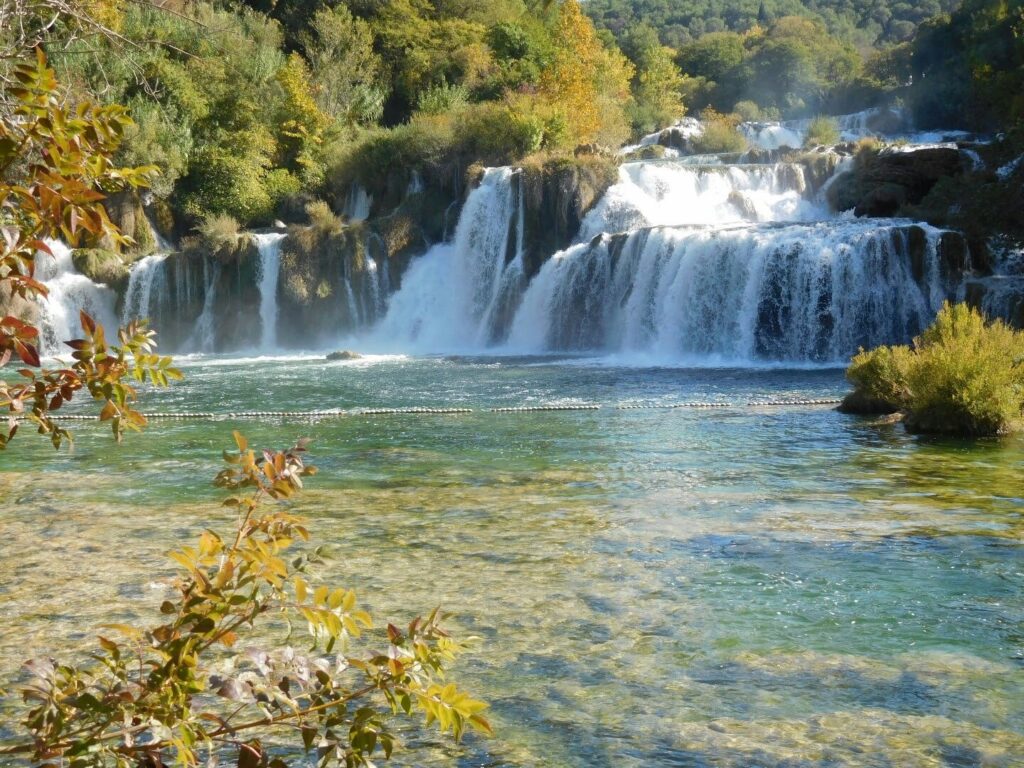
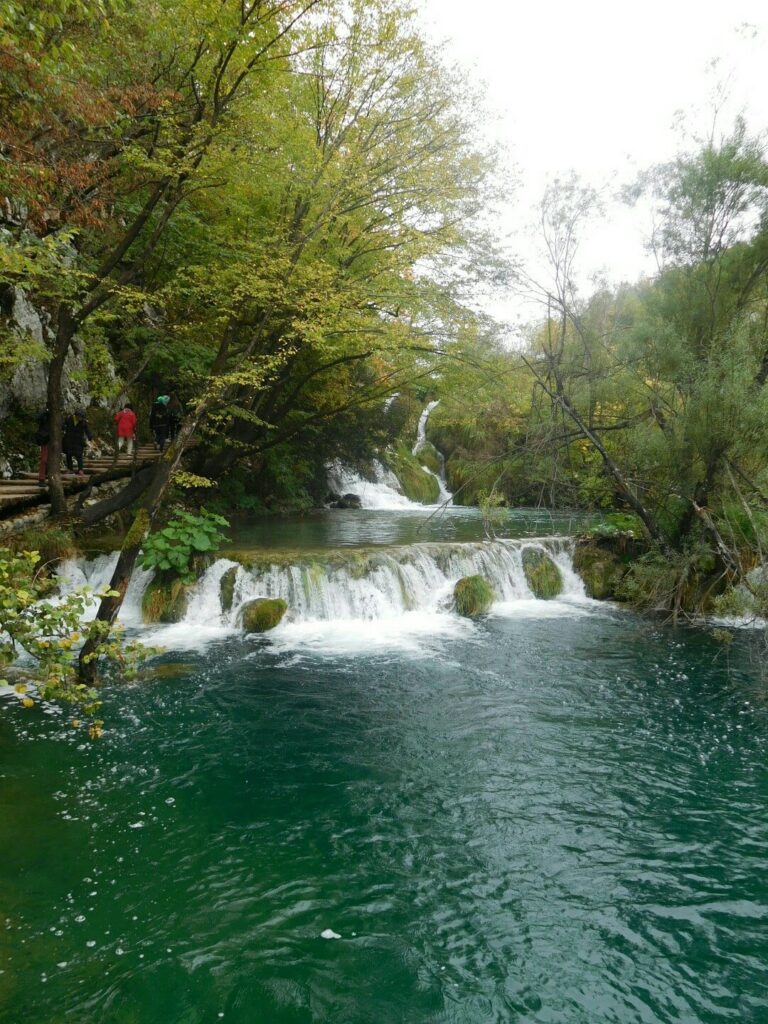
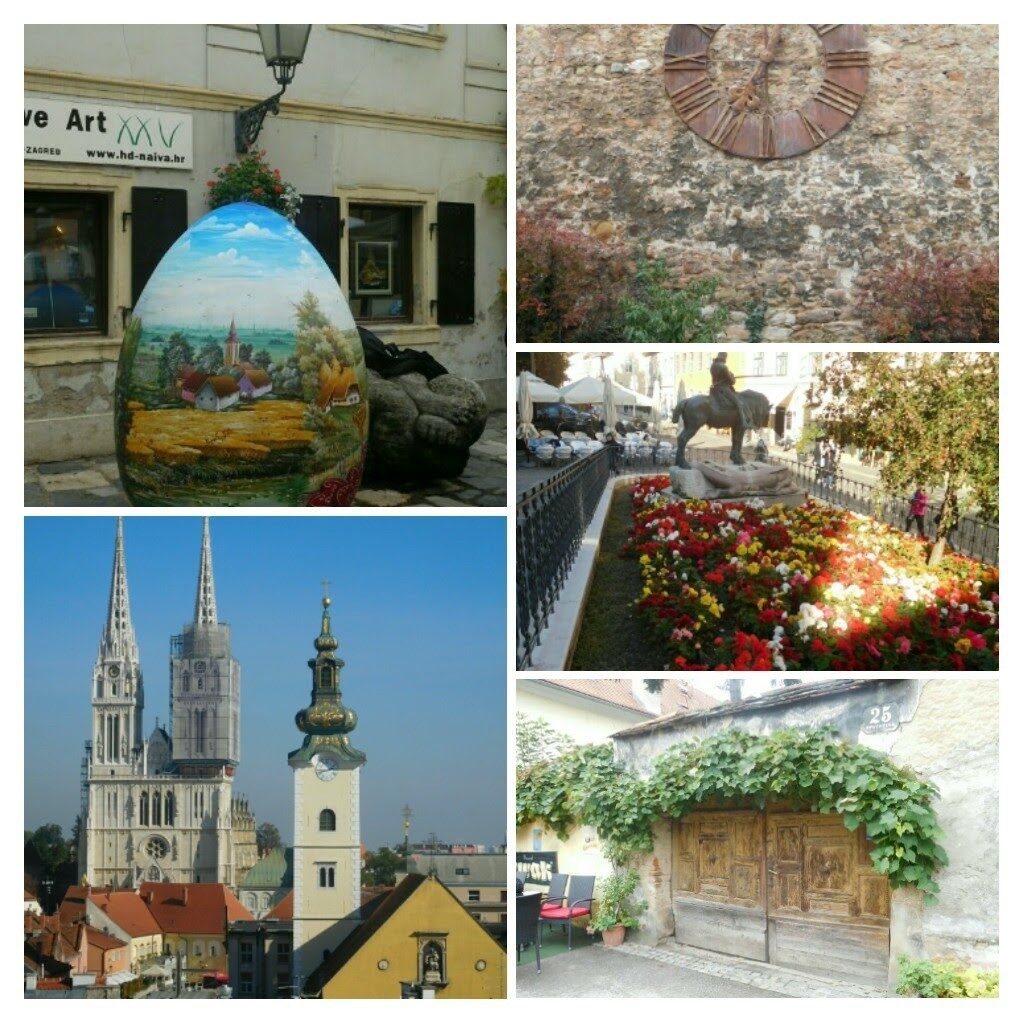
Zagreb has an Upper Town and Lower Town with the latter being not as interesting unless you want a name brand fashion shop, a commercial identity, restaurants and cafes. We headed for the Upper Town and initially noticed the fog had lifted slightly but the nearby cathedral’s spires were still up in the clouds. The Zagreb Cathedral was unique in that it was surrounded by a fortified wall (now only 3 sides remain) and are among the best-preserved Renaissance defences in Europe. The town was once walled but there is no evidence of them now.
With a lot of the Upper Town a pedestrian zone, it was easy to meander around the streets and we found both Tkalciceva and Radiceva Street very trendy. There were quirky/interesting shops, fashion and jewellery, bespoke style products, outdoor seating cafes, bars and restaurants. Not far away was St Marks Church with the most colourful tiled roof we had see showing the coat of arms of Zagreb and also of the Triune Kingdom of Croatia, Dalmatia and Slavonia.
The Dolac Market which is held daily was buzzing with people out for a bargain. There were rows of fresh fruit and vegetables, a fish market, cheese, flowers, clothing, leather goods and wooden products.
By mid morning the fog had cleared up and early afternoon the sky was a clear blue. The photographer was no longer complaining.
With map in hand our aim is to try and work out a direction to take that encompasses all streets and points of interest that our destination offers without doubling back too often. The main streets are generally the starting point but sometimes we leave the frequented streets and randomly take a small winding side lane or as we did today, a set of stairs. With at least 150 steps heading steeply in a downward direction the map implied a green wooded area with a nearby street to zig zag back. Arriving at the bottom of the wooden stairs and walking a short distance on, we were disappointed to find another set of steps under repair. Referring to the map we found that the entrance of the Gric Tunnel could be another option.
As we entered the darken arched opening to the tunnel, there was a sign indicating an exhibition about the history of Croatia. With wide sections of draped fabric ahead of us, we entered having no idea of what we would encounter. The tunnel was built during WWII to serve both as a bomb shelter and a promenade, but post war it was no longer used until it was remodelled and opened to the public in 2016 as a tourist attraction hosting cultural events.
The 350m long and 3.2m wide tunnel had 4 connecting passageways extending off at right angles which had displays of Croatia throughout the years. It was fascinating to walk through the dimly lit areas learning about their history. There was an interactive display of Croatia’s Nikola Tesla’s alternating current electricity supply system with light and sound displays. Part of the tunnel was set up as a rain zone so we chose one of the supplied umbrellas and walked about 50m through pelting rain….quite bizarre !
The exit of the tunnel brought us out into a courtyard not far from a set of big opened doors that faced onto the street. We had already passed this area earlier but had no idea what was hidden behind for us to discover. What a highlight to our day whilst exploring Zagreb.
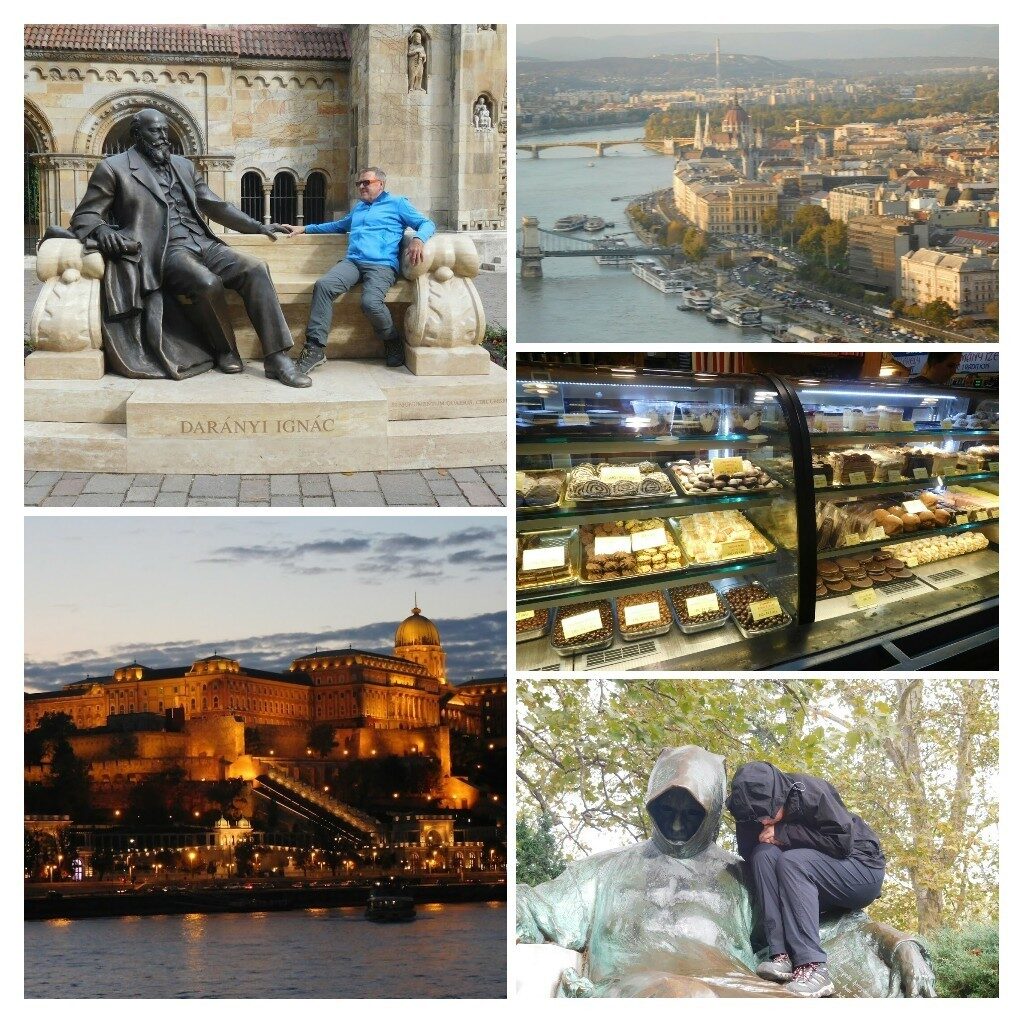
Side note… The most frustrating part about crossing borders is that not every country we are visiting has the same currency whether they are in the European Union or not. Generally the Euro is the currency we have been using but sometimes another currency is used… Switzerland- Swiss Franc, Croatia- Kuna, Bosnia and Herzegovina- Convertible Mark, Hungary- Forint, Czech Republic- Koruna. We not only have to work out the conversion rate back to the Euro each time (as a benchmark only), but we also have to withdrawal sufficient money in that country’s currency knowing that when we leave we hopefully have nothing left…..Quite a challenge.
After our longest drive and greatest distance travelled since we have had the car, we arrived in Budapest early afternoon and were greeted by the owner of the apartment who was very nice and gave us a run down of the places of interest to visit whilst here. As we are staying here for 3 nights, we bought a 72 hour transport ticket at the local metro only 100m away and then 5 stops later we were in the city ready to explore.
The name Budapest came about in the 1800s from the unification of the town of Buda on the west bank and Pest on the east bank. The Chain Bridge was built in 1849 and the first permanent bridge over the Danube River linking both sides and is classed as the most famous of the many bridges there.
As the majority of the city area is pedestrian friendly, we started with a long walk down Vaci Street where we found fashion and souvenir shops, cafes and restaurants. Crossing the Elisabeth Bridge which connects Buda and Pest across the wide and fast moving River Danube we starting our steep 130m walk up the rocky Gellert Hill to the summit to see the Liberty Statue and the Citadel. What amazing views from the top.
In the late afternoon after our panoramic view of the city, we continued our walk along the river and on the spur of the moment we decided to catch the approaching public transport river boat for a ride/cruise upstream. Just as the lights were coming on around the city it was a pretty sight with the reflections in the river. The boat zig zagged from one bank to another where passengers got on and off and then after 1 hour of enjoying the sights, to our surprise the boat did not turn around but finished its run!! We needed then to find the nearest Metro station and headed back, past our accommodation’s train stop, into town for dinner. A traditional Hungarian meal was our food of choice and after finding a restaurant just off the main drag, we enjoyed a very tasty 3 course meal. We always thought goulash was a stew like main course dish but we were informed that it is in fact a soup. The day had been long so we caught the train back about 10.30pm and were surprised to find the many carriages as full as if it were at the end of the work day !!
Day 2….was a late start with a walk to the Vajdahunyad Castle, built in 1896 to celebrate the 1,000 years of Hungary since the Hungarian Conquest of the Carpathian Basin in 895. The collection of buildings were representative of landmarks from different parts of the Kingdom of Hungary and from different time periods resulting in the architectural styles of Romanesque, Gothic, Renaissance and Baroque. The buildings were originally made in cardboard and wood but they became so popular that it was rebuilt from stone and brick.
The visit to the Heros Square is where we saw some massive Greek like statues representing the 7 Chieftains of the Magyars and other important Hungarian national leaders. We then headed back into town along Andrassy Street walking down the pedestrian centre, similar to La Rambla in Barcelona, passing many impressive buildings along the way. We stopped for a pre-lunch treat and bought a Chimney Cake which is classed as Budapest’s sweet winter treat. Sweet dough is wrapped around a wooden cylinder (a fat rolling pin), baked over embers and then rolled in castor sugar and various flavours. Eaten hot, we chose cinnamon but other options were cocoa, chocolate, walnut, vanilla and coconut…yummm
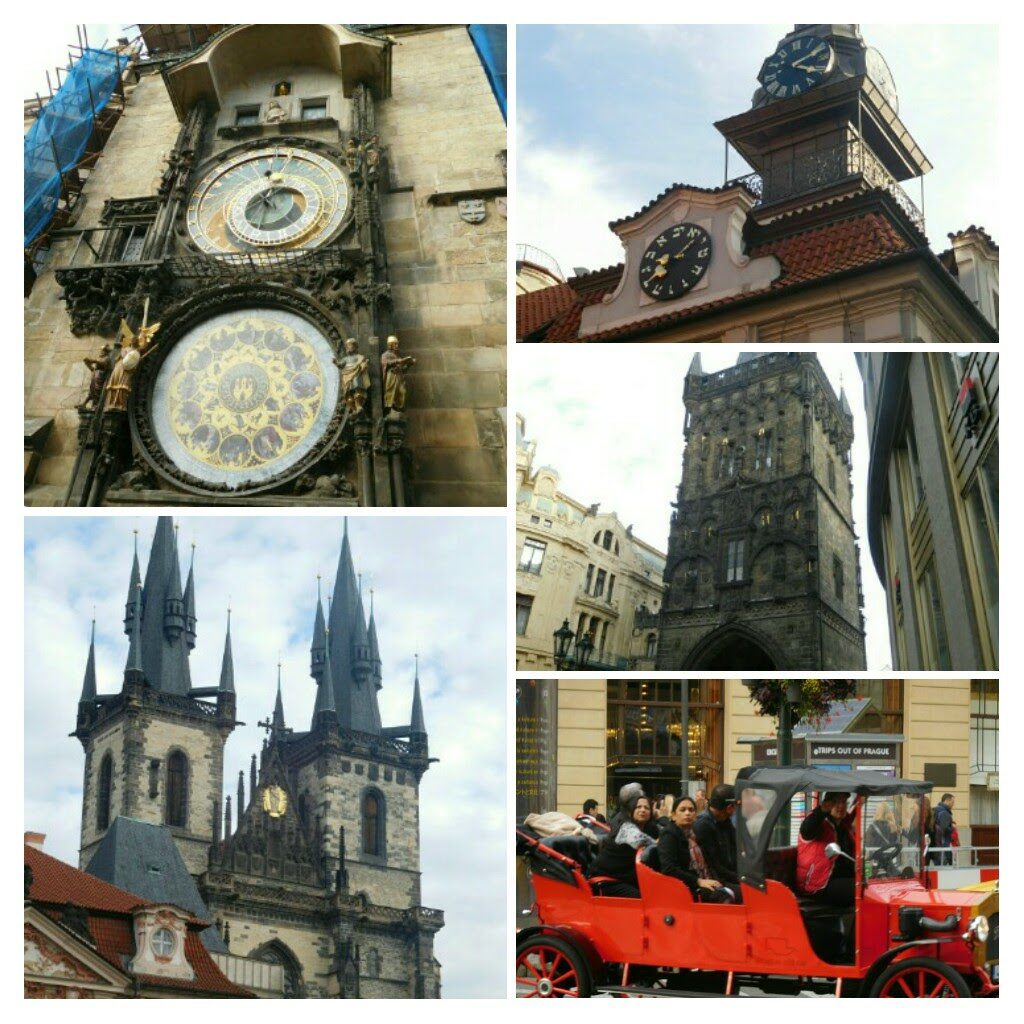
As our feet were becoming a little tired after all our walking during the day so after a once over and back on the Liberty Bridge, we heading back to the Metro for a ride back to the apartment and a catch up on emails and general research. It is our last day tomorrow in Budapest before we head to Bratislava in Slovakia on Sunday.
As I sit here updating the blog, we are eating camembert cheese on biscuits and the camembert came in a rectangular block instead of our usual round or triangular shape… so much better for putting on rectangular biscuits!!
Day 3….after finding a Costa Coffee outlet, we visited the Gellert Hill Cave Church which is located inside a natural cave system formed by thermal springs. Originally the alter was located at the entrance of the cave and the congregation was seated outdoors on the terrace until they expanded further into the mountain and formed many internal chambers. During WWII the church served as a field hospital and asylum for the army of Nazi Germany but today the Pauline Monks continue to use it as a church and there are 3 services daily….not your traditional religious structure.
The Historic Castle Hill dominates the skyline and is certainly a very popular tourist attraction as well as a place for bridal couples to remember their special day. This area of Buda became the centre of the Kingdom of Hungary in the 13th century with the Castle District being divided into 3 parts….The Royal Palace, Szent Gyorgy Square and the Historic Residential Area.
We walked around the grounds of the Royal Place which over the years has changed its layout many times to accommodate the needs of the royal family of the time.
The nearby Sandor Palace is the office of the President of Hungary and there we noticed a grand entrance located on 2 sides of the building where a pair of sentry boxes stood. In front of each box was a guard in full uniform holding a rifle with a bayonet. Initially we thought they were identical dummies wearing dark sunglasses as they were standing soooooo still without any movement at all. We watched intently and could not make up our minds so Google search was hopefully going to offer an answer. How amazing, on You Tube it showed the changing of the guards which happened every hour on the hour. It was 2:40pm so for 20mins we stood and watched one pair of guards the entire time and the only thing we noticed was them swallowing ever so gently.
3pm arrived and so did the sound of drumming. Appearing from around the corner was a leader and a drummer with 4 replacement guards following close behind. With specific commands being given by the guy in charge, the 2 new guards and those being relieved performed a routine in front of the spectators. We watched a spectacular choreography with rifle exchanges and turning, saluting, marching up and down and domino like movements all to the beat of the drum. Everything was done in perfect unison with the new replacement guards eventually positioning themselves to stand motionless for the next 60mins…what a challenge. After a few minutes of entertainment, the uniformed group moved on around the corner to repeat the routine with the next 2 guards. As they moved off, we noticed that each guard had similar features and looked closely cloned to each other !!
Heading to the Residential Area we visited the Labyrinth under the Buda Castle which was certainly a difference experience. After descending down many steep steps, we entered the 1200m long cave system which is located about 16m below the Castle District. This is again a natural cave system that over time the individual chambers have been connected to form a labyrinth encompassing 10 halls open to the public. The caves had many uses over the centuries but are most famous as a prison and torture chamber where Dracula was imprisoned here for 10 years.
Without a map or knowledge as to where we were going, we entered the first area and could hear eerie opera music playing as we approached some random displays of mannequins dressed as characters of The Masked Ball of the Black Count. We continued to walk on through a series of confusing connecting passages. The many halls we encountered were certainly irregular in shape, sometimes with central columns and little nooks in the dark corners. The muddy ground was damp with puddles in places and the light in many areas was practically non existent adding to the spooky experience.
After being pre-warned, we entered a particular section where we were confronted with complete darkness. Holding on to the thin floppy hand rail we slowly and cautiously worked our way around the perimeter of the chambers having absolutely no idea of what to expect. Feeling very disorientated and what felt like forever and possibly a distance of 100m, we found the light at the end of the tunnel. It was a circular route and we had arrived back at where we began ! We were intrigued about where we went and what we didn’t see, so we re-entered the area again but this time with the light on the phone turned on. The walls were practically zig zagged which explained the sharp direction changes of the railing and there were a series of thick floor to ceiling columns in the centre of the open spaces. The experience certainly tested our senses and hopefully no-one heard us giggling like little girls.
We were confronted with a choice of passages at times, a dilemma deciding which one to take. A dry ice mist was slowly being introduced the further we travelled and at one stage we had zero visibility ahead of us. Using a torch just made the situation worse. The air was becoming cooler with moisture dripping in from areas of the ceiling and our clothes were feeling rather damp. In dim lit areas and hazy passageways we could see human shapes behind barred doors, random little wall openings, a wall cavity with severed heads on poles, wall shackles and a suspended cylindrical iron cage.
We eventually found our way back to the start and over an hour had passed since we entered the labyrinth. Back to the street level and more exploring in the daylight.
We passed the Matthias Church, named after Dracula’s wife’s uncle King Matthias and known for its acoustics, but unfortunately we were unable to enter so we moved onto the fantastic views from the Fisherman’s Bastion of the Pest side of the Danube. The Maria Magdolna Tower, Buda Castle Funicular, The Old Town Hall, monuments, restaurants, hotels and other places that are represented in the residential area that give it a lovely charm. Buda’s elevated location, the many impressive buildings and the panoramic view of the Danube will be a lasting memory when we leave.
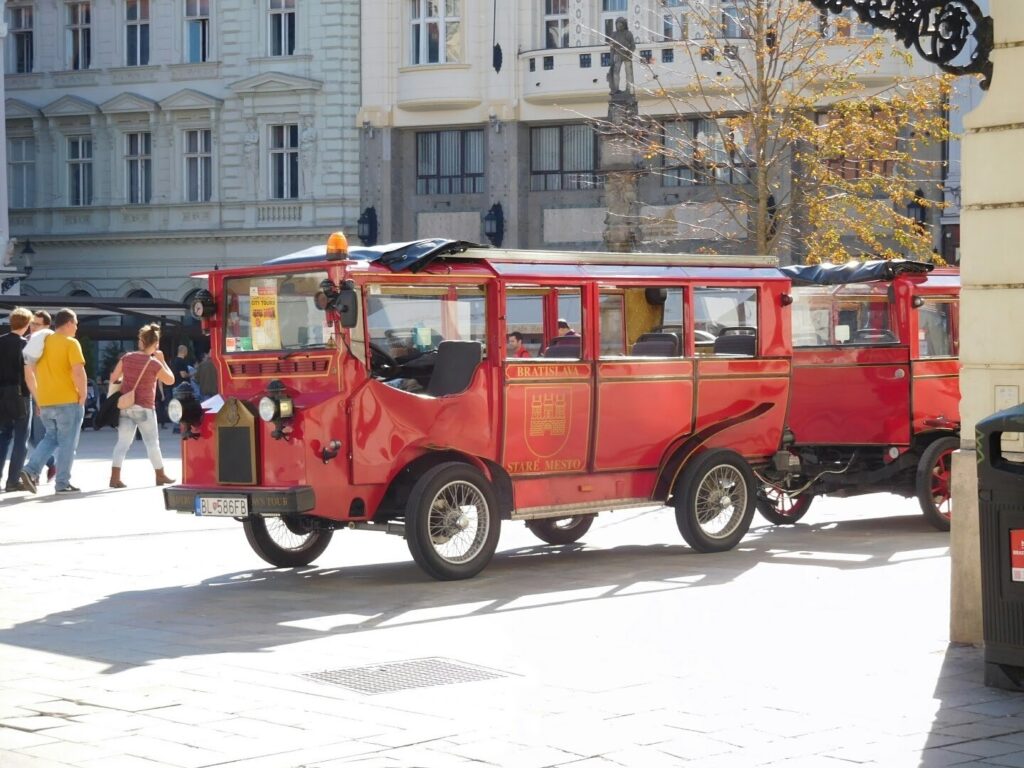
We initially intended to stop at Gyor on the way to Vienna for a look around but as we were not moved with what we saw, we continued to drive on through the centre of town toward Bratislava. Not long after crossing the border into Slovakia we had to stop to buy a minimum 10 day vignette for road tolls even though by the end of the day we planned to be in Austria. Only a 20 minute drive later and we had arrived in Bratislava and parked in an underground carpark that charged by 15min increments !!
After obtaining a map from a nearby hotel we found the initial walk into the town centre very uninspiring. It was a Sunday and there did not seem to be very many people around until we continued a little further and found the main pedestrian mall. Cafes and restaurants were busy serving lunches, and the place was full of people on walking tours and shopping which was unusual as shops were generally shut in the bigger cities on a Sunday. We walked around the streets, eventually ending up at the Danube River and then worked our way along the promenade area which offered outdoor seating and more eateries to make the most of the sunny afternoon.
What a surprise, the town had so many interesting things to see and if time wasn’t against us we would have definitely stayed longer than the 3 hours we did.
After an enjoyable time exploring the town, we had only driven another 14km when suddenly 3 lanes became 1 lane and we were stopped at an open air border control crossing into Austria. This meant the purchase of another 10 day vignette, the 2nd for the day. At a snails’ pace vehicles were moving forward and being waved into particular areas where an officer requested ID from all the occupants. After a quick glance at our passports we were on our way to Vienna for a stay of 4 nights.
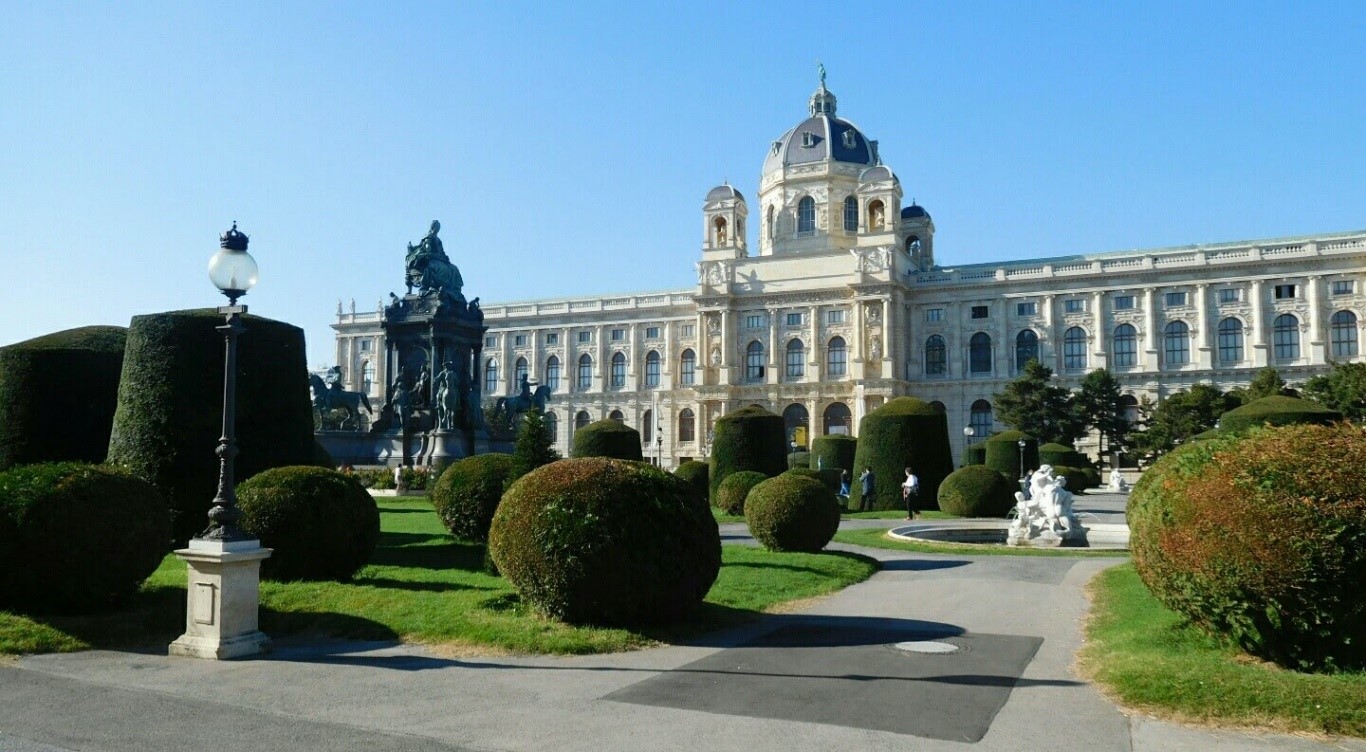
After alighting the train we followed the crowds of people heading up the stairs and at the top we found ourselves in Stephansplaz which is at the geographical centre of Vienna. St Stephen’s Cathedral stood there in the large open area but we both agreed it is not quite as impressive as Milan’s cathedral The Duomo, that we found more imposing when you come up from the underground station into the main city square.
Standing at the information map and obviously looking like a tourist, we were approached by one of the many guys traditionally dressed in Viennese costumes selling an experience at the theatre. On offer was a night listening to the ‘Barockorchester’ playing the works of Mozart, Vivaldi, Donizetti and Tschaikowski so with Vienna being known for its cultural heritage, we decided to attend the Palais Schonborn built in 1699.
First impressions of Vienna were not that great, but then we started working our way around the Ringstrassse which is the wide tree lined boulevard that encircles the medieval core of the city. This ring route was built on the old city walls and the buildings are nothing short of impressive. The Rathaus or Town Hall must have been the biggest Rathaus in Europe, infact ALL the palaces, magnificent homes, museums, churches, parliament buildings, University and library we passed today were HUGE. In fact, the photographer had trouble getting photos of them as they wouldn’t fit into one frame!
Side Note…. Throughout our travels we seem to see the names of a lot of the same retail shop chains each time we visit another city or town. The first thing we seem to focus on as we explore around an area is which store we are likely to see first. It is too easy to have an extensive list but we narrowed it down to only a few… Will it be H&M, C&A, Mango, Douglas or DM ?
Day 2…what started off as a very gloomy day, eventually cleared up mid afternoon to a blue sky.
We took a drive in the morning to Seegrotte to see the largest underground lake in Europe. Just 23km from our apartment the lake grotto was originally a gypsum mine and is spread over different 3 levels. From 1848-1912 grey and red gypsum was mined there for agriculture fertilizer and in 1912 a blasting error caused 20 million litres of water to flood the lowest level of the mine (60m below ground) causing it to be shut down. In 1932 it was reopened as a tourist attraction and also holds special events and celebrations.
With a year round temperature of 9deg, we donned our jackets and our guide took us 450m into the mine through a crooked low brick reinforced tunnel. Ahead of us opened up to a more spacious area where additional passageways were formed as the mining operation continued to remove the gypsum from underground. Rail tracks were used throughout the tunnels to move the heavily laden carts, drawn by blind horses that worked for 20 years and never left the mines.
During 1944 the Nazis used the mine as an aeroplane factory, using prisoners from concentration camps to make the first jet fighter plane, the Hinkel He 162. They pumped out the water continually to keep it dry, added heating and put in concrete floors. Today the lake has 7 springs that fill the mine with about 60,000 litres daily and with no natural outflow, water has to be pumped out each night to maintain a height and prevent further flooding. Toward the end of the tour we had a ride in a boat that had an electric motor which glided very smoothly and silently through the passageways. The crystal clear water produced amazing reflections of the lighting and the surrounding rock walls and around the last corner a random man made water feature appeared !!
Our tour guide had a fantastic dry sense of humor which made our 45 min tour even more enjoyable.
After dropping the car back at the apartment, we headed back into town to continue walking around the city. Unlike the majority of other cities we have visited throughout Europe, the centre of Vienna is not close to the Danube so we caught the underground to the river’s edge. Here we noticed the very elongated central Donauinsel island splitting the waterway in 2. The island is 21.1km long and 70-210m wide and was formed when a parallel excavated channel called Neue Donau or New Danube was undertaken. Walking across the large expanse of a bridge, used by cyclists and has a train station also, we saw boats moored on the side where the water was fast flowing but on the other side of the island the flow was not noticeable and is used as a swimming and recreation area with nearby restaurants and cafes.
The underground took us back toward the city so we could continue walking on the ring route admiring more of the grand architecture, parks and gardens. As we were eventually heading in the direction of our accommodation, we decided to keep walking ‘homeward’ when we came across Belvedere Palace and its massive grounds. Entering the gates we saw the impressive palace ahead of us at the top of the terraced grounds, people sitting around enjoying the scenery, joggers and tourists like us admiring the view back to the city. The many hedges and garden beds were mirrored, along with the ponds and statues. The grounds reminded us of Versailles but on a smaller scale.
Day 3…we walked to the train station but due to a technical issue the trains were delayed so we caught a tram into town to see the Spanish Riding School that has practiced classical horsemanship in its purest form for more than 450 years. Four days a week from 10am-12 the morning exercise for the training of the riders and their Lipizzans is open to the public. We saw the horses at the stud farm not far from Sezanna in Slovenia and today we watched 4 x half hour sessions where the young grey stallions and the fully trained white School stallions refine their moves and strengthen their muscles. Unfortunately they don’t perform the aerial jumps everyday but we did see one horse stand on its hind legs quite a few times. Part of the Hofburg Palace, the Baroque Winter Riding School hall in which the horses performed, built in 1735, was very grand and located only a short walk from the Lipizzan stables.
Prior to the concert we enjoyed a Weiner schnitzel at a bustling outdoor restaurant in Stephanplatz in the city. The colourful roof of the cathedral was lit up and the lights from the retail shops and nearby eateries added to the charm of the surroundings.
The concert hall was not as grand as we were expecting from the pictures Toni the ‘sales person’ showed us very quickly from his clip board. None the less the room itself, which seated 150, was intimate and the chamber music was enjoyable and very moving. The musical director played first violin and her dramatic entrance, amazing performance and 3 exits added to the night’s entertainment !! A most enjoyable evening, opera singers and all.
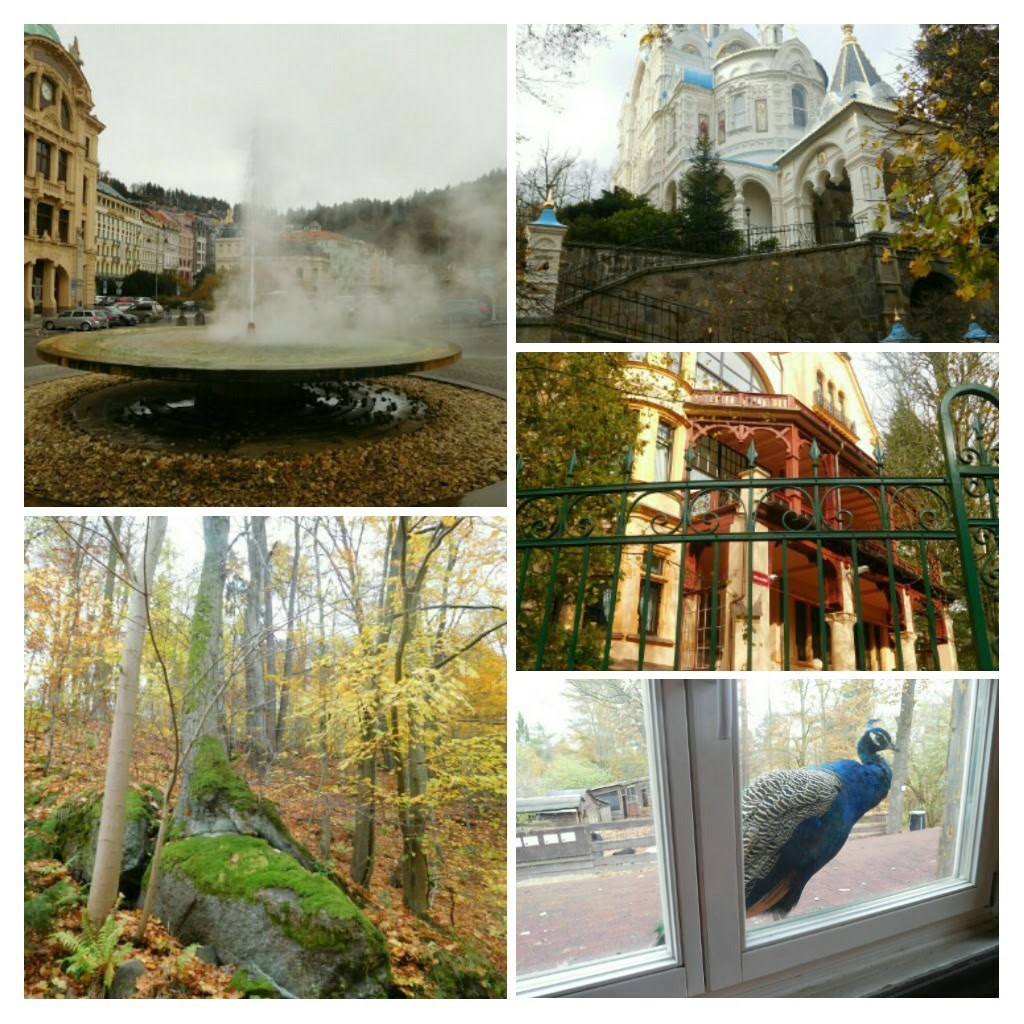
A quick 10 minute walk and we had arrived in the very pretty town, nestled in amongst the meandering Vltava River. The town has a large central square, many narrow cobblestone lanes, footbridges and restored Gothic and Renaissance frescoes on building facades. Being a medieval town, the castle was easy to find perched high on a hill overlooking the river and town with its colourfully painted dominating tower and internal walls. After initially starting to look around we decided to join a 2 hour free walking tour which was informative and very entertaining. Before heading back for the evening, we stopped at a great restaurant not far from the cathedral for some traditional Czec food which was the best and cheapest food we had tasted so far !!

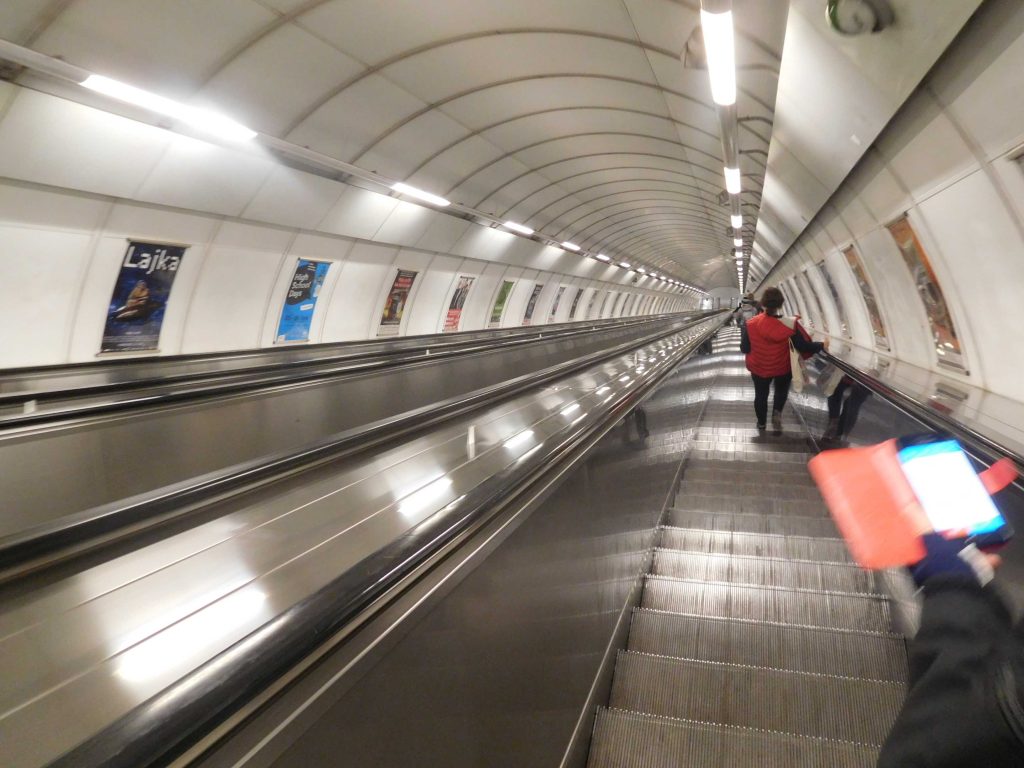
Length 87m
Vertical span 43.5m
Steps 533
Time 2 mins 15 sec to ascend or descend without walking
Stepping onto the escalator and looking up toward the top was just CRAZY !!!!!!!
After enjoying the tour guide Ryan from yesterday’s ‘free’ tour, we decided to do the Prague Castle with him today. The 3 hour tour was again quite informative but also full of humourous anecdotes. We began the walk by crossing the river and entering a lovely massive manicured garden, a large fish pond and white peacocks tucked away out of sight with no obvious signage. Passing the man made grotto wall of multiple stalactites with hidden faces, snakes and frogs we made our way to catch a tram up to the back entrance of the castle.
Prior to passing through the police security check, our concern was the 2 sharp knives we always carry with us for making lunch. Those ahead of us had their backpacks and bags checked followed by the metal detector wand being passed over the body. Holding our plastic cutlery and the sharp knives in a clear plastic bag ready to declare, the officer looked quickly into the backpack, moved the wand briskly around and moved to the next person. Obvious not fitting the description of a terrorist, the knives were safe to keep and the tour group moved on into the castle grounds. The gardens along the way were very pretty and full of a variety of species of trees from different parts of the world. The view over the city and also across the dry moat to the castle was amazing.
After the tour, we made our way back over the very busy Charles Bridge and again enjoyed the castle, but this time the sun had set and it was beautifully lit up. Experiencing the city at night seemed to soften the Prague we had discovered over the last 2 days and the atmosphere with the number of people still around was just great. It was Sunday night, the shops were still open when we left at 7pm to head back for tea…so unlike home, but we don’t have the population to experience this.
Day 3…Just to mix it up we caught the tram into the city and saw some more of the surrounding suburbs from above ground this time. After finding a Costa Coffee the moment we arrived, we then headed across the Charles Bridge again to investigate further into Lesser Town. The 10m wide historic bridge was built in the start of the 15th century and was full of small market stalls and very slow walking people absolutely everywhere. There are 30 statues across the bridge and some were of a religious nature which caused even more of a challenge to pass as people were waiting patiently to pray and have photos taken in front of them.
We visited the John Lennon Wall which since the 1980’s is an ever changing piece of graffiti art where anyone can contribute to it using the available cans of spray paint. The wall was supposed to represent a symbol of global ideals such as love and peace but today we found it a bit disappointing that people had added vulgar imagery and wording with unrecognisable colour mashed together. Still an interesting place but if you are not in any way artistic, maybe stay away from the can.
Over the years we would always have a joke about Graeme threatening to buy a fur lined deer hunter’s hat each time we see one…and Prague has them on display everywhere. They come in variations of the general style, in all colours, patterns, with and without trims….but today it was no longer a joke. The next cold and windy day, Graeme maybe warm but he will be walking on his own !!
Being the last night in Prague we enjoyed a nice authentic Czech dinner not far from the Charles Bridge, which meant no dishes tonight.
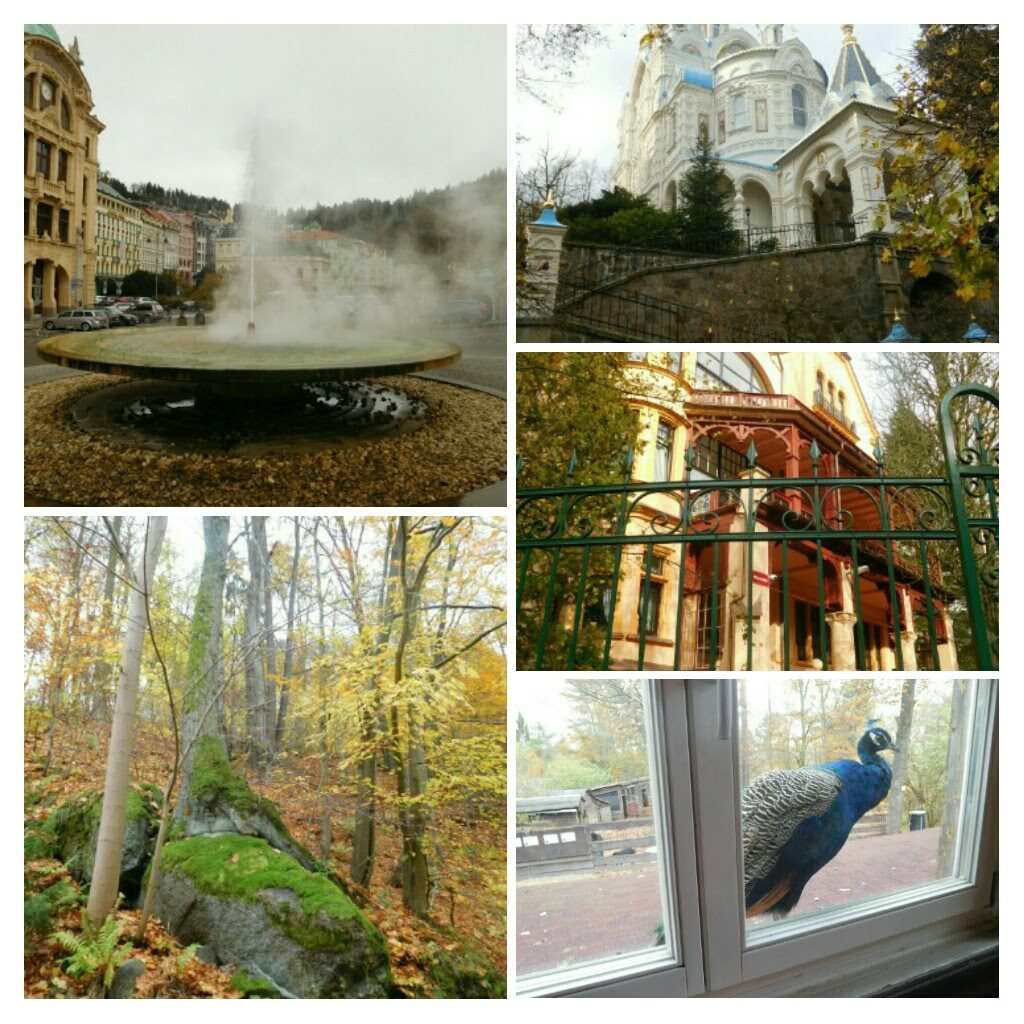
Arriving in Karlovy Vary it seemed from the back entrance, we drove around many very sharp corners working our way downward at every turn. Then around the last corner the very colourful town open up. The now narrower windy streets continued down, and they were so steep we saw a very long hand rail to assist the ascent !!
Karlovy Vary is situated on the confluence of the Tepla and Ohre Rivers and is nothing like any one place we have seen. It has colourful buildings like Burano in Venice and The New Town in Prague, the proximity of buildings to both sides of the waterway like in Lyon, a meandering waterway as in Ceske Karlovy, the buildings are either mansions or spa Hotels similar to those on the Ringstrasse in Vienna, a shopping strip of high-end fashion shops like Konigsallee in Dusseldorf, beautiful autumn trees like those in the Black Forest, the hilliness of Cinque Terre and the police ride segways like tourists do in any city. Karlovy Vary are all these things and more rolled into one. It is certainly not a town for push-bikes, big four wheel drives, those on a walking frame or having bad knees…although this possibly is the place to cure the discomfort.
To get a better view of the town layout, we took the funicular ride 166m to the Diana Historical Restaurant and Lookout Tower in a quaint old fashioned carriage. The autumn colour of the trees holding on to the very steep slopes along the way were just fantastic. Not far from the station was the observation tower which is 35m high and stands 566m above sea level. After climbing 150 steps to the top, we had magnificent views over the spa town and wider surroundings of Karlovy Vary. The choice of taking the stairs over the lift was chosen to justify our decision to have lunch in the main dining hall of the Diana Restaurant. The restaurant was built in 1914 and has fantastic viewing windows similar to that of a glasshouse, high ceilings and is ever so grand. The place was buzzing and after our tasty goulash which was served in a cob (and a different flavour to the one we had in Budapest), we had the best apple strudel we have tasted on our entire trip. TripAdvisor suggested the funicular ride and eating at the restaurant and it did live up to the many positive reviews.
When we were in Baden-Baden in the Black Forest in Germany, we missed the opportunity to visit a spa so we went on the hunt to find something to suit our needs. As we are not staying at a spa hotel for the night, Chateau or Castle Spa was nearby and open to the public. We purchased a 1 hour package which gave us a ‘procedure’ and the remaining time in the mineral swimming pool. Graeme’s 30min ‘procedure’ was Oxygenotherapy which is the inhalation of air with added oxygen which stimulated bio-chemical processes in the entire body on a cellular level. Tania’s 15min ‘procedure’ was Electro-Aerosol Inhalation where a device generates mineral water of the castle spring into aerosol which covers the air passages, enters the bronchial mucous membrane and having an anti-inflammatory effect.
The souvenir shops here sell skinny rectangular porcelain cups with a handle and spout (visualise a hip flask tea pot) and people walk around the town with these filling them with water sourced from any of the 15 drinking fountains of which the town is famous for. These drinking fountains are fed from the cold and hot springs with temperatures from 9deg to 73.4deg C and people can be seen filling many containers to take away with them. In the centre of the town we saw a thermal spring colonnade or glass windowed passageway with seating around the perimeter. It was full of people sitting, chatting and drinking mineral rich water from their spa cups filled from the different temperature fountains (30, 50 and 72deg) housed inside the building.
The town is definitely an interesting place to visit, it is a very quiet place at night and we can see how the town would have been a place for the wealthy to live or visit during the 1700-1800s in particular.
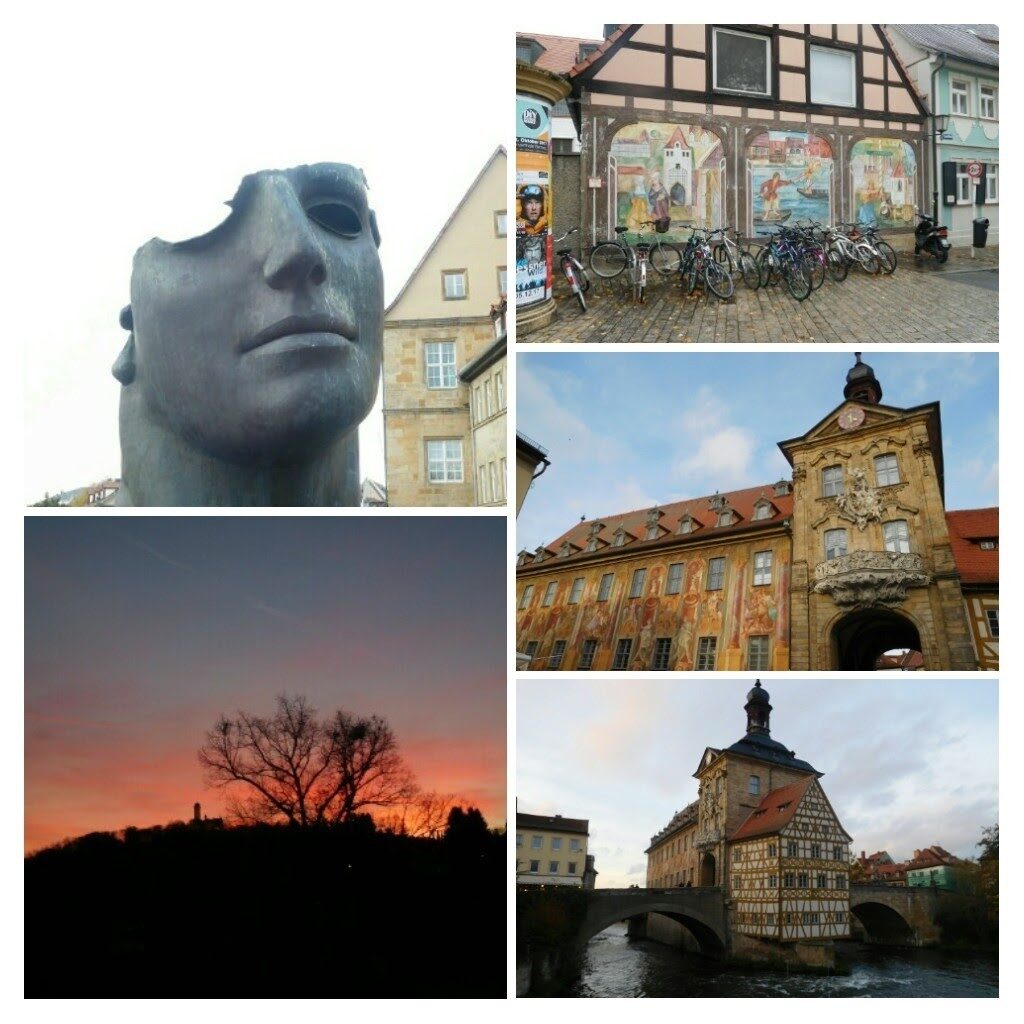
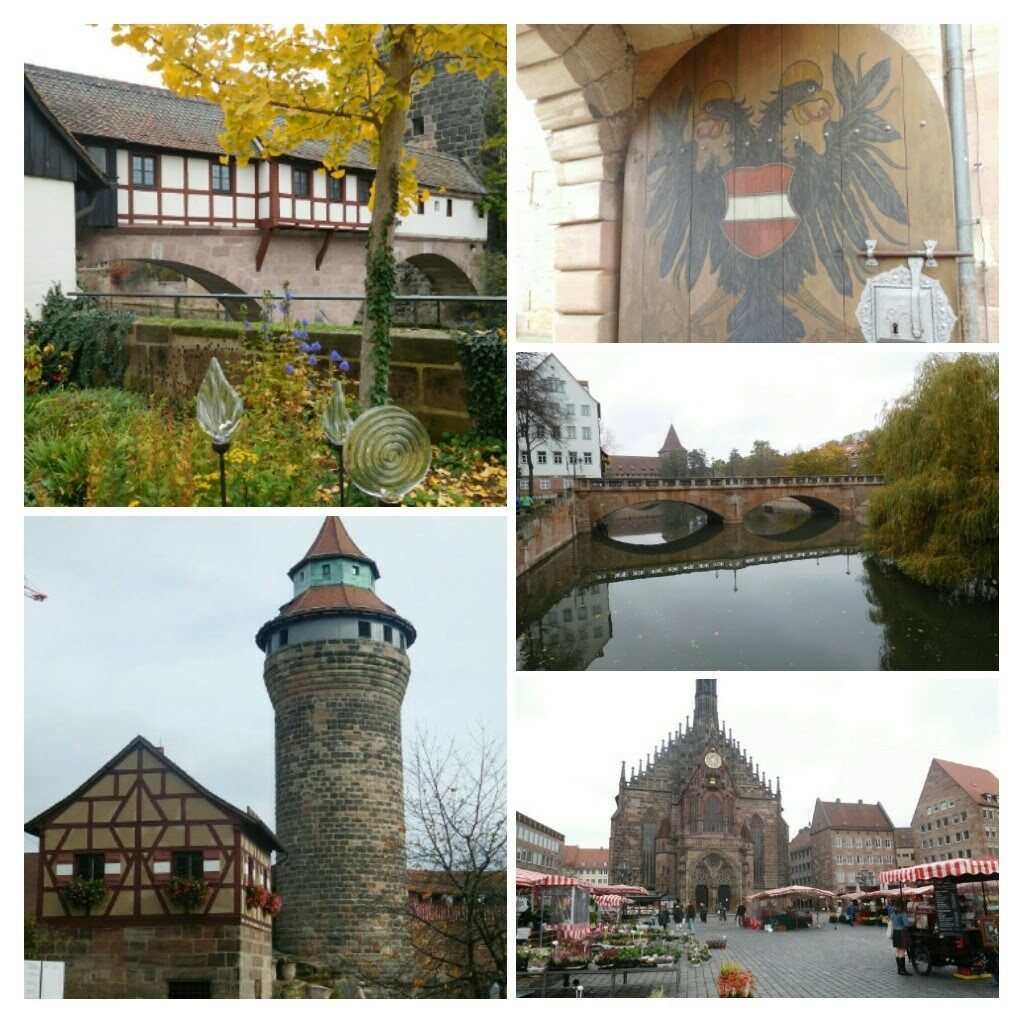
This was another pedestrian city with wide cobblestone streets and we made our way up and down the main shopping streets, past the Hauptmarkt (central square) which had fruit and vegetable stalls and eventually arriving at the castle. Perched high up on the hill at the northern edge of the Altstadt (Old Town), surrounded by red roofed buildings and reached from behind the fortifications and stone towers, stands the massive Kaiserburg Castle.
It was begun in 1050 as a small Imperial Castle and later enlarged, altered and enlarged again, and again and again, bombed in WWII and then restored once more to its current state. The gardens are not large but are extremely well manicured and maintained. The castle is a group of medieval fortified buildings but unfortunately we only had access to a few of them. With an audio guide in hand we made our way through the Palas, the main building of the Imperial Castle. It was the Emperor’s residence and was used for his official functions but now is a museum with interesting artefacts.
The Sinwell Tower was built perfectly round and the view from the top was worth the climb. There were photographs from different areas of the viewing platform showing the condition of the buildings after the intense degree of destruction from WWII and the reconstruction efforts. A large portion of the city was rebuilt in the same pre war appearance but some parts are now modern replacing some of its medieval buildings.
The Deep Well was another area we could visit, located inside a small half timbered house in the courtyard and taking 10 years to build. Standing on our toes to lean over the edge, all we could see was a black hole as the well is 50m deep with 3m of water in the bottom. The Guide poured a large jug of water into the well and it took about 5 sec before we heard it hit the water below. A central light fitting was lowered into the well taking about 60 seconds to reach the surface below indicating just how deep it was.
On our way back to the hotel we sampled some local curry wurst from a street vendor after 6 hours of exploring another well chosen location during the 2017 European holiday.
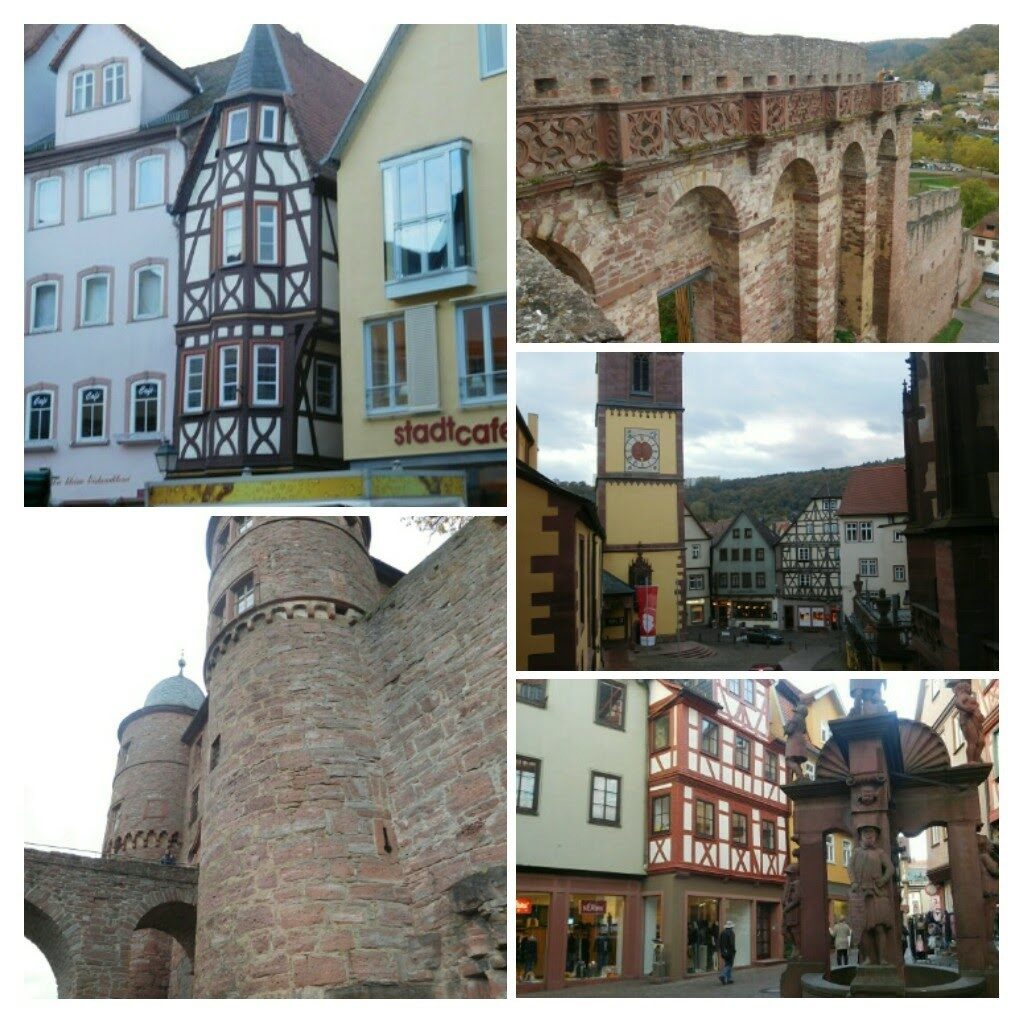
The rain had stopped as we continued on to Wertheim Am Main which meant today was the day to completely repack our bags in readiness to fly out in 2 days time.
The suitcases have lived permanently in the boot of the car for 2 months and we were taking only our incidentals and food into the accommodation each time. The biggest issue now was hoping that the bits and pieces we had bought during our travels will also fit in the bag without too much juggling. It is amazing what you accumulate along the way over a 3 month holiday, so to reduce unnecessary weight the daily maps and credit card receipts have been photographed. Management of the food we carry with us for breakfast, snacks and backup easy meals, will mean the last night could be a smorgasbord. The empty bin was beginning to fill quickly and the amazing packing cells we have used many times before on our travels certainly made packing easy. A list was being made to amend the master list to reduce further our gear for the next overseas trip in 2019.
The suitcases were sorted so we headed into the heart of the medieval town to look around. Our accommodation was high on a hill overlooking the colourful buildings and half timbered houses and the steep stone stairs took us down to street level very quickly. We thought Bamberg was lovely, well this topped it. The streets were quite narrow and not a public thoroughfare for cars, although it seemed local residents and businesses did use them. The clothing boutiques had racks of winter coats outside their doors and other stores displayed their goods on tables in the street. Everything was very compact and interesting at each turn of a street corner. The eaves and guttering of nearby buildings either side of a narrow road were not parallel and some buildings did not seem to have straight front walls as they followed the angle of the roadway.
The fairytale like town is located at the meeting of the Tauber and Main rivers with the former in particular being very green and pretty with a cobblestone walkway alongside. The market square was buzzing with tourists and it was lovely to hear the Australian voices as groups passed by us. We were informed that APT and Scenic bring a lot of Australians here on the riverboats to visit the quaint place. People were standing around the food and drink stalls in the market where the what ever meat ‘wurst’ was being placed between a bread roll for a quick snack.
The actual town is not far from Frankfurt and so it is a place where people tend to live and commute to the city for work. A quick walk around the town was all it needed and then we gave the interior of the car a clean before handing it back tomorrow morning.
It was raining when we woke and continued raining on the way to the airport where we dropped off the car. We ended up travelling 7021km over the 2 months we had our wheels, through 14 of the 18 countries we visited. We were saddened that we had to give the car back as it meant the European part of the holiday is now over. When we drove the car for a month through France and Italy 2 years ago, the confidence was not there driving on the other side of the road. This time though it has been a little different having the car twice as long and with a lot more driving practice up our sleeves. Saying it is now second nature would be a big statement as we constantly reminded each other of the road rules each day to stay alive. Breaking a long time habit of first looking to the right before entering a round about could avoid a serious injury or even death if you miss the truck coming around on our left.
The car gave us freedom to travel anywhere at anytime and without timetables to follow. This meant the loosely structured holiday was extremely flexible and therefore offered many surprises for both of us. Everyday was exploring somewhere different and with minimal time restraints it allowed decision making on a whim to result in quite exciting outcomes. Now, roll on country #18.
With 4 1/2 hours before scheduled lift off, we fine tuned the contents of the suitcases and headed off to arrange our seating and book in our bags. At least we were not likely to be rushing !
Frankfurt’s airport was enormous. We needed terminal 2 so from the car rental area we took a lift, walked a long way down a passageway that looked endless, took a branch off to the right, rode 4 different escalators, caught a train for a 5 minute ride, then 2 more escalators before arriving at the Emirates counter. Our bags had weighed very similar to when we left Australia nearly 3 months earlier (21.4kg & 22.1kg) with 8kg to spare to our allowed maximum weight of 30kg each.
Once sorted it was 1 more escalator to McDonalds for a sit down and a coffee which then left us with €4.44 (A$6.66) cash remaining. Not bad for calculating how much converted cash we needed of Euro to the very last minute.
The next stop was the tax refund counter to arrange a refund for some products we had bought throughout Europe. The line up was amazingly long and all of them were Asian tourists. I wonder how many of their products were actually made in Asia and would it have been cheaper to buy their goods back home ?
Arriving so early we had to wait quite some time to find out which gate we needed. Eventually it was announced and then we waited in line for 30 mins to have the hand luggage x-rayed and a full body scan for everyone. Beep….both of us were pulled aside for a pat down but all was good.
Eventually seated on the plane but because Frankfurt’s bad weather had continued, there was only one runway open for arrivals and one for departures. Scheduled to leave Frankfurt at 3pm we had a delay of 1 hour 40mins whilst sitting on the tarmac. We eventually took off at 4.10pm and 5 ½ hours later we arrived in Dubai, 12.45am local time. Another gigantic airport and you would think with the number of people around it was the middle of the day and not the night.
Fortunately we had spare time between flights that the delay in Frankfurt didn’t affect us, but it did others on our flight.
After a lay over of 2 ¼ hours we left Dubai at 3.00am for a 7 ½ hour flight to Singapore. Tania had problems with the TV screen not reacting properly so we were moved a couple of rows back. To avoid any jet lag both of us stayed awake on each flight watching movies, knowing that we could have a couple of hours sleep before arriving in Singapore at 1.55pm.
Looking back it seems crazy that we left Frankfurt at 4.10pm on Sunday 29th and after flying only 15 ½ hours including a lay over, we arrived in Singapore at 1.55pm on Monday 30th. We had lost 6 ½ valuable sleeping hours flying eastward !! But the big question now is will we be able to last another 7 hours or so on such little sleep before we go to bed tonight !!
Passing through immigration we first produced our passports and then had to place both thumbs on a glass plate which was then stored in their data base. We were now on record.
After collecting our bags and buying a 3 day Tourist Pass for the local transport system, we left the airport on the Metro. 45mins later and a short walk to the hotel we had arrived for 5 nights and 6 days before we were to return home after an amazing 3 month holiday overseas.
The hotel room was well located in the city with transport only a 30sec walk away to the underground. Just 9 days earlier a new Metro link opened and the brand new station was practically on our doorstep. With map in hand, the largest of all maps we have used, we headed out to see what the city was doing. The temperature was in the high 20’s and slightly humid so short sleeve tops were the go after not much earlier wearing coats, gloves and scarves !
We didn’t need to walk too far before we crossed the street and a couple of corners later, we came across a market of clothing, everything phones, handbags, novelty items and more. Everyone was calling you in to make a sale after a simple glance their way. It was hard to look at anything without being confronted by an assistant helping you spend your money.
Working our way around the local area we found ourselves in a multi storey building where electronics were located on the 5 or 6 floors. Cameras, phones, accessories, ipods, drones, repairs to electrical items, anything you want it would have been there. Our heads were in a spin and so we agreed to return another day when we were less exhausted. Approaching the exit to the building, we noticed it had started to rain and people were running to avoid getting drenched. We both shared an umbrella and walked slowly together so we did not slip in the puddles across a wide walkway to an eating area. It was time to eat tea anyway so why not check out the available meals available and wait it out there.
Before too long, the rain was getting heavier and instead of draining away, the outdoor eating areas were starting to flood. Tables were being stripped of their settings or moved inwards as much as possible and nearby patrons were lifting their feet up to avoid getting wet. It then started, the thundery showers brought amazing lightning and the loudest claps of thunder. We were definitely staying now. The lightning cycled about every 3 minutes with the thunder only 2 to 3 seconds following after the lightning! It was amazing to experience a show like this over a very tasty meal. Then 2 ½ hours had passed and it started to lighten up so we headed back to the hotel using covered walkways as much as possible.
We should not have been surprised, as prior to leaving Europe we checked the next 10 day weather forecast which had stated thundery showers every day for Singapore. In hindsight we should have packed our flippers before we left.
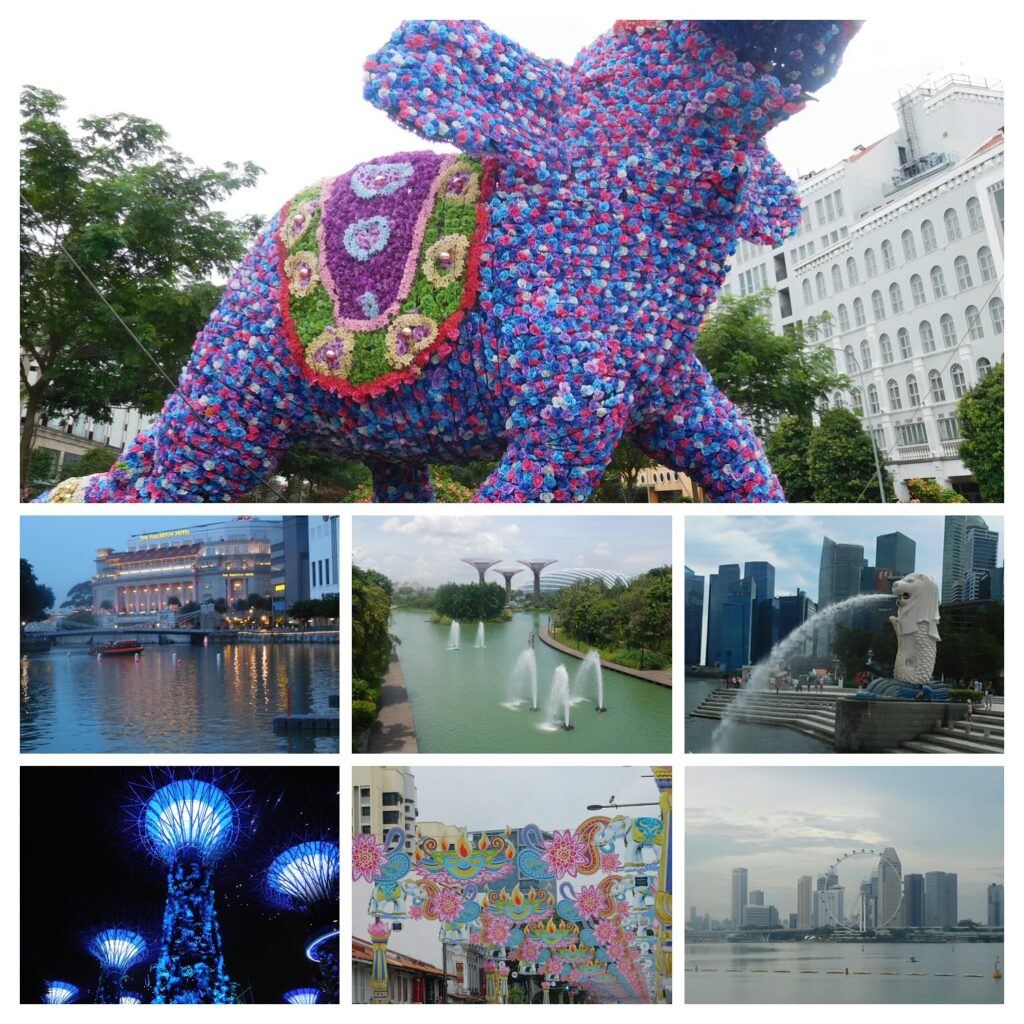
Our hotel is walking distance to so many things that Singapore has to offer. We studied the map each day so we could allocate the different areas of interest to a particular day to maximise our time here. Arab Street, which is the name of a street and neighbourhood and Little India had interesting buildings, small shops and markets along the main drag as well as in the side streets. We took a train trip to another suburb to buy some kites for resale at Pt Vincent and the proximity of both the supplier and station were so close it was great. Chinatown has its own station which made it easy to exit to street level and be immersed into the culture of the food markets and stalls immediately.
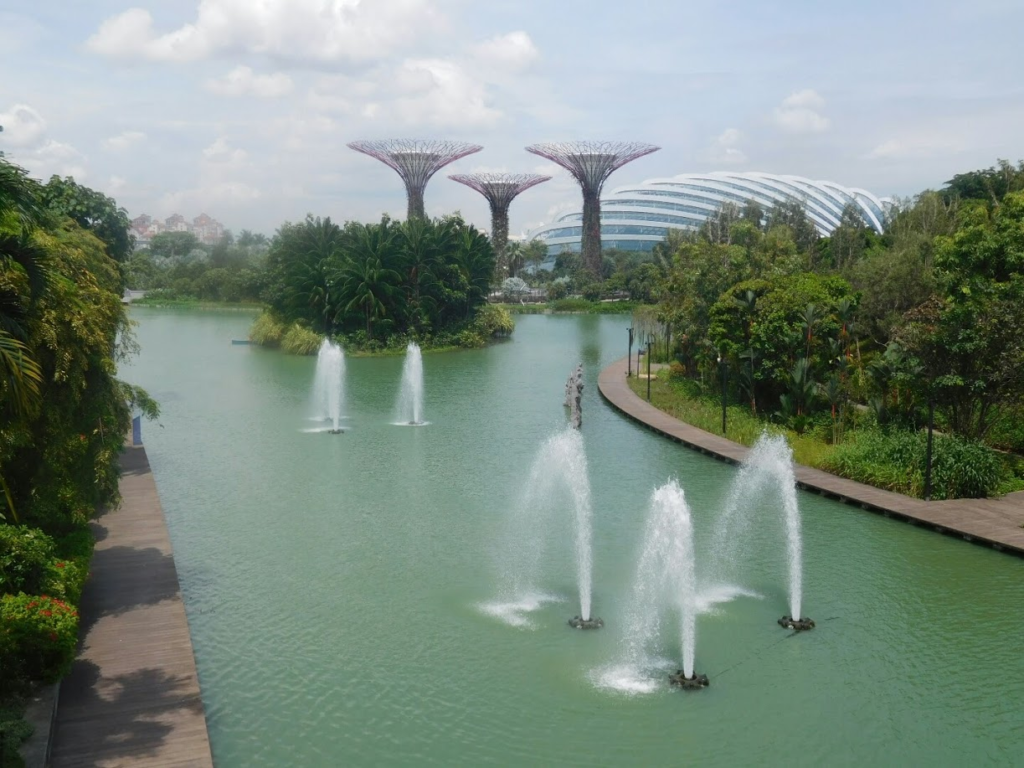
Gardens by the Bay, what an amazing place !! The gardens are a nature park spanning a large 250 acre area of reclaimed land in central Singapore which are open to the public between 5am and 3am each day. There are many different areas within the gardens such as the gigantic Flower Dome and Cloud Forest, the Supertree Grove, Children’s Garden and other gardens with specific themes…something for everyone.
The whole complex works towards being sustainable and aims to reduce its environmental footprint. The 2 domes try to be energy efficient by collecting rainwater and using it in the cooling system which is connected with the Supertrees. These massive 18 tree like structures range between 25-50m tall and are used to vent hot air and cool circulated water. There are over 163,000 plants growing up the sides of the Supertrees which also store solar energy used for the light and sound show which is on twice each night. We went to the Gardens by the Bay 3 times all up and saw the spectacular light and sound show twice with thousands of others, all enjoying the new Christmas theme. The manicured gardens by night were lit up amazingly well and the waterways with fountains and connecting bridges reflected the lights beautifully.
The Flower Dome is a free standing 38m high glass house without any interior supports and has plants from 7 different countries, one being Australia. The plants are growing in a mild, dry climate and it was special to walk around familiar trees and shrubs similar to what we see in most back gardens at home. We spent 2 hours walking around the glass house amazed at the displays that cover 3 acres of land.
The Cloud Forest is slightly higher again with a 42m Cloud Mountain and 35m indoor waterfall. The amount of plants growing on the mountain structure itself is crazy. Everywhere you look there are plants that would be found in moist conditions in tropical mountain regions. We first walked around the ground level, caught a lift up the centre of the mountain and walked around a circular path toward the ground again. Every 2 hours the misting process occurs and jets from the base of the walkway and surrounding areas send moisture into the air to support the plant life. It looked fantastic and after about 20 minutes of this continuously occurring, it was so dense that the entire dome looked like it was covered in a cloud. This dome in particular was very educational with information panels within the tall structure and at the end of the path. We watched a 12 minute video showing what will happen as the earth warms up a further 5 degrees between now and 2080 which was very concerning about the earth’s future. Two and a half hours flew by as we enjoyed this dome the most.
What an amazing experience and a highlight of our time in Singapore.
Travelling on the Metro was extremely easy and Singapore’s recently completed 6th line being close by to our accommodation…how lucky was that ! This new station like all others was so clean and we had to travel 4 levels down to reach the platform…toward what felt like the centre of the earth !! There were no bins to be found anywhere and no eating or drinking was allowed either in the stations or on the trains. The frequency of the trains were great any time of the day so that if you just missed one, within 3-5 minutes another one arrived. They also were driverless trains which could travel up to 80km/hr. The train system is so well sorted you often forget that the arrival at the stations and exact positioning in front of the glass door openings on the platforms happens by computers and not by drivers on the train.
There is a network of walkways from the underground stations branching off in many directions to reach the different corners at street level avoiding traffic on the busy roads. In the busier or major train station areas, there is a whole shopping precinct underground especially down Orchard Road and we felt like we were part of an ant colony moving around busily, surviving without the need to return to the surface. At street level it could be wet or humid, but below the weather conditions weren’t an issue.
Singapore is easy to get around using the Metro, but we decided to see the rest of Singapore from above ground on electric scooters. How long was going to be enough to hire them and would we get lost if we venture out too far? We randomly chose City Scoot and after sorting out all of the paperwork and a quick lesson, we were off on our way moving tentatively at the beginning as we familiarised ourselves with the machine. A map was supplied with a possible direction to follow and places to see just to get us started.
We were not allowed to ride the scooters at all on the roads but fortunately the paths in the parks were great and to avoid the many stairs, there were inclines and declines close by or tunnels under roads and overpasses. We travelled along the Waterfront Promenade, around Marina Bay, raced along the Grand Prix track with the wind blowing in our faces. We hooned over the helix bridge connecting the Bayfront to the Marina Centre, saw the Merlion monument stopping for a quick photo, across old steel bridges and always trying to avoid any annoying tourist getting in our way !! Fortunately, the paths were wide in lots of places which made it easier to zig zag around the garden beds, large water features and statues. As we flew past the enormous shopping centre windows, we noticed the Christmas decorations and a large Christmas tree was so tastefully done. With signs on the glass that scooters were not allowed inside, we ducked inside the doors quickly with them for a photo opportunity before we were approached by anyone to leave. There was a long lower level of wooden decking along a section of the waterfront with lounge seating, and the vibration and noise travelling along the planks was excellent as we passed some people relaxing for the day. There was a line up of 10-15 bollards spaced equally apart but more experience was needed before we could manoeuvre comfortably around more than 2-3 in a row.
We started the adventure early afternoon with the possibility of stopping somewhere for lunch along the way but as it would have impacted on the great experience we were having, we ate the bananas from the backpack and continued. After 2 ½ hours of fun, fun, fun we headed back to return the scooters and have an early tea.
The nearby Riverwalk area was full of restaurants so we headed there to check things out. All our lunches and dinners have been Asian based so far, that we were considering a schnitzel or similar at an English pub next to the water’s edge. If you are not careful, menus can show the meal costs net of tax and when the bill arrives, it will be the meal, plus a service charge, plus GST. What looked a reasonable price ended up being….Dinner ++
Fortunately the projected weather forecast of 10 days straight of thundery showers was not the case for us during our stay. We experienced only one more night where, from our room, we watched the heavy rains and lightning occurring every 2-3 seconds in the nearby skies…what a light show !
Our 6 days in Singapore were now over and the end of our 3 month holiday overseas. It has been the best time travelling around like vagabonds, in our own timeframe, driving through different places and countries that initially were not even on our radar. The freedom of a car, fantastic public transport and the knowledge we had amazing friends back in Adelaide looking after our day to day and financial affairs allowed us to enjoy what was a FANTASTIC time away.
We caught the 45 minute Metro ride one last time to the airport. After waiting patiently for some time in line to drop off the bags and obtain our seat allocation, Australian shores were not far away. With our thumb identification in their system, we were fast tracked through immigration and then customs before boarding the plane. Expected departure for the 6 ½ hour flight was 7.45pm but after a short delay we took off at 8.20pm in a Singapore send off of more rain, lightning and thunder.
After a sleep on the plane it was 6am when we had arrived in Melbourne in readiness of a connecting flight to Adelaide at 8.20am. Self service seems to be the theme across a lot of airports now so with Australia’s computerised SmartGate scanning of our passport and face recognition at the airport, we moved through Melbourne immigration and customs really quickly. After rechecking in our bags for a domestic flight, seat allocation in hand and then a change of gate announcement made, it was not a long wait before we left Melbourne at 8.35am.
When we arrived in Adelaide the sun was shining to welcome us home…a bitter sweet feeling though to now be back. The positives of being home are the feeling of comfortable and familiar surroundings and hearing the Aussie voice everywhere. Catching up with friends and relatives and sharing experiences makes the return home also special.
We were collected by a lovely neighbour who presented us with a beautiful food care package to get us started knowing the fridge would be bare of staple foods. Both of us know we are so lucky with our beautiful friends who supported us whilst we were away for so long…we could not have done it without them in our lives.
Now for the unpacking of all our gear, washing the travel clothes and packing them away for the next trip, finding a home for the things we had bought and trying to slip back into the day to day responsibilities and the ‘same old same old’. Catching up on paperwork etc, friends, lunches, Saturday mornings walking and coffees as the Christmas season approaches…we will need another holiday just to get over it. Oh yes, it will be 5 more weeks and then we are off to our annual pilgrimage to Pt Vincent for 5 ½ weeks…year 31…can’t wait !!